The universe is a place with a structure so vast and complex that it surpasses our perception and imagination. Various theories have emerged to unravel the secrets hidden within it, but string theory (String Theory) has attracted particular attention. Based on the idea that the most fundamental constituents of matter are one-dimensional strings rather than points, string theory attempts to explain the fundamental principles of the universe.
This article will analyze string theory from various perspectives, covering its basic concepts, mathematical structure, the challenges of multidimensional space, potential practical applications, and prospects for future development.
Basic Concepts of String Theory for Exploring the Origins of the Universe
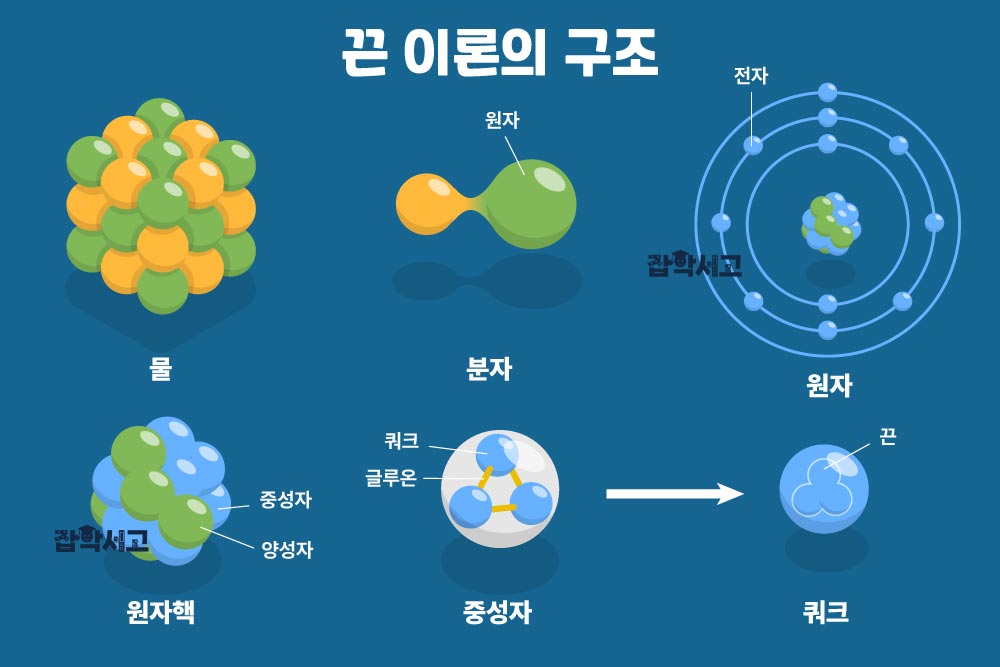
Basic Concepts of String Theory
String theory begins with the revolutionary idea that the fundamental constituents of the universe are one-dimensional 'strings' rather than point particles. Conventional particle physics has viewed all matter and forces in the universe as being composed of point particles, but string theory argues that, at a more fundamental level, all particles are formed by the vibrations of tiny strings that have only length. According to this theory, different particles arise from different ways in which strings vibrate, making it possible to explain the properties of fundamental particles such as electrons and quarks.
One of the most significant features of string theory is that these strings provide a theoretical framework capable of unifying all the forces in the universe: gravity, electromagnetism, the weak nuclear force, and the strong nuclear force. Physicists have long pursued a unified field theory (Theory of Everything) that would bring all these forces together into a single consistent theory. String theory is regarded as a theory that could bring us a step closer to this goal.
The Relationship Between String Vibrations and Particles
The central element of string theory is the vibration of strings. Each string has its own distinctive way of vibrating, and this vibration pattern determines a particle's properties. For example, particles such as electrons arise from a particular vibrational mode, while other particles are likewise distinguished by their different forms of vibration. In this way, string theory provides a theoretical foundation for explaining the diversity of all particles through a single fundamental element: the string.
String theory can also make an important contribution to solving the problem of quantum gravity. Existing quantum mechanics and general relativity have struggled to unify gravity and quantum phenomena. However, string theory can naturally incorporate gravity through string vibrations, offering the possibility of resolving this problem.
Supersymmetry and String Theory
Another important concept in string theory is supersymmetry (Supersymmetry). Supersymmetry is based on the hypothesis that every fundamental particle has a corresponding supersymmetric particle. This hypothesis plays an important role in explaining particle masses and the balance of forces, and it is compatible with string theory. If supersymmetry exists, it could provide a key to a deeper understanding of the early state of the universe and the evolution of particles. Supersymmetry could also provide clues about the dark matter present in the universe.
Multidimensional Space and String Theory
String theory proposes space with at least 10 dimensions, extending beyond the 4-dimensional spacetime we perceive in everyday life. We generally perceive 3-dimensional space and 1 dimension of time, but according to string theory, the universe has more dimensions. Such multidimensional space offers the possibility of explaining why we experience particular physical laws, and the theory argues that other dimensions unknown to us may be hidden at extremely small scales.
In particular, string theory seeks to explain problems such as the weakness of gravity through phenomena occurring in this multidimensional space. It proposes the hypothesis that gravity is relatively weak compared with the other fundamental forces because its strength spreads into other dimensions that we do not perceive.
The Limitations and Future Potential of String Theory
String theory provides a very powerful and unified theoretical framework, but it has the limitation of being difficult to verify experimentally. So far, experimental evidence that could directly verify string theory remains insufficient, and its complex mathematical structure is not yet fully understood. In particular, because the existence of multidimensional space and supersymmetry are hypotheses that have not been experimentally confirmed, fully verifying string theory may require a great deal of time.
The Mathematical Structure and Theoretical Foundations of String Theory
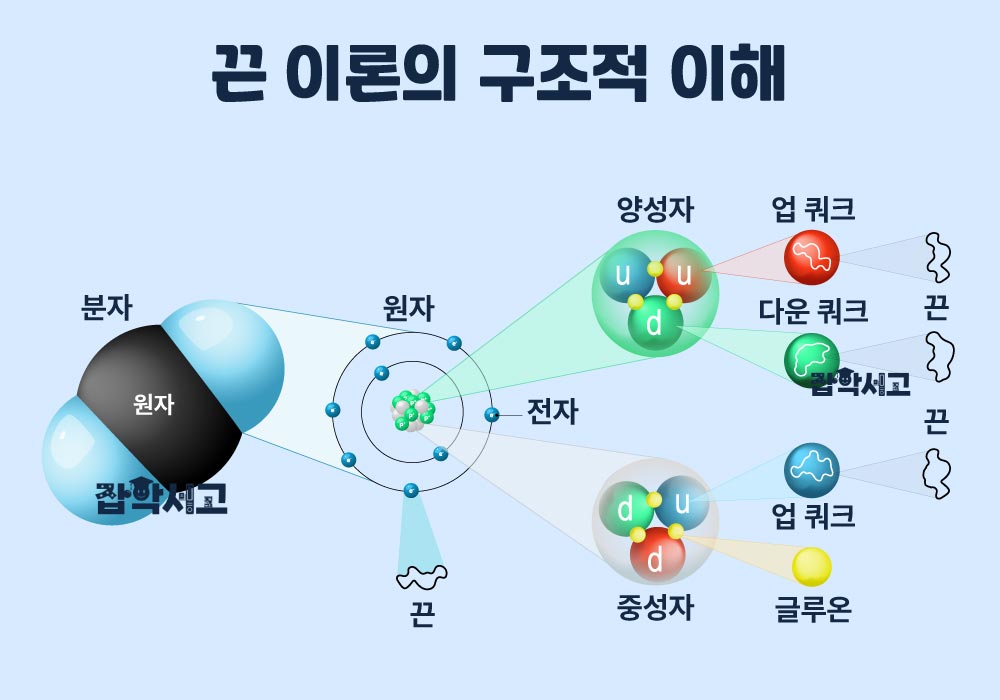
The Mathematical Foundations of String Theory
String theory is built on a complex mathematical structure, and advanced mathematical knowledge is essential for understanding it. The basic starting point of this theory is a Lagrangian (Lagrangian) that describes the motion of one-dimensional strings. A Lagrangian is a mathematical expression used in physics to describe the motion of objects, and it plays an important role in addressing string dynamics. The equations of motion for strings are derived from the Lagrangian, making it possible to explain how particles interact and move in string theory.
Quantum Field Theory and String Theory
String theory is closely related to quantum field theory (Quantum Field Theory). Quantum field theory explains interactions between particles and plays an important role in understanding the mathematical structure of string theory. Quantum field theory is a powerful tool for explaining interactions over long and short distances, and it helps us understand how different string vibration patterns interact with one another. String theory extends quantum field theory by explaining interactions through the vibrations of one-dimensional strings rather than fundamental particles.
By applying the mathematical framework of quantum field theory to string theory, we can analyze how strings account for particles and forces through their various vibrational modes. In this way, string theory provides a unified theoretical framework that goes beyond the simple concept of particles and offers a new perspective on explaining the fundamental forces of the universe.
The Role of Moduli Space
Moduli space (Moduli Space) plays an important role in string theory. Moduli space is a mathematical space that describes the various vibrational modes of strings, and it is an essential tool for understanding the multidimensional nature of string theory. This space allows us to analyze string states and vibration patterns at multiple levels and helps visualize the complex structure of string theory.
Moduli space plays a particularly important role in explaining the concept of a multidimensional universe proposed by string theory, providing a mathematical framework for a more refined analysis of how strings move and interact.
Gauge Theory and String Theory
String theory is deeply connected to gauge theory (Gauge Theory). Gauge theory plays an important role in explaining interactions between particles and is essential for understanding the basic structure of string theory. Gauge theory is primarily used to explain fundamental forces such as electromagnetism, and it serves as a framework for explaining the interactions of the various forces proposed in string theory.
In particular, the complex mathematical structure called Calabi-Yau space (Calabi-Yau Space) serves as an important mathematical device connecting gauge theory and string theory. Calabi-Yau space is used to describe the structure of multidimensional space and plays an essential role in analyzing how such multidimensional space can exist in string theory.
The Mathematical Complexity and Challenges of String Theory
Because of its complex mathematical structure, string theory has the limitation of being difficult to verify experimentally. Current technology does not allow string theory to be confirmed directly through experiments, but efforts continue to assess its validity through theoretical calculations and computer simulations. In particular, the equations and calculation procedures of string theory are highly intricate, and resolving them presents many difficulties. Nevertheless, research into these mathematical challenges continues because of the innovative perspectives and possibilities that string theory offers.
New Mathematical Discoveries Brought About by String Theory
Research into string theory has also had a major impact on various fields of mathematics. The mathematical tools of string theory are connected to fields such as calculus, algebraic geometry, and topology, and new mathematical principles have been discovered in this process. The development of string theory has made an important contribution to mathematicians' exploration of new structures and unknown areas.
Multidimensional Space and the Innovative Challenges of String Theory

The Proposal of Multidimensional Space and the Innovation of String Theory
One of the most innovative aspects of string theory is its proposal that multidimensional space exists beyond the 4-dimensional spacetime we experience. Conventional physics has regarded 4-dimensional spacetime, combining time and space, as fundamental, but string theory argues that space with at least 10 dimensions is necessary. These additional dimensions are too small to be perceived directly by our senses and may be curled up to an extremely tiny size. This concept provides an important turning point in reinterpreting the fundamental structure of the universe.
Calabi-Yau Space and Multidimensional Structure
Calabi-Yau space (Calabi-Yau Space), proposed in string theory, is described as a complex geometric structure in which additional dimensions are curled up. This space provides a mathematical framework for understanding how strings vibrate and how those vibrations determine the properties of particles. To explain why these multidimensional structures are invisible to us, physicists interpret these dimensions as being extremely small and existing in a realm that we cannot observe in everyday life. Calabi-Yau space is theoretically essential for explaining string motion and interactions, and it plays a central role in the mathematical foundations of string theory.
The Relationship Between Gravity and Multidimensional Space
Multidimensional space plays an important role in reinterpreting existing physical laws, particularly gravity. Gravity is known to be a relatively very weak force compared with the other fundamental forces. String theory explains this phenomenon as the result of gravity spreading into additional dimensions that we cannot detect. Consequently, gravity feels weak in the 3-dimensional space we perceive. This explanation could make a major contribution to understanding the weak strength of gravity, an unresolved issue in current physics.
Multidimensional space is also useful for explaining extreme phenomena in the universe, such as black holes. The concept of multidimensional space can also be an important tool for interpreting physical phenomena inside black holes and the initial conditions of the Big Bang. In this way, multidimensional space is a key concept in string theory for unraveling the universe's many mysteries.
Experimental Verification of Multidimensional Space and Its Challenges
The multidimensional space proposed by string theory is a highly appealing theory in itself, but it has the limitation of being very difficult to verify experimentally at present. This is because the additional dimensions are too small to observe directly. Accordingly, theoretical physicists are making efforts to prove the existence of multidimensional space indirectly in various ways. One example is the attempt to detect interactions between dimensions using high-energy particle accelerators such as the Large Hadron Collider (LHC).
Philosophical Debates and New Ways of Thinking
The multidimensional space proposed by string theory has physical implications and also sparks philosophical debates. Because the concept of multidimensional space goes beyond our intuitive understanding, accepting it requires new ways of thinking. The idea that dimensions imperceptible to human senses could actually exist poses a challenge that extends beyond conventional ways of thinking in physics.
The development of string theory depends on resolving these challenges, and our understanding of the universe will deepen further as we overcome them. Multidimensional space will be an important key to exploring the foundations of the universe's structure and could provide significant direction for future research in physics.
Practical Applications of String Theory and Future Research Directions
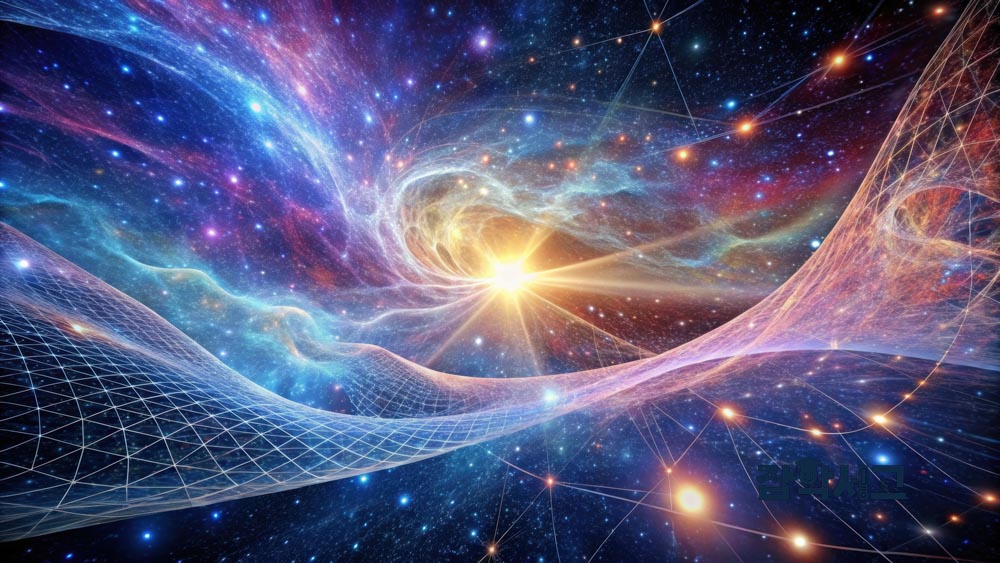
Potential Applications of String Theory and Experimental Verification
Although string theory is studied primarily within theoretical physics, its potential applications are being discussed as an important topic in various fields. The most prominent areas of application are high-energy physics, cosmology, and black hole research. String theory plays an important role in analyzing interactions between particles at high energies, and this research could help explain the most fundamental structure of the universe and how it works. As a leading candidate for a unified field theory (Theory of Everything) that seeks to unite all fundamental forces in a single theory, string theory offers the possibility of realizing physicists' long-standing dream.
Experimental verification of string theory can take place through particle accelerator experiments. Experimental equipment such as large particle accelerators (LHC) observes particle collisions at very high energies, and the resulting data can be used to check whether the results agree with string theory's predictions. These experiments have not yet directly proven string theory, but some of its predictions may be confirmed through more sophisticated particle experiments in the future.
The Relationship Between Quantum Gravity and String Theory
String theory is regarded as an essential tool for understanding the theory of quantum gravity (Quantum Gravity). Quantum gravity is a theory that seeks to explain gravity within the framework of quantum mechanics, aiming to bridge the gap between existing general relativity and quantum mechanics. Existing theories have failed to adequately explain gravity in the microscopic world, at the quantum level, but string theory can also explain gravity as a vibrational mode of a string, making it a strong candidate for solving the problem of quantum gravity.
In particular, string theory could play an important role in explaining the internal structure of black holes and the universe immediately after the Big Bang. Many aspects of black hole singularities and the state before the Big Bang have been difficult to explain using existing theories, but applying string theory allows for a more precise analysis. This will give us a deeper understanding of the extreme conditions of the early universe.
The Origins of the Universe and String Theory
String theory plays an essential role in understanding the initial conditions and evolution of the universe. The Big Bang theory, a prominent theory explaining the origins of the universe, can provide a more refined explanation when combined with string theory. Various physical phenomena occurring during the rapid expansion after the Big Bang can be interpreted more clearly through the concepts of string theory. By considering the multidimensional structure of the universe, string theory can also address aspects that conventional cosmology has not covered.
Such applications of string theory provide a new perspective on understanding the origins and evolution of the universe and help us gain deeper insights into the numerous physical phenomena that current theories cannot explain. In particular, the concepts of multidimensional space and supersymmetry play an important role in extending the Big Bang theory and explaining the complexity of the early state of the universe.
Future Research Directions for String Theory
Future research into string theory focuses on clarifying its mathematical structure and refining the theory. Many aspects of string theory's complex mathematical formulas remain incompletely understood, and work is needed to organize them systematically. In particular, strengthening the mathematical foundations of string theory could help physicists improve the theory's accuracy and discover new physical laws.
Continuing to develop methods for experimental verification is also an important task. Because the effects of string theory can only be observed at high energies, developing experimental technologies that satisfy these conditions is essential. In the future, new methods for experimentally verifying string theory's predictions will be developed through more precise particle accelerators or observations of cosmic phenomena.
Research into string theory will contribute to expanding the fundamental framework of physics. Concepts such as multidimensional space and supersymmetry encourage a deeper reinterpretation of the physical laws we know and play an important role in developing a new understanding of the fundamental properties of the universe. In this way, string theory will become an important theoretical framework that opens up the future of physics, and its potential for development is boundless.
String theory offers an innovative perspective on understanding the universe we inhabit. Although the theory itself is highly complex and many aspects are difficult to verify experimentally, its potential is limitless. Revealing the fundamental principles of the universe and discovering new physical laws through string theory will remain important tasks for future physics research.
Such research could fundamentally change how we view the universe and is expected to make a major contribution to opening a new scientific era.