If you’ve ever watered a garden with a hose, you’ve probably pressed a finger lightly over the end of it. As the opening narrows, the stream suddenly speeds up and shoots much farther. To pass through a narrow gap, the same amount of water has to flow faster, and wherever the flow speeds up like this, the pressure drops. The law that first described this relationship is known as ‘Bernoulli’s Principle.’
Put simply, Bernoulli’s principle means that ‘within a single flow, when a fluid speeds up its pressure falls, and when it slows down its pressure rises.’ Substances that flow, such as air and water, are called fluids, and this principle underlies many technologies, from aircraft airspeed indicators and car carburetors to the oxygen delivery devices used in hospitals.
In this piece, we will look in turn at how Bernoulli’s principle came about and its basic concepts, examples of its use in everyday life, and the common misconceptions that make it easy to apply incorrectly.

How Flow Speed and Pressure Trade Off
What Is Bernoulli’s Principle?

Bernoulli’s principle is named after the Swiss mathematician and physicist Daniel Bernoulli. In his 1738 book Hydrodynamica, he showed that pressure drops where a flow speeds up. The equation in the form we use today was worked out by Leonhard Euler around 1752.
(1) The Principle Seen Through Conservation of Energy
A flowing fluid carries energy in three forms: pressure, motion, and height. As long as no energy is added or removed from outside, the sum of these three stays constant. So when the share that belongs to motion, the speed, increases, the share that belongs to pressure shrinks by the same amount.
(2) The Principle Seen Through Forces
The same phenomenon can also be explained with Newton’s laws of motion. A small parcel of fluid is pushed forward and speeds up when the pressure behind it is higher than the pressure in front. In other words, it gains speed as it flows from a region of high pressure to a region of low pressure.
Conditions for the Principle to Hold

Bernoulli’s principle is not a universal law that always applies as is; it is most accurate for flows that meet a few conditions.
- Steady Flow: The speed and pressure at any given point must not change over time.
- Incompressibility: The density of the fluid must stay nearly the same even as the pressure changes. Water mostly meets this condition, and air can be treated similarly when it flows slower than about 30 percent of the speed of sound.
- Inviscid Flow: The energy lost to the fluid’s internal stickiness, that is, its viscosity, must be small. The principle does not work well where friction is large, such as near the inner walls of a long pipe.
One more important point is that this principle is a law for comparing two points within the same flow. You cannot put two flows that started from different places side by side and conclude that the faster one has lower pressure. Overlooking this condition gives rise to several of the misconceptions we will look at below.
Bernoulli’s Principle in Everyday Life and Technology

By making use of the relationship between speed and pressure, we can measure invisible flows or draw fluid to where we want it.
(1) The Venturi Tube for Measuring Flow
If you pinch the middle of a pipe so it narrows, the flow speeds up there and the pressure drops; this is called the Venturi effect. By measuring the pressure difference between the wide part and the narrow part, you can calculate how much is flowing through the pipe, so it is widely used as a flow meter in water mains and factory piping.
(2) The Pitot Tube That Tells an Airplane’s Speed
A pitot tube, a small tube mounted at the front of an airplane, takes in the pressure of the air striking it head-on, while holes on the side measure the pressure of the surrounding air. From the difference between the two pressures, it works out how fast the aircraft is moving through the air.
(3) The Carburetor That Draws Up Fuel
The carburetors of older car and motorcycle engines narrowed the air passage to lower the pressure, using that force to draw up fuel and mix it evenly with the air. Sprayers and airbrushes likewise use a fast stream of air to draw out liquid and scatter it in fine droplets.
(4) The Venturi Mask That Sets Oxygen Concentration
The Venturi mask used in hospitals jets oxygen quickly through a narrow opening, and the lowered pressure draws in outside air along with it. Because the size of the opening determines how much air is mixed in, it can deliver oxygen at a steady concentration to the patient.
Common Misconceptions About Bernoulli’s Principle
Because the principle is so famous, it is often used to explain phenomena that actually happen for other reasons.
(1) The Explanation That Air Above and Below a Wing Meets at the Same Time
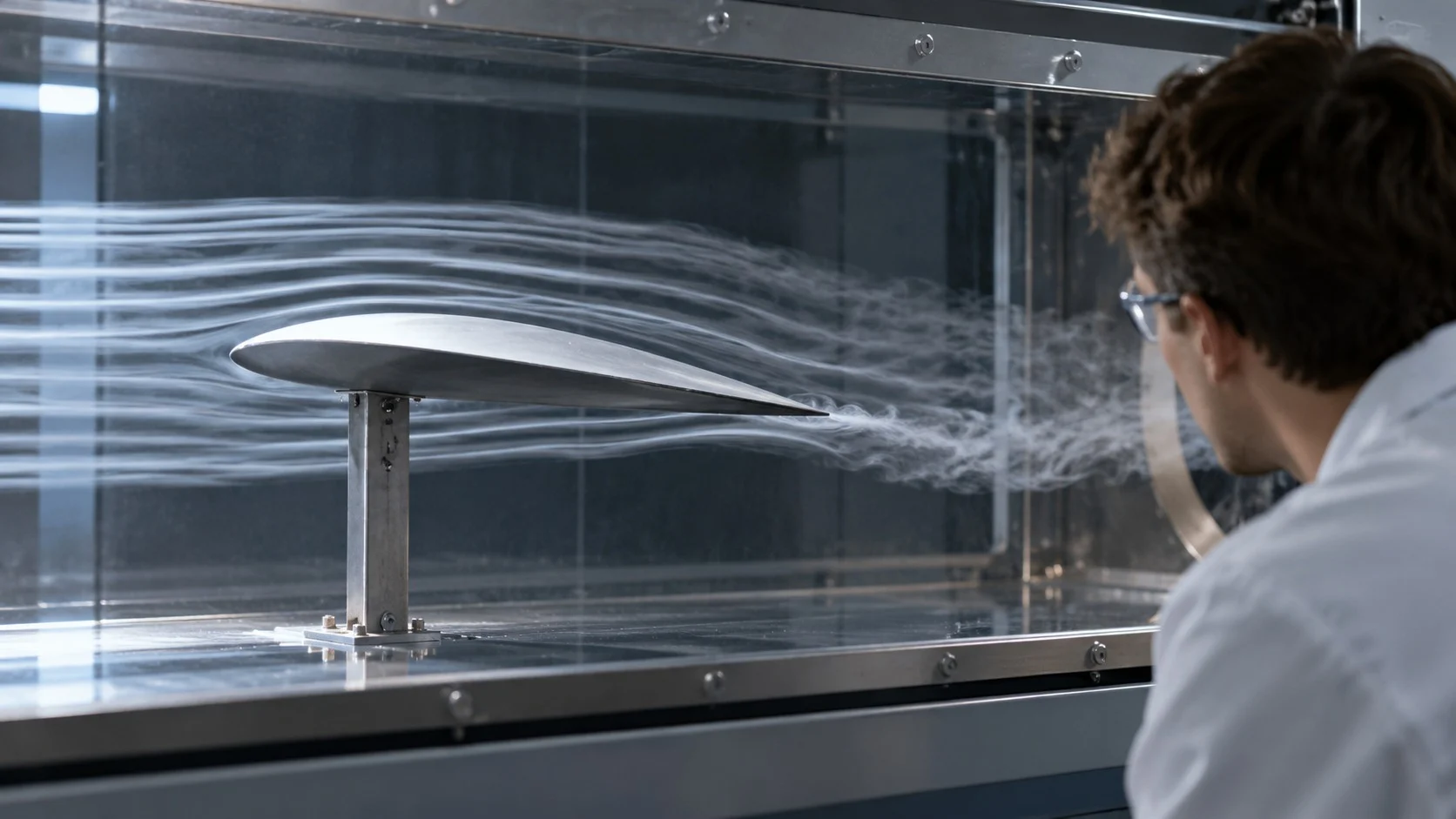
A widespread explanation says that because the upper surface of a wing is longer, the air on top flows faster so it can meet the air underneath at the trailing edge at the same moment. But there is no reason the air has to arrive at the same time, and experiments show that the air on top actually reaches the trailing edge well ahead. The conclusion that air over the wing is faster and at lower pressure is itself correct, but it is more accurate to say the reason is that the wing deflects the airflow downward.
(2) The Experiment in Which Paper Rises When You Blow Over It
The air coming out of your mouth is already at the same pressure as the surrounding air, so it does not drop in pressure just because it is fast. The paper rises because the airflow bends as it follows the curved surface of the paper, creating a pressure difference. A ping-pong ball floating in a stream of air likewise stays put because the flow pushes the ball back toward the center.
Bernoulli’s principle shows that speed and pressure trade off against each other within a flowing fluid. Technologies that apply this principle correctly, such as the Venturi tube, the pitot tube, and the carburetor, are still at work all around us today. But if you forget the condition that it holds only within the same flow, it is easy to fall for explanations that sound plausible but are wrong. When you see something lift or get pulled along where the wind is blowing, it helps to make a habit of thinking once more about whether it is really due to a difference in speed within the same flow.
Weighing how far the principle actually reaches along with it is the first step in the physics of reading a flow.