Have you ever walked in the rain without an umbrella? Raindrops fall from clouds hundreds of meters, sometimes several kilometers, above us, yet when they reach our heads they merely sting a little. Without air, a drop of water falling from the same height would speed up to hundreds of kilometers per hour. That does not happen because a falling object stops speeding up at a certain point. This limiting speed is called ‘terminal velocity.’
Put simply, terminal velocity means ‘the speed at which the air resistance on a falling object becomes equal to gravity, so the object no longer speeds up.’ The English word ‘terminal’ means ‘end,’ referring to the speed at the point where acceleration ends; in Korean it is also called ‘jongmal sokdo.’ Motion through a resisting medium such as air was first treated in depth by Isaac Newton in Book II of the Principia in 1687.
In this article, we will look in turn at why a falling object does not keep speeding up, what determines terminal velocity, how fast skydivers and raindrops actually fall, and where this principle is put to use.
Where gravity meets air resistance
Why doesn’t a falling object keep getting faster?

In a place with no air, a falling object gains about 9.8m per second of speed every second. But the real sky is full of air, and a falling object collides with air molecules all the way down.
(1) Air resistance grows with speed
Air resistance increases as speed increases. For reasonably large objects moving fast, like people or raindrops, doubling the speed makes the resistance about four times larger. At first the resistance is small and the object speeds up almost as in free fall, but as it gains speed, the upward push grows too.
(2) The moment the two forces match
Gravity pulling downward is fixed by the object’s weight and does not change. As air resistance grows and finally equals gravity in size, the net force on the object becomes zero. According to Newton’s first law of motion, from that moment the object neither speeds up nor slows down but falls at a constant speed.
(3) Not stopped, but falling steadily
Reaching terminal velocity does not mean the object has stopped. It is still falling fast; only the acceleration has disappeared. That is why skydivers say that at terminal velocity it feels less like falling and more like floating on a powerful wind.
What determines terminal velocity?

Terminal velocity differs from object to object, because the speed needed for air resistance to catch up with gravity depends on the object’s weight and shape, and on the surrounding air.
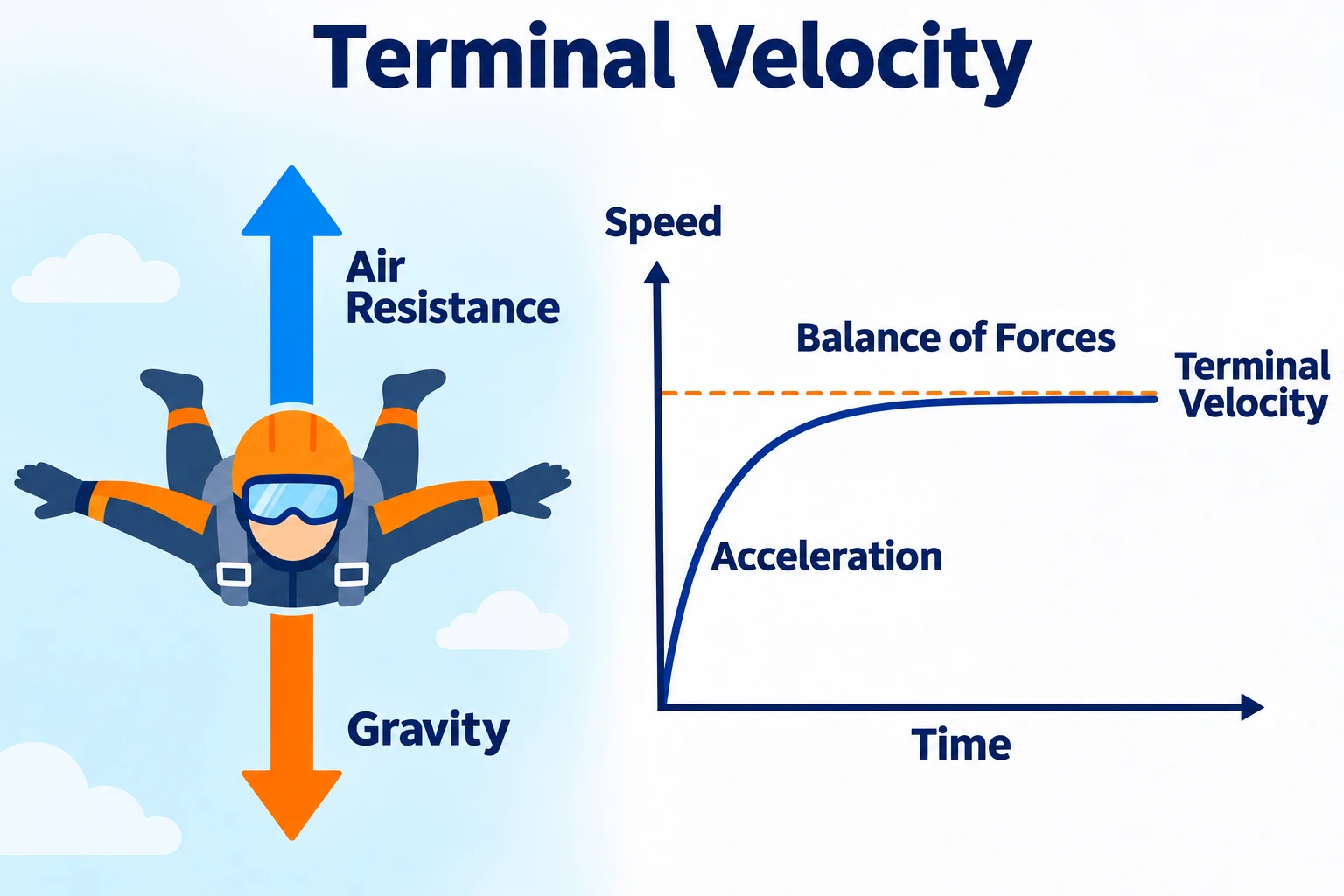
- Mass: The heavier an object, the stronger the gravity on it, so more air resistance is needed to balance it. That is why, for the same shape and size, a heavier object has a higher terminal velocity.
- Cross-sectional Area: The area of the object as seen from the direction of the fall. The larger it is, the more air must be pushed aside, so terminal velocity is lower.
- Drag Coefficient: A number expressing how well a shape cuts through air. Streamlined shapes have small values, while concave shapes like a parachute have large ones.
- Air Density: High in the sky, where the air is thin, resistance is small and terminal velocity is higher.
This relationship is summed up in the drag equation. Air resistance is half the product of air density, the square of the speed, the cross-sectional area and the drag coefficient. Setting this equal to the weight and solving shows that terminal velocity is proportional to the square root of the weight divided by the other factors. All else being equal, quadrupling the weight doubles the terminal velocity.
How fast do skydivers and raindrops fall?

Terminal velocity varies astonishingly from object to object. Falling from the same sky, people, raindrops and small animals reach the ground at completely different speeds.
(1) A skydiver with arms and legs spread
Belly to the earth with arms and legs spread wide, a person’s terminal velocity is about 200km per hour. Diving head-down with the body straight reduces the cross-sectional area, and the speed can exceed 250km per hour. Once the parachute opens, the area and drag coefficient grow dramatically, slowing the fall to around 20km per hour.
(2) Raindrops slower than you think
According to measurements by Americans Ross Gunn and Gilbert Kinzer in 1949, even a large raindrop about 5mm across falls at only about 9m per second, and tiny drizzle droplets fall at less than 1m per second. That is why getting caught in the rain without an umbrella does not hurt.
(3) Why smaller bodies are safer
As a body gets smaller, its weight shrinks with the cube of its length, but its cross-sectional area shrinks only with the square. So the smaller the animal, the more air resistance it meets relative to its weight, and the lower its terminal velocity. The British biologist J. B. S. Haldane explained in his 1926 essay ‘On Being the Right Size’ that a mouse dropped down a deep mine shaft gets only a slight shock and walks away.
Where is terminal velocity used?

Terminal velocity matters both when designing devices that reduce danger and in experiments that measure things too small to see.
(1) Parachutes and landing systems
A parachute is a device that lowers terminal velocity to a level at which a person can land safely. Mars landers also slow down with parachutes after entering the atmosphere, but because the Martian atmosphere is far thinner than Earth’s, parachutes alone cannot slow them enough, so retro-rockets are used as well.
(2) A man who jumped from the stratosphere
In 2012, Austria’s Felix Baumgartner jumped from a height of about 39km and reached a top speed of 1,357.6km per hour. At heights where the air is extremely thin, air resistance is so small that terminal velocity becomes fast enough to exceed the speed of sound. As he descended into denser air, his speed dropped again.
(3) The electron’s charge measured with oil drops
Starting around 1909, the American physicist Robert Millikan measured the terminal velocity of tiny oil drops falling through air to calculate their size, and then, from the force needed to hold a drop up with an electric field, worked out the charge of a single electron. This oil-drop experiment underpinned his 1923 Nobel Prize in Physics.
Terminal velocity is the result of a tug-of-war that every falling object plays with the air. Raindrops falling gently, parachutes keeping people safe and oil drops revealing the secret of the electron all come from the same principle. The simple idea that the faster something goes, the harder the air pushes back—that is the first step to understanding terminal velocity.