What if you filed your taxes and, instead of collecting money from you, the government sent money to your bank account? People with high incomes pay tax, while people with very low incomes ‘receive’ tax in reverse. A system that flips the direction of tax at the bottom of the income scale to reduce poverty is called the ‘Negative Income Tax’.
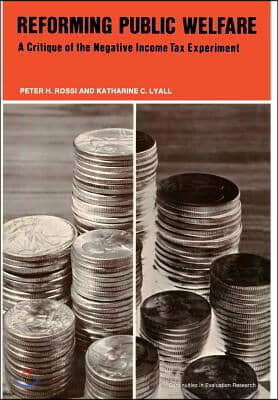
Simply put, a negative income tax means ‘a system in which, if your income falls below a set threshold, you receive a fixed share of the shortfall from the government instead of paying tax.’ The American economist Milton Friedman popularized the idea in his 1962 book Capitalism and Freedom, and around the same time the economist Robert Lampman developed a similar plan and introduced it to U.S. policymakers around 1965.
In this article, we will look in turn at the background of the negative income tax, its calculation structure built on a basic guarantee and a reduction rate, the large-scale social experiments carried out in North America, and how it lives on today in the Earned Income Tax Credit and Seoul’s Ansim Income program.
A Welfare Design That Turned the Direction of Tax Upside Down
1. An Idea to Eliminate the Welfare Trap

The United States in the 1960s was enjoying strong economic growth, yet many poor families remained in its cities and rural areas. As the government expanded various welfare programs, criticism also grew that the very way benefits were paid was discouraging people from working.
(1) Benefits that vanish above the threshold
Under a system that pays support only when income is below a threshold and cuts support by 1 won for every additional won earned, working more leaves your take-home money unchanged or even smaller. Because the extra income is effectively taxed at 100%, efforts to escape poverty go unrewarded, creating a ‘Welfare Trap’.
(2) Friedman’s prescription
Friedman proposed bundling the many welfare programs into a single cash payment and, as income rises, reducing support only partly instead of cutting it off all at once. He argued that every bit of extra earnings would then always raise final income a little, while complex screening and administrative costs would also fall.
(3) Why both conservatives and progressives took notice
Those who value small government and individual choice welcomed the chance to shrink bureaucratic welfare administration, while those who put poverty reduction first welcomed the guarantee of a minimum income for every poor family.
2. Basic Guarantee, Reduction Rate and Break-even Income

A negative income tax works once just three numbers are set: the amount you receive with no income at all, the rate at which support is reduced as income rises, and the income at which support reaches zero.
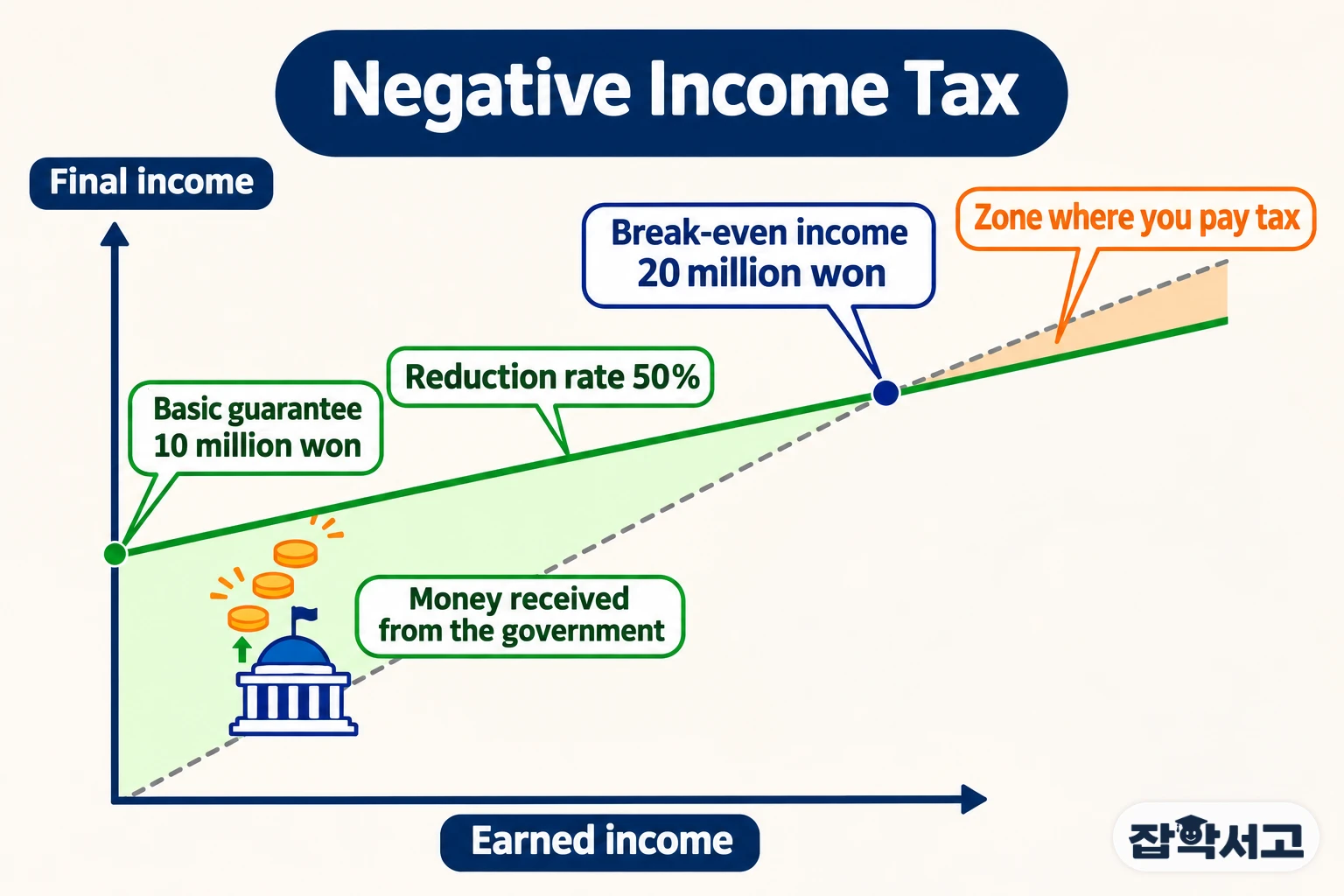
- Guarantee: the amount received from the government when earned income is zero; it sets the minimum living standard the system guarantees.
- Benefit Reduction Rate: the rate at which support falls for each extra won of income, also called the ‘negative tax rate’.
- Break-even Income: the income at which support reaches zero, equal to the basic guarantee divided by the reduction rate.
- Effective Marginal Tax Rate: the share of extra earnings lost to taxes and reduced support; under a negative income tax, the reduction rate is exactly this value.
For example, if the basic guarantee is 10 million won and the reduction rate is 50%, a person with no income receives 10 million won. A person who earns 10 million won sees support fall to 5 million won but ends up with a final income of 15 million won, and at 20 million won of earnings support reaches zero and ordinary tax begins. Lowering the reduction rate discourages work less, but it raises the break-even income, increasing both the number of recipients and the fiscal burden; this trade-off is the central dilemma in designing a negative income tax.
3. Large-Scale Social Experiments in North America

The negative income tax did not remain a theory on paper. From 1968 to 1980 in several parts of the United States, and in the 1970s in Canada, large-scale social experiments handed out real money and observed how people behaved.
(1) From New Jersey to Seattle and Denver
The first experiment began in 1968 in New Jersey and Pennsylvania with urban two-parent families. The University of Wisconsin’s Institute for Research on Poverty led the research, and the research firm Mathematica ran field operations. It was followed by experiments in rural North Carolina and Iowa, with single-parent families in Gary, Indiana, and finally the largest of all, the Seattle–Denver experiment (SIME/DIME).
(2) Smaller work reductions than expected
Analysis of the Seattle–Denver experiment found that husbands’ working hours fell by an average of 9% and wives’ by 18%. Much of the decline came from wives delaying their return to work. However, results showing more divorces and separations were released at the same time, fueling political controversy, and these findings were later challenged over their methods of analysis.
(3) Mincome in Dauphin, Canada
In Manitoba, Canada, the ‘Mincome’ experiment ran from 1974 to 1979, and working hours fell by only about 1% for men, about 3% for married women and about 5% for unmarried women. In the small town of Dauphin, any resident who met the conditions could take part, and in 2011 economist Evelyn Forget published an analysis showing that hospitalizations among Dauphin residents fell by 8.5% during the experiment.
4. The Negative Income Tax Today

No country has yet implemented a nationwide negative income tax in its pure form. But its design lives on, in altered shapes, inside a number of programs.
(1) A legacy in the Earned Income Tax Credit
In 1969 the Nixon administration proposed the ‘Family Assistance Plan’, which resembled a negative income tax, but it failed to pass Congress. Instead, in 1975 the U.S. Congress introduced the Earned Income Tax Credit (EITC), which returns tax only to low-income households with earnings from work; it is regarded as a version of the negative income tax limited to working people. South Korea has also paid its earned income tax credit since 2009.
(2) Seoul’s Ansim Income experiment
In July 2022 the Seoul Metropolitan Government began paying benefits under its ‘Ansim Income’ (secure income) pilot, modeled on the negative income tax. Households at or below 85% of the standard median income with assets of 326 million won or less receive, every month, half of the gap between 85% of the standard median income and their household income. As of 2022, a single-person household with no income received 827,000 won a month, half of 1,653,000 won.
(3) How it differs from basic income, and remaining challenges
A basic income first gives everyone the same amount and then recovers it through taxes, whereas a negative income tax checks income first and pays part of the shortfall only to those who fall short. If payment levels and tax rates are matched, the after-tax results of the two systems can be similar, but a negative income tax requires the administrative capacity to measure income accurately and quickly, and the fiscal question of where to set the reduction rate and the guarantee level remains.
The simple idea of ‘returning tax to those who earn less, while making sure that earning more always leaves you with more’ is the first step to understanding the negative income tax.