TVs and computers get better every year and yet cheaper, so why do haircuts, college tuition and hospital bills only keep going up? It is not as if hairdressers have become worse at their jobs. The economic concept that solves this puzzle is ‘Baumol's Cost Disease’.
Baumol's cost disease simply means ‘the phenomenon in which work whose productivity barely rises must still raise wages to keep up with wage growth in other industries, so its costs and prices keep climbing.’ American economists William Baumol and William G. Bowen first described it in the 1960s while studying the economic problems of the performing arts, and it is also called the ‘Baumol Effect’.
In this article, we will look in turn at how Baumol's cost disease was discovered in the concert hall, the two-sector model that divides the economy into progressive and stagnant sectors, everyday examples in hairdressing, education and health care, and finally the debates around the phenomenon and what it means.
Why prices rise where productivity stands still
1. A cost disease discovered in the concert hall

Baumol's cost disease began not in a factory but in a concert hall. In the 1960s, American theaters and orchestras struggled to cover their costs even with audiences in their seats, and Baumol and Bowen set out to find out why.
(1) A string quartet still takes four players
Baumol often said, “It still takes four musicians to play a string quartet, the same number as in Mozart's time.” Because the same piece must be played for the same length of time, the ‘output’ one performer produces in an hour has barely changed in centuries.
(2) A 1965 paper and a 1966 book
In 1965 the two published a paper on the economic problems of the performing arts in the American Economic Review, and the following year they expanded their research into the book Performing Arts, The Economic Dilemma. The book covered problems common to theater, opera, music and dance.
(3) An answer that came at 4 a.m.
Baumol later recalled in an interview that one night he suddenly woke up at 4:00 in the morning and said, “I know why those costs are going up!” The insight was that if wages rise across society while a performer's productivity stays the same, the cost of a performance has no choice but to rise as well.
2. Progressive and stagnant sectors: the two-sector model

In his 1967 paper “Macroeconomics of Unbalanced Growth,” Baumol explained this phenomenon by dividing the economy into two sectors: one where productivity rises steadily thanks to technological progress, and one where people's time and care are themselves the product, so productivity hardly rises.
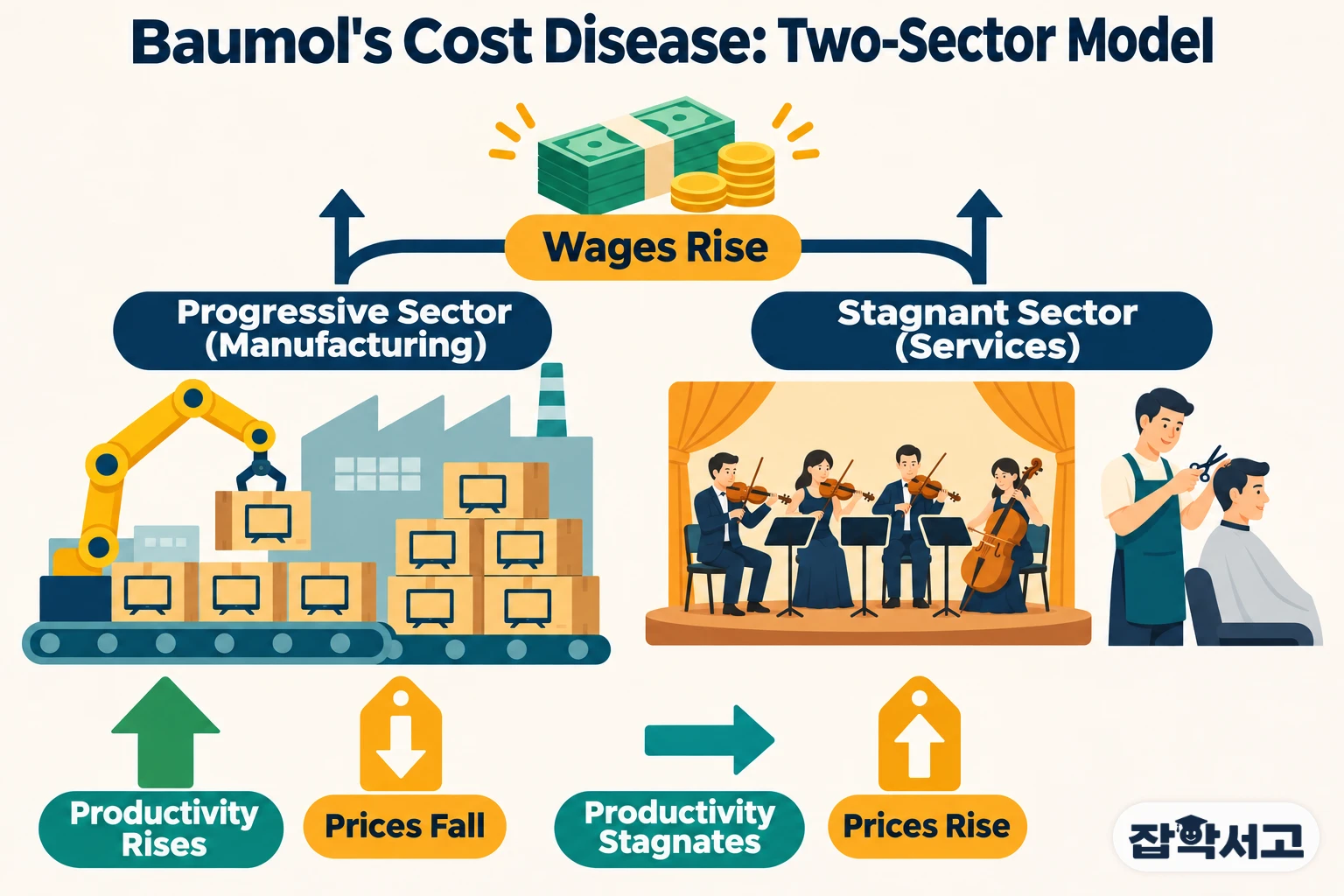
- Progressive Sector: A sector where machines and technology let the same person make more in the same amount of time, with manufacturing as the typical example. Even when wages rise, output grows faster, so product prices can fall.
- Stagnant Sector: A sector such as performance, education or care, where human labor itself is the service and productivity barely rises.
- Wage Catch-up: To keep its workers, the stagnant sector must also raise wages as much as the progressive sector. Otherwise people would leave for other industries that pay more.
- Relative Price Increase: Because wages rise while productivity stays the same, costs and prices in the stagnant sector climb faster than in the progressive sector. In Baumol's model, this gap keeps widening over time.
Although it is called a ‘disease’, the key point of the concept is that services become more expensive not because the people doing the work are lazy, but because other industries have improved so quickly.
3. The cost disease at the barbershop, the university and the hospital

Baumol's cost disease shows up across services that require people to spend their own time directly. Many of the items that make us feel the cost of living is rising belong here.
(1) Barbershops and hair salons
As early as 1949, French economist Jean Fourastié pointed out that technology advances at different speeds in different industries, writing that a men's barber did not cut more customers' hair in 1948 than in 1900. The speed of the scissors stayed the same, but barbers' wages followed wages across society upward.
(2) University education
The student-to-faculty ratio at American universities was 16:1 in both 1981 and 2011, yet tuition rose sharply over the same period. Since the number of students each professor taught did not grow, the cost of each unit of education increased.
(3) Health care and caregiving
The time it takes a nurse to change a bandage is not much different now from 1966. In his 2012 book The Cost Disease: Why Computers Get Cheaper and Health Care Doesn't, Baumol explained rising medical costs through this phenomenon.
4. Debates over the cost disease and what it means

Baumol's cost disease is a leading theory for explaining rising service prices, but opinions differ on how much of the rise it explains. At the same time, the concept tells us what we should worry about and what we can worry about less.
(1) Baumol's optimism that we can afford it
Baumol believed that services in the stagnant sector would never become unaffordable for society as a whole. In his example, in a country where health care takes $20 billion out of a national income of $100 billion, even if income doubles to $200 billion fifty years later and health care grows to $120 billion, the money left for everything else does not shrink below $80 billion. Meanwhile, goods from sectors with rising productivity become cheaper, so society's overall purchasing power grows.
(2) A heavier burden on the poor
Baumol also pointed out, however, that these rising costs weigh more heavily on the poor. As income inequality grows, rising prices for essential services such as education and health care become an even more serious social problem.
(3) Objections about how much it explains
One study found that the cost disease explains only 23–32% of the rise in US college tuition, and some argue that the productivity of performances has in fact risen, as concert halls grew larger and broadcasting and recording carried a single performance to many more people. On the other hand, William Nordhaus, analyzing US industry data from 1948–2001, confirmed the phenomenon, finding that relative prices rose more in industries with lower productivity growth.
Rising prices for a service do not mean the work has lost its value. The simple idea that ‘when everything else speeds up, the price of work that cannot speed up goes up’ is the first step toward understanding Baumol's cost disease.