The balance of payments (BOP) is a comprehensive statistical indicator that records all financial activities arising from a country's economic exchanges with other countries. This indicator plays an important role in identifying and analyzing balances and imbalances in the flow of funds between countries. The balance of payments is an essential tool for understanding the dynamics of the international economy and serves as an important benchmark for formulating national economic policies and predicting global economic trends.
This material will explain the concept and components of the balance of payments, its role and importance in the global economy, and balance of payments adjustment mechanisms and their economic effects, and will compare and analyze balance of payments patterns across major countries.
Understanding the Basic Concepts and Components of the Balance of Payments

The Concept of the Balance of Payments
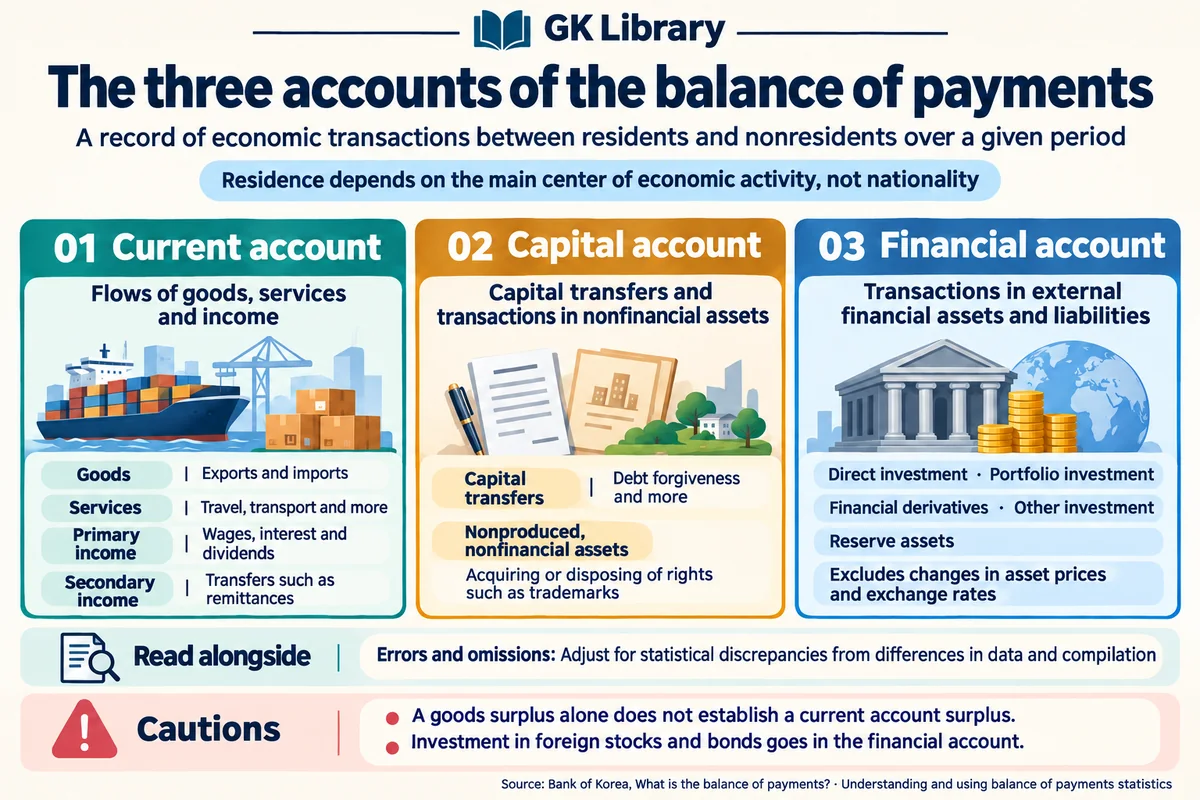
The balance of payments is a statistical report that records a country's economic transactions with foreign countries over a given period. This report is an important indicator that comprehensively shows the movement of capital, goods, services, and income between countries and is essential for understanding transaction flows in the international economy. The balance of payments is primarily divided into the current account, capital account, and financial account, each of which reflects various sectors of a country's economy.
The Current Account: A Country's Trade and Income Flows
The current account consists of trade in goods, service transactions, income, and transfer income.
- Trade in goods: This represents the exchange of goods between countries and is often also called the trade balance. When exports exceed imports, a current account surplus occurs, while the opposite results in a deficit.
- Service transactions: These include transactions in intangible assets such as tourism, transportation, insurance, and finance. Service transactions are an important factor in assessing the competitiveness of a country's service industries.
- Income: This includes investment income and wage remittances and records interest, dividends, and other income generated by assets invested abroad.
- Transfer income: This represents the movement of funds exchanged without compensation, such as migrant workers' remittances and international aid.
The current account represents the fundamental transaction flows of a country's economy and directly reflects its economic health.
The Capital Account: The International Movement of Assets
The capital account primarily records international purchases and sales of assets. It mainly represents asset transfers between governments or businesses, and its major components include items such as capital transfers. The capital account plays an important role in understanding economic cooperation and the movement of capital between countries. For example, overseas infrastructure investment and flows of foreign investment assets affect the capital account.
The Financial Account: Flows of Funds in International Financial Markets
The financial account includes portfolio investment, direct investment, other investment, and changes in foreign exchange reserves.
- Portfolio investment: This includes transactions in financial assets such as stocks and bonds. It primarily covers short-term asset movements in financial markets.
- Direct investment: This includes long-term equity investment in foreign companies and is an important form of investment that brings about substantive changes in the economic structure.
- Other investment: This includes other financial transactions such as lending and borrowing and records borrowing activities or the movement of funds between countries.
- Changes in foreign exchange reserves: This records changes in a central bank's foreign exchange reserves and is an important indicator for assessing a country's ability to make external payments and its financial stability.
Interactions and Adjustment Mechanisms in the Balance of Payments
The various components of the balance of payments interact, and changes in the current account can affect the capital account or financial account. For example, a current account deficit can be offset by a capital account surplus or financial account surplus, while a current account surplus can be balanced by a capital account deficit or financial account deficit. These interactions make it possible to understand capital flows in the international economy and develop policy responses.
The Economic Importance of the Balance of Payments
The balance of payments serves as a key source of information for economic policy, extending beyond its use as a statistical tool. It can be used to assess a country's economic health, predict its potential for economic growth, and measure its level of international competitiveness. Balance of payments data can also be used to formulate appropriate exchange rate, monetary, and trade policies, and serves as an important benchmark for responding to volatility in the global economy.
The Role and Importance of the Balance of Payments in the Global Economy

The Role of the Balance of Payments in the Global Economy
The balance of payments is a key indicator for assessing a country's economic condition and plays an important role in understanding its position in the global economy. It can be used to analyze the strengths and weaknesses of a country's economy and provide a foundation for formulating various economic policies. In particular, the balance of payments serves as an important measure of a country's credibility and stability in international financial markets.
Interdependence Between Countries and the Importance of the Balance of Payments
The global economy is based on interdependence between countries. Balance of payments conditions affect individual countries as well as the world economy as a whole. When one country records a current account surplus, the likelihood of current account deficits occurring in other countries inevitably increases. This provides important clues for understanding the balance and flows of the global economy and is essential for understanding the diversification of the international economy.
The Relationship Between the Balance of Payments and Exchange Rate Fluctuations
The balance of payments is also closely related to exchange rate fluctuations. A current account deficit can be a factor that lowers the value of a country's currency, while a current account surplus can cause its currency to appreciate. This has a major impact on the competitiveness of exports and imports and provides an important reference for determining a country's trade and exchange rate policies. Because exchange rate fluctuations have a substantial impact on the economy as a whole, the balance of payments is a very important factor in maintaining stable economic management.
Economic Crises and the Role of the Balance of Payments
During global economic crises, the balance of payments is used as an important tool for assessing economic conditions in individual countries. During the global financial crisis of 2008, many countries recorded current account deficits, increasing economic instability. Under these circumstances, the balance of payments played a key role in assessing countries' ability to respond economically and in formulating appropriate economic policies. It enabled countries to analyze their financial structures and develop strategies for economic recovery.
Cooperation with International Financial Institutions
The balance of payments also plays a significant role in relations with international financial institutions. Institutions such as the International Monetary Fund (IMF) and the World Bank set lending conditions or determine support policies based on individual countries' balance of payments conditions. These institutions closely analyze a country's balance of payments to assess its economic soundness and, when necessary, propose economic restructuring programs. In this process, the balance of payments is used as an essential indicator for a country to obtain international financial cooperation and support.
Its Importance in Developing Long-Term Economic Strategies
The balance of payments serves as a key source of information for countries developing long-term economic strategies. It enables countries to clearly define their economic goals and develop concrete plans to strengthen their international competitiveness. In particular, the balance of payments is an essential economic indicator for maintaining competitiveness in global trade and increasing capital inflows, and countries can use it as a basis for effectively pursuing international cooperation or trade negotiations.
Analyzing Balance of Payments Adjustment Mechanisms and Their Economic Effects

An Overview of Balance of Payments Adjustment Mechanisms
Balance of payments adjustment mechanisms play an important role in resolving economic imbalances between countries and maintaining long-term economic stability. These adjustment processes take place through the market's self-regulating functions and government policy intervention. When a balance of payments imbalance occurs, the process of correcting it has various effects on the economy as a whole.
Market Self-Adjustment Mechanisms
Market self-adjustment mechanisms are a way of naturally correcting balance of payments imbalances through price changes. When a current account deficit occurs, the likelihood of currency depreciation increases. Currency depreciation makes the prices of exported goods more competitive in international markets, leading to increased exports and reduced imports and thereby improving the current account. This self-adjustment process occurs automatically in the market according to the principles of supply and demand.
This mechanism finds a balance through market movements without intervention and is one of the fundamental functions of the international economy. However, for self-adjustment to have a positive effect on the economy as a whole, it must be supported by stability that prevents sharp fluctuations in currency values.
Government Policy Intervention
When market self-adjustment is insufficient, governments can use policy tools to adjust the balance of payments. Government intervention primarily takes the form of trade promotion, currency stabilization, and import restrictions.
- Export promotion policies: Governments can implement various policies to promote exports in order to address current account deficits. By providing tax benefits to exporting companies or easing trade barriers, they increase overseas sales of domestic products and seek to achieve a current account surplus.
- Import restriction policies: By introducing import restrictions to protect specific industries, governments can expect to protect domestic industries and reduce foreign currency outflows. However, excessive use of these policies can also lead to trade conflicts between countries.
Government policy intervention can improve the balance of payments in the short term, but excessive intervention can cause market distortions, requiring a cautious approach.
Central Bank Intervention in Foreign Exchange Markets
Central banks can use foreign exchange reserves to stabilize the value of their domestic currency and adjust balance of payments imbalances.
- Foreign exchange market intervention: When a current account deficit occurs, a central bank can prevent a sharp decline in the value of its currency by selling domestic currency and buying foreign currency. This allows it to maintain export competitiveness while reducing the risk of inflation caused by rising import prices.
- Financial stabilization: Central banks can also use interest rate policies to adjust capital flows and maintain financial market stability. Appropriate intervention in foreign exchange markets plays an important role in securing a country's foreign currency liquidity and defending the value of its currency.
Economic Effects and the Limits of Balance of Payments Adjustment
Balance of payments adjustment mechanisms have various effects on the economy.
- Changes in currency value: Currency depreciation strengthens export competitiveness, but it can also raise import prices and intensify inflationary pressure. Especially in countries that depend heavily on imports, this can lead to rising prices and affect people's living standards.
- Industry protection and distortions: If a government excessively implements import restrictions or export promotion policies to protect specific industries, the market's natural competitive structure can be distorted. This risks reducing industries' international competitiveness in the long term.
The Importance of Prudent Policy Management
Balance of payments adjustment mechanisms are tools for maintaining long-term economic balance and must be managed carefully. Abrupt intervention to resolve short-term problems can negatively affect the economy as a whole, so governments and central banks must formulate and implement policies based on comprehensive economic analysis. To maintain balance across the economy, it is important to harmonize market self-adjustment with appropriate policy intervention.
Balance of Payments Patterns in Major Countries and a Comparative Analysis

Differences in Balance of Payments Patterns Across Major Countries
Countries' balance of payments patterns vary according to their economic structures, industrial composition, trade policies, and the global economic environment. Comparing and analyzing these differences allows for a clearer understanding of interactions in the global economy and each country's economic position.
The United States: Balancing a Current Account Deficit with a Financial Account Surplus
The United States has maintained a current account deficit for a long time. High consumption and dependence on imports are the main causes. However, it records a certain surplus in its services balance, partially offsetting the deficit. The United States' current account deficit is balanced by capital account and financial account surpluses. Its attractiveness as an investment destination in global financial markets and the dollar's function as a reserve currency play a major role in this. These are important factors in maintaining the United States' balance of payments pattern.
Germany and China: Leading Countries with Current Account Surpluses
Germany and China are leading examples of countries that consistently record current account surpluses.
- Germany: Germany maintains a current account surplus through its strong manufacturing base and world-class export competitiveness. In particular, the automotive, machinery, and chemical industries account for a large share, and exports continue to increase steadily based on their competitiveness in global markets.
- China: China records a current account surplus through massive exports supported by inexpensive labor and a large manufacturing base. More recently, it has also shown positive results in its services balance and capital account while pursuing diversification across the economy. On the basis of this economic structure, China occupies an important position in the international economy.
Japan: A Changing Current Account Pattern
Japan consistently recorded current account surpluses in the past, but more recently it has alternated between current account deficits and surpluses.
- Population aging and a shrinking domestic market: Japan's aging population causes its domestic market to shrink, leading to reduced domestic consumption and investment and negatively affecting the current account.
- Weakening export competitiveness: Japan once boasted world-class competitiveness in electronics and the automotive industry, but more recently, intensified competition with other countries has weakened its leadership in export industries. The Japanese government is implementing various economic policies to address this, but it is struggling to find sustainable drivers of growth.
South Korea: An Export-Driven Current Account Surplus
South Korea is a country that records a current account surplus, supported by an export-oriented economic structure.
- Competitiveness of major industries: South Korea has world-class competitiveness in major industries such as semiconductors, automobiles, and ships, and these industries play an important role in maintaining its current account surplus.
- The interaction between a services deficit and a capital account surplus: South Korea often records a deficit in its services balance but offsets it with a capital account surplus. This works as a way of resolving current account imbalances through returns from investment in overseas assets and financial transactions.
A Comparative Analysis of Major Countries' Balance of Payments in the Global Economy
Comparing each country's balance of payments patterns helps explain interdependence in the global economy and differences in economic structures. The United States offsets its current account deficit with a capital account surplus, while Germany and China maintain current account surpluses based on strong export competitiveness. Japan exhibits a fluctuating pattern amid economic changes, while South Korea and Russia occupy important positions in the balance of payments through their respective reliance on an export-oriented economy and energy exports. This analysis provides a clearer understanding of the global economy's complex structure and economic interactions between countries.
The balance of payments is a key tool for understanding the balance and dynamics of the global economy. It plays an essential role in formulating countries' economic policies and understanding international economic trends, and it has important implications for various areas, including exchange rate fluctuations, trends in global financial markets, and responses to economic crises. Comparing and analyzing balance of payments patterns across major countries enables us to understand the diversified structure of the global economy and use that understanding to develop better economic policies and strategies.
Above all, it is important to use the balance of payments to clearly understand the complex interactions of the global economy and maintain long-term economic balance.