If, after buying car insurance, you find yourself taking a little less care when choosing where to park, that change may not be simple laziness. Part of the cost of an accident or theft now belongs to the insurer. Economists call this phenomenon, where behavior loosens or grows bolder after risk has been passed to someone else, ‘moral hazard (Moral Hazard).’
Put simply, moral hazard means ‘the phenomenon in which, after one party takes on a risk, the other party changes its behavior in a way that increases the size of that risk.’ It is a problem of hidden action (hidden action) that emerges after a contract or insurance policy is made, and a classic concept that Kenneth Arrow (Kenneth Arrow) brought squarely into economics in 1963 while analyzing health insurance. Although the name contains the word ‘moral,’ economics today uses it less as an ethical reproach than as a term for the inefficiency created by incentives and information asymmetry.
In this piece we will look, in order, at what moral hazard means and how it differs from adverse selection, how it shows up in daily life and finance, and the mechanisms such as deductibles, coinsurance and monitoring that share risk to keep behavior in check.
The incentive that arises when coverage changes behavior
What is moral hazard?

Moral hazard arises after a deal is done. Even if both sides hold similar information when the contract is signed, the other party cannot fully see how careful or how hard-working one side is afterward. Behavior changes in that gap.
(1) When you don't bear the full cost, behavior changes
Effort to reduce risk costs time and money. But if insurance or a guarantee covers the loss from an accident, the price I pay for cutting back that effort shrinks. So caution slackens, or an incentive arises to take on greater risk.
(2) It is hidden action
The problem grows when an insurer cannot check a driver's attention at every moment, or a principal cannot observe every bit of an agent's effort. Because the crux is behavior that is hard to observe or enforce by contract, information economics frames this as a hidden-action model.
(3) Before and after the event differ
Neglecting prevention before an accident is sometimes called ex ante (ex ante) moral hazard, while excessive claims or responses after an accident are called ex post (ex post) moral hazard. Both share the point that ‘coverage changes behavior.’
How does it differ from adverse selection?

Moral hazard is often placed alongside adverse selection (adverse selection), but the moment when information diverges is different. Mixing the two up can lead to the wrong prescription.
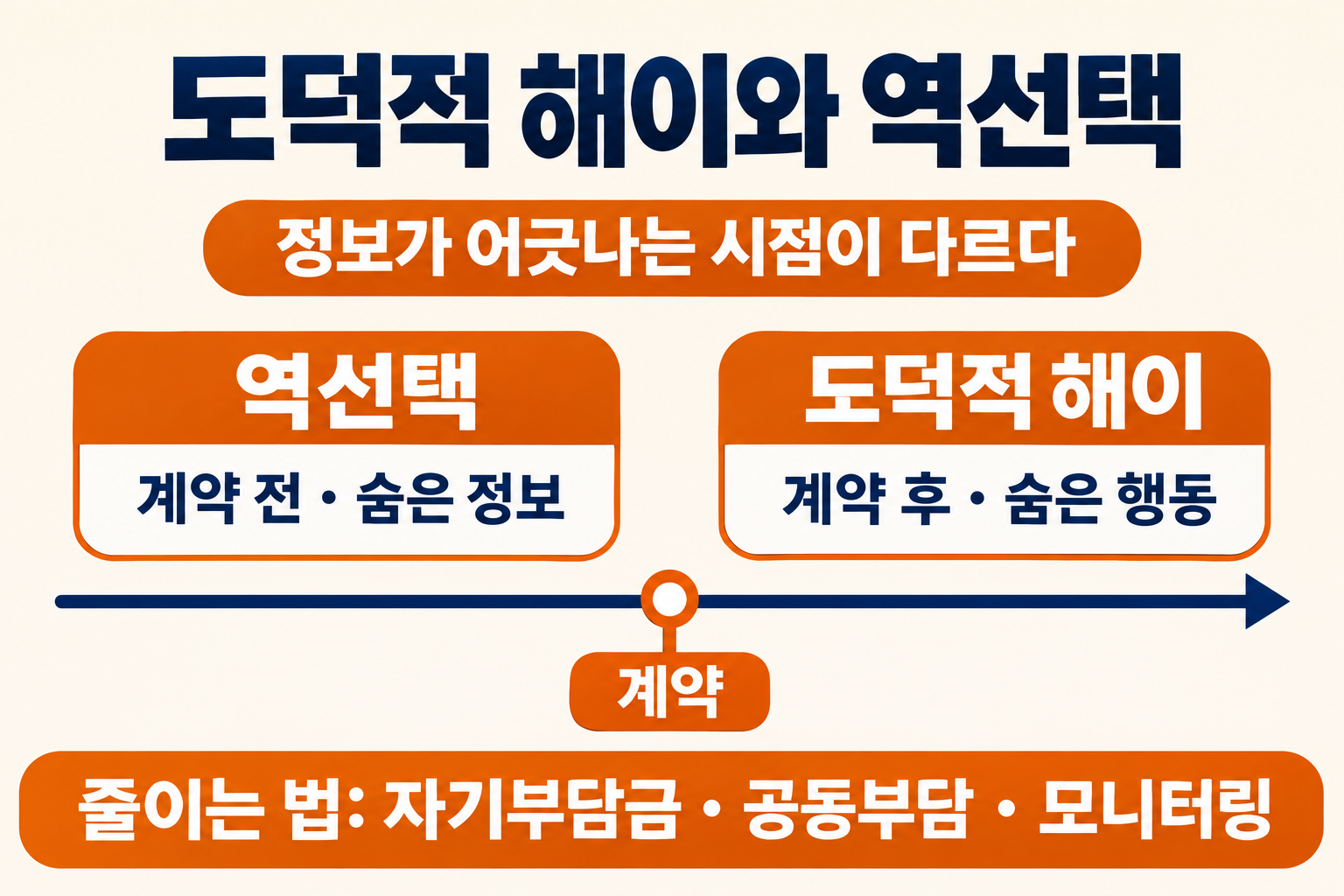
(1) Adverse selection is hidden information before the contract
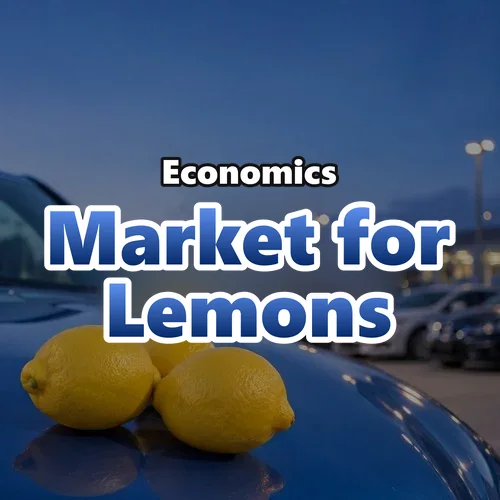
Adverse selection is the problem in which only one side knows its own level of risk before a contract is made. As in George Akerlof's (George Akerlof) market for lemons, when people trying to sell bad cars come to market more eagerly, average quality falls and trade itself shrinks.
(2) Moral hazard is hidden action after the contract
Even with the same insurance, it is adverse selection when only already-risky people flock to sign up, and closer to moral hazard when driving gets rougher or medical use rises after signing up. The information lies not in ‘who someone is’ but in ‘what they do after signing up.’
(3) It also touches the agency problem
In a principal-agent relationship, an agent choosing what is convenient for itself over the principal's interest is also a form of moral hazard. It can appear anywhere with a ‘I decide, someone else bears the loss’ structure, such as shareholders and managers, patients and doctors, or depositors and banks.
How it appears in daily life and finance

Moral hazard does not stay a classroom example. From everyday insurance to financial safety nets, the same logic repeats as coverage grows thicker.
- Auto insurance (Auto Insurance): After signing up, people may pay less attention to locks or where they park, or drive a little more boldly, because part of the loss passes to the insurer.
- Health insurance (Health Insurance): As Arrow pointed out, when out-of-pocket costs are close to zero, there is an incentive to request tests or treatments more readily even when they are not really needed. In effect, demand becomes less responsive to price.
- Deposit insurance (Deposit Insurance): When deposits are protected, depositors monitor banks' risk-taking less. Banks, too, have a greater incentive to reach for riskier assets if they believe losses can pass to the safety net.
- Bailouts (Bailout): Once people expect public funds to cover the failure of a large institution, choices that build up risk in advance become easy to justify. The belief in ‘too big to fail’ is exactly that channel.
How can it be reduced?

Eliminating moral hazard is difficult. Instead, mechanisms are used that avoid passing the risk on entirely and make behavior somewhat visible, realigning incentives.
(1) Deductibles and coinsurance
A deductible (deductible) makes the insured pay up to a set amount, and coinsurance (coinsurance) makes them pay a set share of the cost. When people bear part of the loss themselves, it becomes hard to neglect prevention and consumption entirely.
(2) Monitoring and contract clauses
There are also ways to observe behavior directly or indirectly and bind it with rules, such as bank regulation, restrictive covenants in loan agreements and performance reviews at work. Even if behavior can't be seen perfectly, spending on observation narrows the room for hidden action.
(3) Tie outcomes and interests together
Like performance bonuses, stock options and premiums that vary with risk, returning the rewards of good and bad outcomes to the party involved moves the agent's choices closer to the principal's interests. Perfect alignment is rare, but even pointing in the same direction makes the slack smaller.
Moral hazard is not a story about ‘bad people’ but a story about structure, arising when incentives diverge wherever there is coverage. Mechanisms that share risk protect lives, but we must also look at how those mechanisms change behavior.
First asking who decides and who bears the cost: that is the first step in understanding moral hazard.