Game theory is an important analytical tool used in many fields, helping us understand how individuals or groups make strategic decisions in situations involving interaction. In economic activity, game theory is particularly essential for analyzing and predicting complex situations in which competition and cooperation coexist.
This material explores the importance of game theory in economics based on its fundamental concepts, presents methods for analyzing strategic interactions and addressing economic decision-making problems, and uses examples to explain specifically how game theory is applied in economics.
The Definition and Role of Game Theory
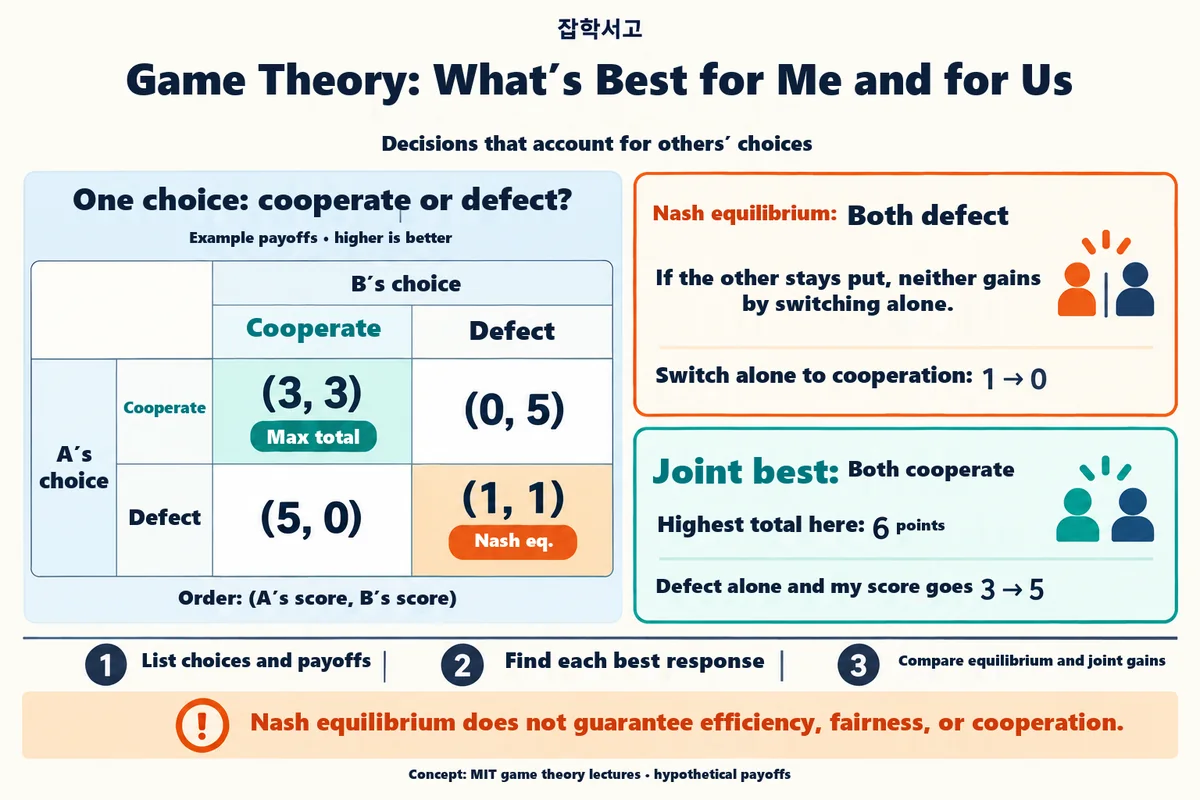
Game theory is a theory that mathematically models and analyzes interactions among people. These interactions involve situations in which participants' actions affect one another, and such situations are called 'games.' Each participant is called a 'player' and chooses a strategy from various options to maximize their own interests. Game theory is an important tool for analyzing how these interactions occur and how their outcomes are produced.
Economic Interactions and the Necessity of Game Theory
Traditional economic theory explains economic structures with a focus on market efficiency, while game theory analyzes interactions among economic actors in greater depth. It greatly helps us understand how individuals or firms produce outcomes through their interactions in complex market situations. Game theory can clearly explain various economic phenomena, such as competition among firms, negotiation, and pricing. For example, game theory provides a useful framework for analyzing how individual firms behave when multiple firms compete with one another and set prices.
The Importance of Nash Equilibrium
One of the most important concepts in game theory is 'Nash equilibrium.' Nash equilibrium is a state reached when no player needs to change their strategy, arising from each player choosing an optimal strategy. In economics, Nash equilibrium is used to explain the stable state that occurs when firms or individuals have each made their best choice. For example, when multiple firms set prices while considering one another's strategies, a state in which they no longer have any reason to choose a different price constitutes a Nash equilibrium.
Cooperative and Non-Cooperative Games
Game theory can be broadly divided into cooperative and non-cooperative games. In cooperative games, players work together to pursue shared interests, and the outcome of the game varies according to the outcome of negotiations. In non-cooperative games, by contrast, each player seeks only to maximize their own interests, and individual strategies play a more important role than cooperation with others. This distinction is an important criterion when analyzing economic situations and is useful for examining negotiations or competition among firms.
Information Asymmetry and the Role of Game Theory
In real-world economies, information is often incomplete or uncertainty exists. In such cases, game theory serves as an important analytical tool. For example, in the insurance market, insurers cannot fully know their customers' health conditions, while customers know more about themselves, creating a situation of information asymmetry. Using game theory in such a situation makes it possible to predict what choices insurers and customers will each make and to understand how problems of information asymmetry can be resolved.
The Use of Game Theory in Policymaking
Game theory is also useful in the policymaking process. Policymakers can predict how various stakeholders will respond and analyze how their interactions will affect a policy. This enables them to increase the likelihood of a policy's success and design more efficient and effective policies. Applying game theory makes it possible to maximize policy effects by more systematically analyzing the relationship between government and markets or interactions among various stakeholders.
The Economic Importance of Game Theory
Game theory has value beyond being a mere theory and is used as an important analytical tool in actual economic situations. It is essential for resolving complex economic problems, including competition among firms, negotiation, pricing, and information asymmetry. This theory enables better strategies to be developed for economic decision-making and provides useful insights that can also be applied in important areas such as policymaking. Game theory will continue to develop and demonstrate its importance in an even wider range of fields.
Game Theory in the Analysis of Strategic Interactions

Game theory is an essential tool for analyzing interactions among individuals or groups. In particular, it provides a means of modeling and analyzing situations in which each actor's choices affect the decisions of other actors during their interactions. This allows us to understand how various economic actors, including firms, governments, and consumers, interact and produce optimal outcomes according to one another's choices.
Each actor predicts the choices of others and attempts to determine the optimal strategy to adopt accordingly. For example, when a firm lowers its prices, its competitors may respond accordingly, and it is important to analyze what choices each will make in this process. Game theory provides a suitable framework for systematically explaining these complex interactions.
Applications of Game Theory in Competition Among Firms
Game theory is used in various ways in competition among firms. For example, when multiple firms compete in a market, each must choose a strategy that maximizes its profits while considering competitors' pricing policies, marketing strategies, new product launches, and other factors. Game theory plays an important role in analyzing how competitors will respond and proposing the optimal response accordingly.
Game theory is particularly powerful in addressing pricing problems. When a firm lowers its prices, it can increase its market share accordingly, but competitors may also notice this and lower their prices further. In such situations, game theory helps each firm set an optimal price that accounts for the responses of its rivals. It can also support efficient decisions about advertising strategies and new product launch plans by predicting competitors' behavior.
Game Theory in Negotiations
Game theory is also used as a very important tool in the negotiation process. In various situations, such as merger discussions between firms or wage negotiations with labor unions, each party predicts the other party's strategy and develops a strategy in response. Negotiation involves strategic interactions that go beyond a simple exchange of opinions, so game theory helps predict negotiation outcomes and identify ways for each actor to obtain optimal benefits.
For example, when two firms discuss a merger, each must consider the other party's position and strategy to maximize its own interests. Using game theory in this process makes it possible to predict one another's choices and their outcomes and prepare in advance for how negotiations will unfold. This plays an important role in helping negotiators avoid unfavorable situations and obtain relatively favorable terms.
The Relationship Between Consumer Behavior and Game Theory
Consumer behavior can also be explained through game theory. Modern consumers attempt to make the choice that best suits them among various products and services. In this process, they consider various factors, such as price, quality, and brand trust, and the way all these factors interact can be very complex. Game theory is useful for analyzing this complex decision-making process and predicting how consumers will behave.
Firms can anticipate this consumer behavior and develop strategies to respond to it. For example, when a firm lowers its prices, consumers become more likely to choose its product, but their choices may change if competitors also lower their prices. In this way, game theory allows firms to predict consumer choices and develop better marketing strategies or pricing policies.
Using Game Theory in Policymaking
Game theory is also useful when governments or public institutions formulate policies. In various policy decisions, such as tax policies, environmental regulations, and trade agreements, it is important to predict and analyze the responses of multiple stakeholders. Using game theory makes it possible to predict what actions these stakeholders will take to maximize their own interests and analyze whether a policy will succeed accordingly.
For example, if a policy to raise taxes is introduced, firms may reduce investment or relocate factories overseas, and consumers are likely to reduce spending. Policies that fail to anticipate these interactions are highly likely to fail, but analyzing them in advance through game theory can maximize policy effects and minimize unnecessary side effects. This enables policymakers to design more efficient and effective policies.
The Global Economy and the Importance of Game Theory
Interactions among countries are very important in the modern global economy. In complex international economic situations, such as trade negotiations, international disputes, and global supply chain management, national governments and firms must predict and respond to one another's strategies. Game theory helps countries make optimal strategic decisions in these international interactions.
For example, in a trade war, if one country raises tariffs, the other country may impose retaliatory tariffs. These interactions have a major impact on the economy, making it important to predict and respond to them. Through game theory, countries can analyze the responses of other countries in advance and develop strategies accordingly. This makes a substantial contribution to maintaining stability in the international economy and preventing trade disputes.
In addition, cooperation and competition among countries occur simultaneously in global supply chain management. Countries face the complex task of maintaining cooperation in global markets while seeking to maximize their own interests. In such cases, game theory contributes to helping countries make better economic decisions through their interactions and improving the stability of the global economic order.
The Practical Application of Game Theory
Game theory goes beyond theory and is effectively used to solve various problems in the real world. Applying game theory to competition among economic actors, negotiation, policymaking, consumer behavior analysis, and other areas enables more accurate predictions and analyses. This allows firms, governments, consumers, and others to make the best decisions in the situations they face and achieve better economic outcomes. Game theory will continue to establish itself as an essential tool in economics and various other fields.
The Role of Game Theory in Economic Decision-Making

Game theory is used as a useful tool for analyzing complex interactions and solving problems in the economic decision-making process. Economic actors seek to obtain the greatest benefits by making optimal use of limited resources, and in this process, they must make strategic decisions among several options. Game theory is used as a means of supporting efficient decisions by systematically analyzing the complex interactions that arise at this point.
Auction Theory and Applications of Game Theory
Auctions are one of the main mechanisms for allocating resources efficiently, and game theory plays an important role in the auction process. Auction participants analyze one another's strategies to submit their own optimal bids, and game theory can be used to predict how they will behave. Once each participant's bidding strategy has been analyzed through the theory, an optimal price can be determined to maximize the auction's efficiency.
For example, in large-scale auctions, such as bidding for public resources and spectrum auctions, the process by which participants predict one another's behavior and develop their own strategies accordingly can be explained more clearly through game-theoretic analysis. Theoretical analysis comprehensively considers participants' psychology and strategic behavior as well as price competition.
Applying Game Theory in Contract Theory
Game theory also plays an important role in contract theory. Problems such as information asymmetry and uncertainty are common in the process of establishing contracts between firms and individuals. In such situations, game theory helps each party establish optimal contract terms, making it possible to design the incentive structures needed for contract performance.
In situations involving information asymmetry in particular, game theory is useful for analyzing how an imbalance in the information held by one party affects a transaction. For example, when an employer does not have sufficient knowledge of a worker's performance or potential in an employment contract, game theory models such a situation to help identify an optimal contract that satisfies both the employer and the worker.
Internal Corporate Decision-Making and Game Theory
Game theory is also usefully applied within firms. In large firms or complex organizations, situations frequently arise in which departments compete for resources or must establish different priorities. In such situations, the role of game theory is to analyze interactions and cooperation among departments to support optimal resource allocation and decision-making.
For example, when a decision must be made about how to allocate limited resources among multiple projects, each department will attempt to receive the largest share of resources. Game theory can be used to analyze each department's strategic choices and identify ways to maximize the efficiency of the organization as a whole. This enables firms to minimize internal conflict and achieve optimal outcomes.
Using Game Theory in Financial Markets
Game theory is also used as an important tool in financial markets. Investors must choose the investment that best suits them from various financial products, and in this process, they must consider the behavior of other investors. Because one investor's choices can directly affect other investors' returns in financial markets, game theory provides a means of analyzing and predicting how investors will behave in such situations.
For example, in the stock market, investors predict which stocks other investors will sell or buy and develop their own strategies accordingly. Game theory models these interactions to help investors construct optimal portfolios. In addition, game theory can help analyze interactions among financial institutions during financial crises and assist in preventing crises.
The Importance of Game Theory in Economic Forecasting
Game theory also plays an important role in economic forecasting. The economy is a complex system in which various economic actors influence the economy as a whole through their individual choices. Game theory can analyze these interactions to predict the behavior of economic actors and provide more accurate economic forecasts on that basis.
For example, when a government introduces a particular economic policy, it is important to predict in advance how firms or consumers will respond. Analyzing these interactions through game theory makes it possible to predict policy effects more clearly and can contribute to increasing the likelihood of a policy's success. This enables economic analysts to provide more accurate forecasts even in complex economic situations.
Applications of Game Theory in Public Policy Analysis
Finally, game theory also plays an important role in public policy analysis. When a government formulates a new policy, it must consider the responses of various stakeholders, and game theory is useful for analyzing each stakeholder's strategic choices. Policymakers can use game theory to predict what choices each actor will make and achieve their objectives through policy designs suited to those choices.
For example, in public policies such as environmental regulations or tax policies, governments must consider in advance how firms will respond. When firms may adopt other strategies to avoid regulations, or when tax policies are expected to reduce investment, game theory is used to design policies that can anticipate and respond to these developments. This allows governments to maximize policy efficiency and effectiveness.
The Essential Value of Game Theory in Economic Decision-Making
Game theory plays an essential role in the economic decision-making process. Across various fields, including auctions, contracts, internal corporate decision-making, financial markets, economic forecasting, and public policy analysis, game theory helps analyze complex interactions and make optimal decisions. Through this analysis, each economic actor can choose the strategy most favorable to them, thereby maximizing economic efficiency. Game theory will continue to establish itself as an essential tool for solving economic problems.
Economic Research Examples and Applications of Game Theory

Applying Game Theory to Address Price Collusion
Game theory serves as an important tool for addressing price collusion among firms. Price collusion among firms creates a pricing structure unfavorable to consumers and can undermine market fairness. If left unchecked, it can reduce market efficiency and hinder economic growth in the long term. To address such situations, game theory models the ways in which firms can collude tacitly even without explicit cooperation.
For example, repeated-game models that analyze repeated interactions show that firms can obtain greater profits by cooperating over the long term. At the same time, each firm acts while anticipating the possibility that a competitor may break the collusive arrangement and capture exclusive gains. This analysis clearly explains why firms attempt to collude and provides an important foundation for policy responses to manage the risks, such as the enactment of antitrust laws.
The Role of Game Theory in International Trade Negotiations
Game theory also plays a very important role in trade negotiations among countries. Countries enter negotiations using different strategies to maximize their own economic interests. Game theory analyzes how each country's strategic choices affect outcomes in these situations. This allows negotiating parties to anticipate the responses of other countries and bring about efficient and fair negotiations.
In trade agreements among countries in particular, both the economic and political circumstances of each country must be considered, and game theory contributes to optimal decision-making by modeling these complex interactions. This maintains stability and fairness in international trade and can further safeguard each country's economic interests.
Applications of Game Theory in Financial Markets
In financial markets, game theory is particularly useful for analyzing interactions among investors. In the stock market, investors predict one another's strategies and adjust their own decisions accordingly. Game theory systematically models these interactions, helping investors make optimal investment decisions.
For example, game theory can be used to explain the process by which investors predict future market fluctuations and develop appropriate investment strategies. This also makes it possible to develop ways to improve financial market stability. In addition, during financial crises, game theory can help analyze interactions among financial institutions and develop crisis response strategies. This analysis contributes to improving market efficiency and reducing uncertainty.
The Role of Game Theory in Addressing Climate Change
Climate change is a major challenge that the entire world must address together. Cooperation among countries is essential in responding to climate change, but differences in their economic interests create barriers to cooperation. Game theory provides substantial help in analyzing which strategies countries will choose in these complex situations and designing incentive structures that can encourage cooperation.
For example, game theory can model strategic choices about how much each country will invest in environmental protection or how international forms of cooperation, such as emissions trading, can be optimized. This can increase the prospects for international cooperation in responding to climate change and contribute to practical solutions.
Applying Game Theory in the Labor Market
In the labor market, interactions between employers and workers constitute core economic activities. Decisions about wage negotiations, adjustments to working hours, employment contract terms, and other matters are made through complex interactions between employers and workers. Game theory helps systematically analyze the interactions that arise in this process and propose negotiation strategies that enable both employers and workers to maximize their benefits.
For example, employers must set optimal wages by considering workers' productivity, working hours, and wage demands, while workers can also adjust their strategies by analyzing employers' financial circumstances and competitive conditions in the market. This analysis can improve labor market efficiency and create fairer employment conditions.
Using Game Theory in Public Policy Analysis
Game theory also plays an important role in the process of designing public policy. Governments must formulate policies with consideration for the interests and responses of various stakeholders, and predicting each stakeholder's strategic choices is an important factor in determining whether a policy succeeds. Game theory models each stakeholder's choices in this process and proposes ways to maximize policy effects.
For example, when introducing tax increases or environmental regulatory policies, predicting in advance how firms or consumers will respond can increase the likelihood of a policy's success. This enables governments to minimize unnecessary side effects and take an effective approach to achieving policy objectives.
Practical Applications and Economic Usefulness of Game Theory
Game theory has established itself as a very important tool for analyzing economic interactions. In various fields, such as preventing collusion among firms, international trade negotiations, financial market stabilization, responses to climate change, labor market negotiations, and public policy design, game theory helps each actor make optimal decisions. These studies and practical applications demonstrate that game theory is an essential tool for solving economic problems, and it will continue to play an important role in analyzing and resolving economic interactions.
Game theory is an indispensable tool for analyzing economic interactions. In various economic situations, game theory encourages rational decision-making and contributes to a systematic understanding of complex interactions.
Examples of game theory in practice clearly demonstrate its usefulness and provide important insights for solving economic problems and making policy decisions. Game theory will continue to expand its potential applications beyond economics into various fields and play an increasingly important role.