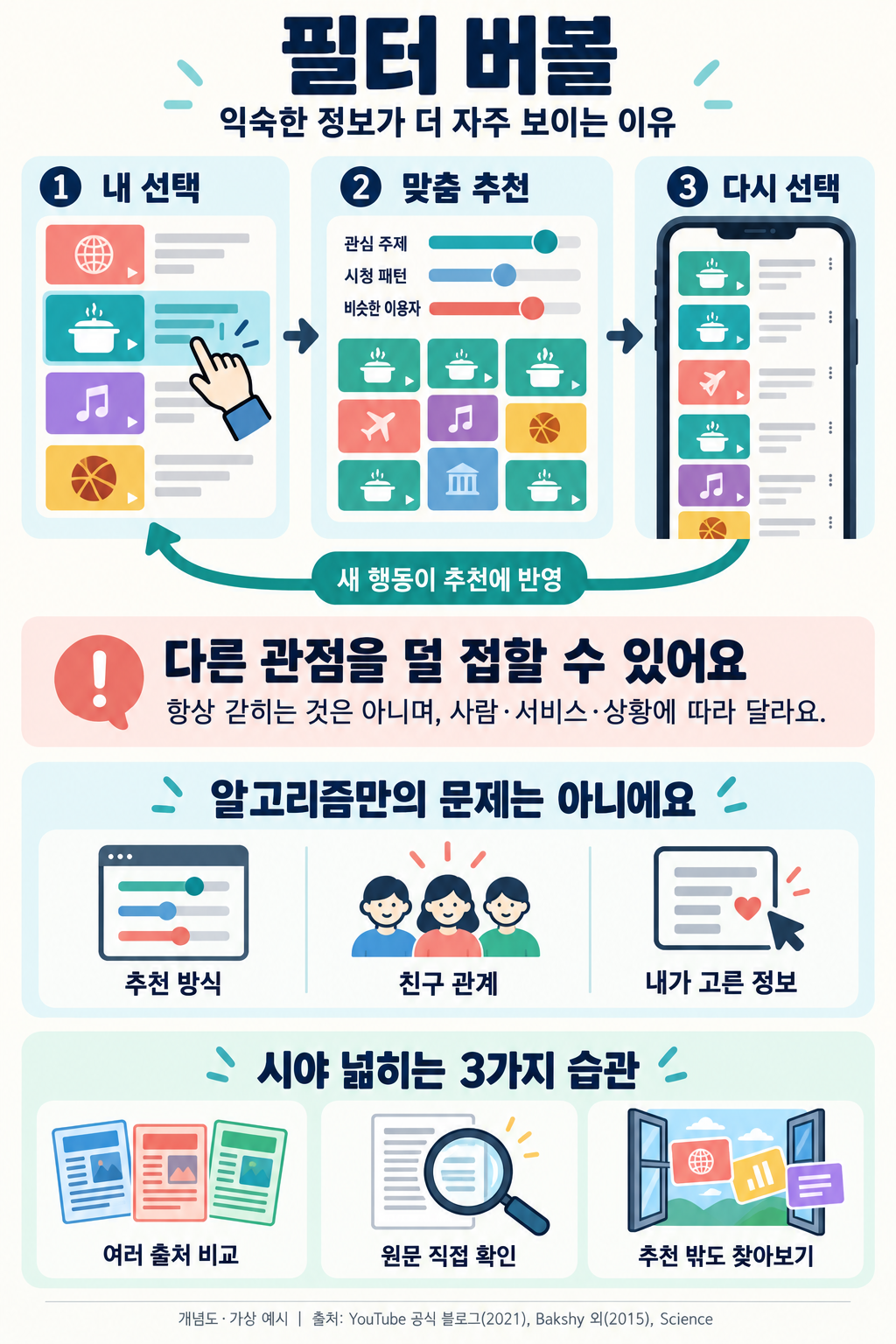
Even if you sit side by side with a friend at the same moment and search for the same word, the results on your screens can differ. Open a video app and one video after another similar to what you watched yesterday lines up, and on social media, posts from people who think like you appear first. It is convenient, but at the same time there is no way to know what information you have missed without ever seeing it.
This phenomenon, ‘as the personalization algorithms of search engines and social media pick out and show only the information users are likely to like, users become trapped inside a bubble surrounded by information that fits their own tastes and viewpoints’, is called the ‘Filter Bubble’. The name carries the idea that an invisible filter creates an information world all your own.
In this article, we will look in turn at the background of how the term filter bubble came about, the principles by which the bubble forms, the research and counterarguments surrounding the concept, and ways to see outside the bubble.
An Information World of Your Own, Made by Algorithms: The Filter Bubble
Search Results That Differ from Person to Person

The term filter bubble was popularized by the American activist and author Eli Pariser in his 2011 TED talk and in his book The Filter Bubble, published the same year.
(1) Personalized search for everyone
Pariser saw Google’s move in December 2009 to apply personalized search even to users who were not logged in as a major turning point. The explanation he heard was that Google guessed who users were from 57 signals, such as where they were connecting from, which browser they used and their previous search history, and changed the results accordingly.
(2) Same word, different results
Around the time of the 2010 Gulf of Mexico oil spill, he asked two friends with similar leanings to search for the name of the oil company ‘BP’. One friend’s first page showed investment information, while the other friend’s showed news about the oil spill.
(3) The vanishing voices of neighbors
He also shared how, on his own Facebook, posts from friends with different political leanings had at some point disappeared from view. Because he clicked on those posts less often, the algorithm had quietly filtered them out.
How Does the Bubble Form?

A filter bubble is not something anyone builds on purpose; it arises naturally from the way personalized services work.
- Behavioral Data: What you clicked, how long you watched and what you ‘liked’ all pile up and become the material for guessing a user’s tastes.
- Recommendation Algorithm: Based on the accumulated record, it places the content a user is most likely to linger on at the front.
- Feedback Loop: Watching what is recommended adds to the record again, and the next recommendations become even more similar. The more this process repeats, the firmer the bubble becomes.
What Pariser took particular issue with was that the bubble is invisible. A newspaper shows everyone the same articles chosen by its editors, but personalization algorithms show each person a different screen. Not only can users not decide for themselves what comes in, but it is also hard for them to know what has been filtered out.
A term used in a similar way is the ‘Echo Chamber’. The echo chamber effect refers to people with similar views gathering together and exchanging the same opinions until those views grow stronger and stronger. If the filter bubble emphasizes being surrounded by information chosen by an algorithm, the echo chamber emphasizes people gathering on their own and echoing one another’s voices.
It Is Not Just the Algorithm’s Fault

The filter bubble drew a great deal of attention, but research also emerged suggesting that its power is not as great as people think.
In a study published in the journal Science in 2015, Facebook researchers analyzed data from about 10.1 million users in the United States. After passing through the News Feed algorithm, the likelihood of seeing news from the opposing political side fell by about 5% for conservative users and about 8% for liberal users.
But at the stage where users themselves chose what to click, the likelihood of clicking on news from the opposing side fell by a further 17% for conservatives and 6% for liberals. The researchers concluded that users’ own choices play a bigger part than the algorithm in keeping them from encountering diverse viewpoints. Some critics, however, pointed out that the findings should be interpreted with care, since the study was carried out by Facebook itself.
In the end, it is more accurate to see the filter bubble not as a problem of technology alone, but as a phenomenon created jointly by algorithms and the human habit of seeking out familiar, comfortable information.
Ways to See Outside the Bubble

It is hard to avoid the filter bubble entirely, but you can build habits that make the walls of the bubble thinner.
Things You Can Try in Everyday Life
- Diverse Sources: Rather than relying on a single app or channel, deliberately seek out and read articles from news outlets with different leanings as well.
- History Management: Occasionally clearing your search and viewing history, or turning off personalization settings, can let you come across results different from usual.
- Chronological Feed: If there is a feature for viewing posts in chronological order instead of by recommendation, try using it too.
- Counterarguments: Reading claims that differ from your own all the way through helps you understand perspectives from outside the bubble.
Clearing away the bubble ultimately begins with an attitude of curiosity about what lies beyond what the algorithm shows you.
The filter bubble shows that convenient personalized services can quietly narrow our field of view. It also tells us that our own choices play as big a role as algorithms in deciding how thick that bubble is.
The world a screen shows you is not the whole world. Recognizing that the information you see has been chosen by someone else is the first step toward a balanced information life that meets the wider world outside the bubble.