In a meeting room where everyone is nodding along, if you alone think differently, you hesitate once more before opening your mouth. Something similar happens when your social media timeline is flooded with the same opinion. The stronger the feeling of ‘Am I the only one who thinks differently?’, the more our words retreat inward, and that silence in turn makes the majority opinion look even bigger. This very feedback loop is the ‘Spiral of Silence.’
Put simply, the Spiral of Silence refers to ‘the process in which people sense the prevailing current of public opinion, voice views that appear to be in the majority, and keep quiet about views that appear to be in the minority, so that as this tendency accumulates, silence grows in a spiral.’ Since the German public opinion researcher Elisabeth Noelle-Neumann formulated it as a theory in 1974, it has become a key concept in communication studies for explaining public opinion and media effects.
In this article, we lay out—in an easy-to-understand way—the definition and origins of the Spiral of Silence, the quasi-statistical sense and the mechanism by which the spiral accelerates, the exceptions known as the hard core and the avant-garde, and the criticisms of the theory and its implications today.
The Spiral of Silence: The Force That Makes Public Opinion Fall Silent
What Is the Spiral of Silence?
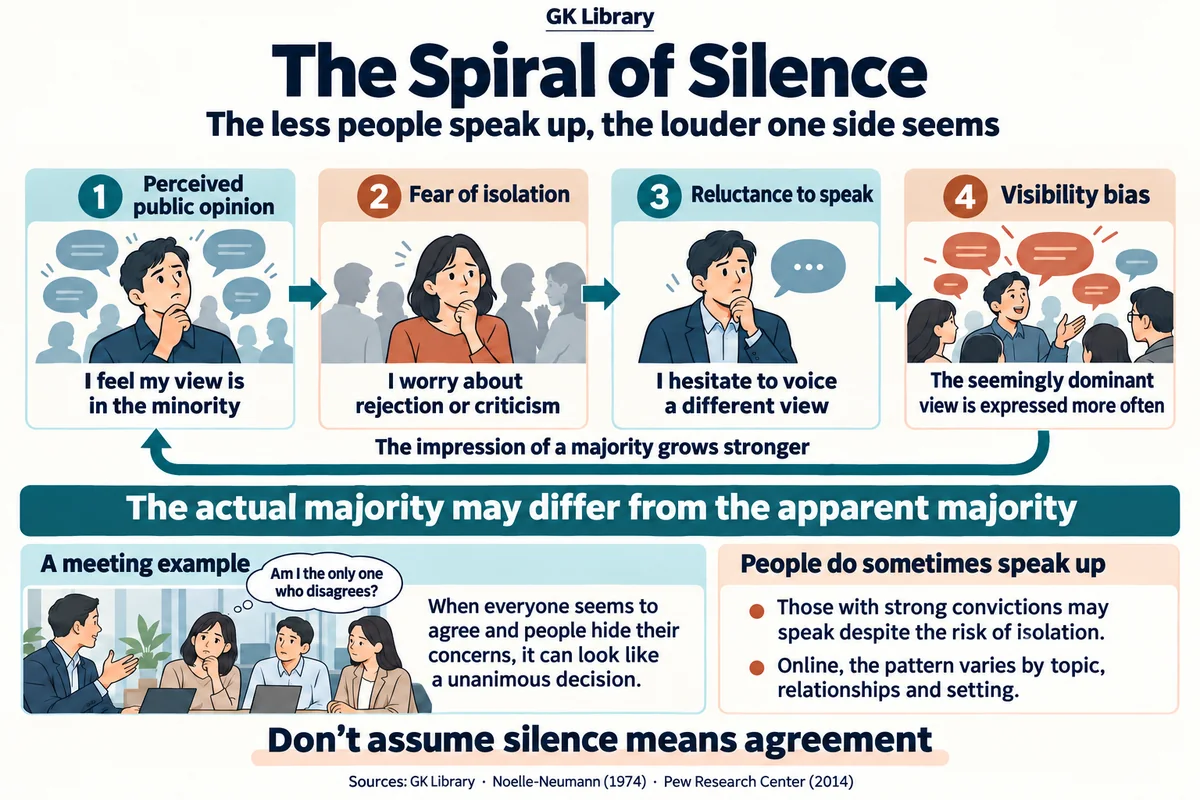

Drawing on her experience with elections and opinion polls in West Germany, Noelle-Neumann argued that people first check ‘what is safe to say’ before considering ‘what to say.’ When the fear of isolation is strong, opinions that feel like they belong to the minority rarely surface in public settings. As a result, even when opinion is in fact evenly divided, the opinion visible on the surface can appear to lean to one side.
The key concepts that help in understanding this theory are as follows.
- Fear of Isolation: The fear of being excluded or criticized for being different from the majority.
- Quasi-statistical Sense: The ability to gauge, by rough estimation from the news, conversations, and the general mood, ‘which side is currently dominant.’
- Climate of Opinion: The current of public opinion that a society feels is ‘accepted’ at a given point in time.
- Spiral Process: The cumulative process in which silence strengthens the impression of a majority, and that impression in turn invites more silence.
The important point is that behavior is governed less by ‘whether it really is the majority’ than by ‘whether it looks like the majority.’ When the perceived majority diverges from the actual majority, the Spiral of Silence works especially strongly.
The Quasi-statistical Sense and How the Spiral Accelerates

According to Noelle-Neumann, rather than counting public opinion precisely in numbers, people read the ‘mood’ from signals around them. Cues such as the tone of television and newspapers, conversations at work, and reactions at family gatherings become the raw material of the quasi-statistical sense. When the media show a particular position more often and with more confidence, that position can feel more like the majority than it really is.
(1) Overestimating the Majority Opinion
The side that appears dominant gains the confidence that ‘it’s okay to say this’ and speaks more loudly. The side that appears to be losing judges that ‘it’s better to stay quiet for now’ and speaks up less.
(2) Silence Changes the Signals
People who do not speak come across as nearly ‘nonexistent.’ The more silence accumulates, the faster the presence of minority opinions shrinks.
(3) The Spiral Accelerates
Impression of a majority → silence of the minority → a stronger impression of a majority → deeper silence: as this chain continues, the opinion visible on the surface can become more skewed than the actual distribution.
(4) Implications for Elections and the Public Sphere
One reason the theory drew attention is that the mood just before a vote—the sense of ‘which side looks likely to win’—can influence last-minute speech and the mobilization of participation. Not only the poll numbers themselves but also the media framing that interprets those numbers affects the climate.
The Hard Core and the Avant-garde: People Who Do Not Fall Silent

Not everyone follows the spiral and goes quiet. Noelle-Neumann distinguished exceptional groups, making it clear that the theory does not mean ‘everyone falls silent.’
- Hard Core: People who openly hold on to their beliefs even at the risk of isolation. They refuse to be silent even though they already know they are in the minority.
- Avant-garde: People who are the first to voice new ideas that have not yet become mainstream. Though they may seem unfamiliar at first, they can become the seeds that later change the climate of opinion.
[A Simple Scene]
Even when most people at work agree on a proposal, a colleague who keeps raising safety or ethical concerns to the end is close to the hard core. Creators or activists who are the first to try new forms of expression are close to the avant-garde. Without them, the public sphere could remain in agreement only on the surface while frustration builds up underneath.
While the Spiral of Silence theory emphasizes the power of majority pressure, it also leaves room for minority voices to turn the climate back. It is closer to ‘there is a strong incentive to stay silent’ than to ‘everyone stays silent.’
Criticisms and Reinterpretation in the Digital Age

The Spiral of Silence is a powerful explanatory framework, but several criticisms have been raised consistently. Rather than applying the theory as is, it is safer to use it with an awareness of its limits.
(1) Criticism of the Homogeneity Assumption
The premise that an entire society shares a single climate of opinion may be overly simplistic. Different ‘local majorities’ exist simultaneously across classes, regions, and groups.
(2) Cultural and Contextual Differences
The intensity of the fear of isolation varies with culture and with how sensitive an issue is. On some topics silence may be more prominent, while on others open expressions of conflict may stand out more.
(3) The Online and Social Media Environment
Anonymity, algorithmic recommendations, and homogeneous networks sometimes reinforce ‘the majority on my timeline’ rather than ‘the majority across society.’ Scenes in which polarized shouting appears all at once, rather than silence, are common.
(4) A Healthy Way to Approach It
Rather than immediately accepting ‘because everyone thinks so’ as the truth, we need to look at who is speaking and who cannot speak. The habit of not reading silence as agreement reduces distortion in the public sphere.
The Spiral of Silence shows that public opinion is shaped not only by numbers but also by the distribution of speech and silence. When the climate the media present, the signals from those around us, and the fear of isolation overlap, voices tend to tilt to one side. If the theory is used only as a tool to blame ‘other people’s silence,’ it becomes a poison; if it is used as a mirror to check the balance between our own speaking and listening, it becomes a remedy.
The next time you feel ‘Am I the only one who thinks differently?’ in a meeting or a comment section, ask yourself once more whether that silence is agreement or self-censorship. Not mistaking silence for the majority—that is the first step toward a healthy public sphere.