Have you ever been looking at your phone while walking, only to realize later that someone you know had waved at you right in front of you? Your eyes were clearly pointed that way, yet nothing stuck in your memory. This failure to notice an obvious object in plain sight while your attention is focused on something else is called “inattentional blindness.”
Inattentional blindness, simply put, means “failing to see something that enters your eyes because you were not paying attention to it.” Psychologists Arien Mack and Irvin Rock popularized the term with their 1998 book of the same name, and the following year the “invisible gorilla” experiment by Daniel Simons and Christopher Chabris made it famous with the general public.
In this article, we will look in turn at what the gorilla experiment revealed, why we fail to see things that are right there, examples from everyday life and professional settings, and finally how to live with inattentional blindness.
Eyes Open, but Nothing Seen Without Attention
The Invisible Gorilla Experiment

In 1999, Simons and Chabris showed participants a short video and asked them to count how many times the team in white shirts passed a basketball. Midway through the video, a person in a gorilla suit walked in among the players, thumped their chest, and walked off.
(1) About Half Missed the Gorilla
Of the participants focused on counting passes, roughly half said they had not seen the gorilla at all. When shown the video again later, some even asked whether it was a different video from the one they had first watched.
(2) Earlier Research
A similar phenomenon appeared in Ulric Neisser’s “selective looking” experiments in the 1970s. Even when a woman carrying an umbrella walked through a scene of people passing a ball, many observers did not notice her.
(3) An Ig Nobel Prize and a Book
The gorilla study won the 2004 Ig Nobel Prize in Psychology, and in 2010 the two researchers summarized their findings and what they mean in the book “The Invisible Gorilla.”
Why We Fail to See What Is Visible

Our brains do not process all incoming visual information equally. Because processing capacity is limited, the brain channels attention to what matters right now and leaves the rest out of awareness. Inattentional blindness is the flip side of this efficient system.
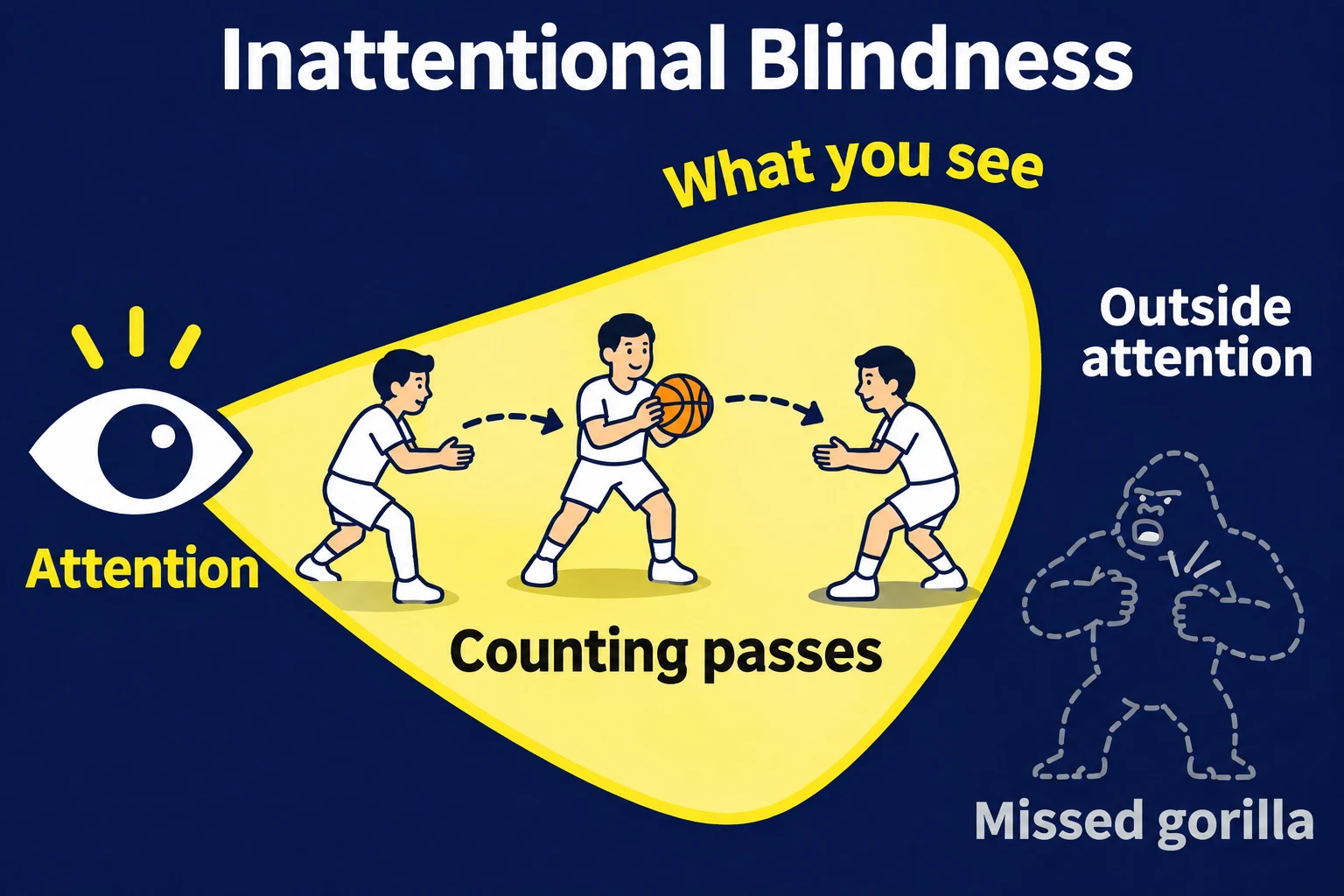
- Selective Attention: The ability to pick out and process only the stimuli needed for the task at hand.
- Perceptual Load: The harder the task and the more information there is, the less attention is left over, making unexpected objects easier to miss. This theory was developed by Nilli Lavie.
- Attentional Set: Once you decide what to look for, objects that do not share those features get filtered out. This is why the black gorilla was hard to see for people counting white shirts.
- Expectation: Objects we assume could not possibly be there are hard to notice even when they are clearly visible.
(1) Not a Problem of Eyesight
Even when your gaze lands on an object, you will not be aware of it if your attention is elsewhere. It is a matter of where attention is, not of the eyes.
(2) It Happens to Everyone
Neither experts nor beginners can fully escape inattentional blindness, because it is simply how a normal brain works.
(3) You Don’t Know What You Missed
Because what you missed leaves no trace in memory, people easily feel sure they saw everything without knowing what they overlooked.
Examples from Daily Life and Professional Settings

Inattentional blindness often shows up outside the lab as well. Especially when distracting tasks overlap, or in work that requires concentrating on finding one thing, a small miss can lead to serious consequences.
(1) Talking on the Phone While Driving
In driving simulator experiments by David Strayer’s team, people who drove while on the phone had trouble remembering even roadside billboards their eyes had landed on. The same was true for hands-free calls.
(2) Reading Medical Images
In 2013, Trafton Drew’s team inserted a picture of a gorilla into lung CT scans and asked 24 radiologists to look for lung nodules. Of them, 83% did not notice the gorilla.
(3) Walking While on the Phone
Ira Hyman’s team had a clown on a unicycle appear in a university square, and people walking while talking on their phones noticed the clown far less often than other pedestrians.
How to Live with Inattentional Blindness

Inattentional blindness cannot be eliminated entirely. Instead, we can accept that we may miss things and design our environments and habits so that important information does not slip outside our attention.
(1) One Thing at a Time
When driving or crossing the street, the surest approach is to stop talking on the phone and looking at screens. The more you divide your attention, the smaller the share each task receives.
(2) Extra Eyes and Checklists
Double checks and checklists in medicine and aviation are mechanisms that let another person or a procedure catch what one person’s attention missed.
(3) Designing for Visibility
Making important signals clearly different from their surroundings, such as warning lights, reflective vests, and sound alerts, can reduce the chance of missing them. However, too many signals can cause them to be ignored.
Inattentional blindness is the price the brain pays to avoid getting lost in a flood of information. People who know they cannot see everything tend to double-check their own certainty. The simple thought that “there may be something I did not see” is the first step toward understanding inattentional blindness.