Would you still feel like working if working hard never made life any better? Welfare programs help people with low incomes, but a poorly designed program can cut off support the moment earnings rise a little, leaving people worse off for working more. One program was built to solve this problem with a simple rule: the more you work, the more you receive. It is the ‘Earned Income Tax Credit’.
Simply put, the Earned Income Tax Credit means ‘a program that gives cash to households with low earnings in the form of a tax refund, designed so that the benefit grows as people work more.’ It is often called the EITC for short and was first introduced in the United States in 1975. South Korea laid its legal basis in the Restriction of Special Taxation Act in 2006 and paid its first earned income tax credits in 2009.
In this article, we will look in turn at why the Earned Income Tax Credit came about, how the benefit changes with income, whether it actually encouraged people to work, and what limitations the program still has.
A Tax That Helps People Who Work
An Idea to Avoid the Welfare Trap

The Earned Income Tax Credit began with a worry that existing welfare programs could actually discourage people from working.
(1) Support That Vanishes as Income Rises
When benefits go only to people whose income is below a certain threshold, earning a little more and crossing that line can mean losing the entire benefit. This situation, where working more leaves you with less money in hand, is called the ‘welfare trap’.
(2) The Idea of a Negative Income Tax
In his 1962 book ‘Capitalism and Freedom’, economist Milton Friedman proposed a ‘negative income tax’, under which people whose income falls below a certain level would receive money back from the tax system instead of paying tax. This idea of using the tax system to put money in the hands of low-income people became the foundation of the Earned Income Tax Credit.
(3) A Refund Only for Those Who Work
In 1975, the U.S. Congress refined this idea and introduced a refund paid only to low-income households with earned income. By making it unavailable to people who do not work, the program tied support and work together.
A Benefit That Grows with Work, Then Shrinks

The Earned Income Tax Credit benefit moves through three ranges depending on income. Drawn as a graph, it forms a trapezoid made of an uphill slope, a flat stretch and a downhill slope.
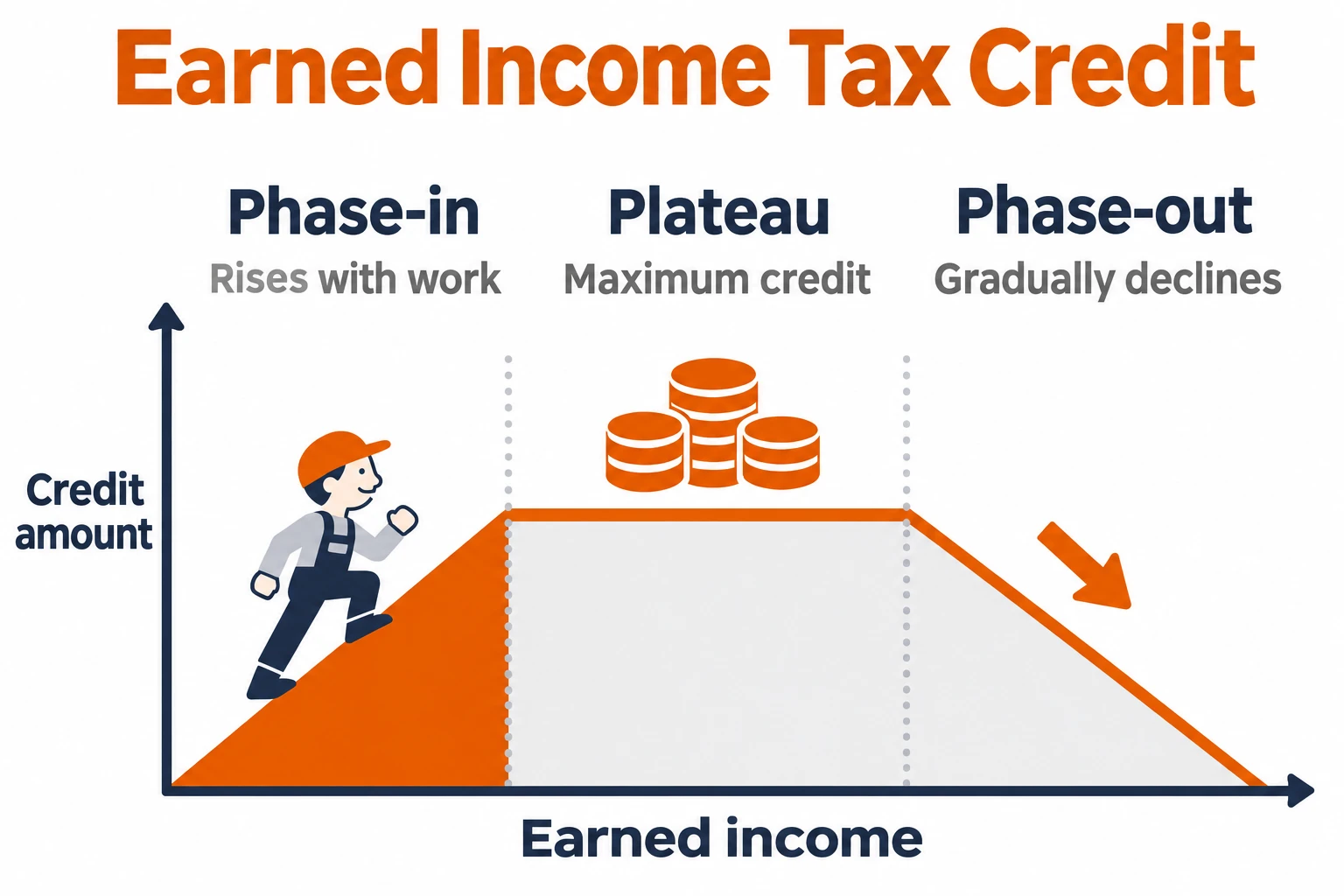
- Phase-in: When income is low, the benefit increases along with every additional amount earned. This is the range where working more brings a bigger gain.
- Plateau: The benefit has reached its maximum, so you receive the same amount even if your income rises a little.
- Phase-out: As income rises further, the benefit gradually decreases and reaches zero once income passes the threshold. Reducing it step by step rather than cutting it off at once avoids the welfare trap.
The size of the benefit and the boundaries of each range differ by household type. South Korea sets separate criteria for single-person, single-earner and dual-earner households, while the United States sets the maximum benefit according to the number of qualifying children. Since 2015, South Korea has also run a child tax credit for low-income households raising children.
Did It Really Make People Want to Work More?

Because the Earned Income Tax Credit was designed to send the signal that ‘working pays’, the most important question is whether people actually ended up working more.
(1) Changes Among Single Mothers
In a 1996 study, economists Nada Eissa and Jeffrey Liebman reported that after the U.S. expanded the program in 1986, the labor force participation rate of single mothers with children rose noticeably.
(2) The Power to Get People Started
Many studies have found that the Earned Income Tax Credit has a bigger effect on the decision of whether to start working at all than on the hours of people who already work. In other words, it is especially effective at drawing people who were not working into the labor market.
(3) The Challenge of the Phase-out Range
On the other hand, for people in the phase-out range, the benefit shrinks as income rises, which can weaken their reason to work more. This effect, predicted in theory, often turns out to be small in actual studies, but it is always weighed when designing the program.
Limitations of the Program

The Earned Income Tax Credit is a model that many countries look to, but running it has also revealed quite a few challenges.
(1) You Have to Apply to Receive It
In most cases, people must apply for the credit themselves. In South Korea, applications are made to the National Tax Service, and a long-standing problem is that some eligible people never apply because they do not know the program exists.
(2) Payments Made in Error
In the United States, critics have long pointed out that complex eligibility rules lead to a high rate of payments made in error, whether by mistake or fraud. It is difficult to identify eligible people accurately while keeping the process simple.
(3) No Help for Those Who Cannot Work
Because it requires earned income, the credit does not reach people who cannot work due to illness, disability or caregiving. For this reason, the Earned Income Tax Credit is run alongside other programs such as basic livelihood security, and other countries have similar programs, such as the United Kingdom’s Working Tax Credit.
The Earned Income Tax Credit is an attempt to turn welfare and work from forces that push each other apart into ones that move together. Just remembering that the benefit follows an uphill slope, a flat stretch and a downhill slope makes the principle easy to grasp. The simple idea that ‘working should make life better’ is the first step toward understanding the Earned Income Tax Credit.