
Particle physics is a scientific field that explores the universe's most fundamental constituents and the interactions between them. This discipline is essential to uncovering the universe's fundamental secrets and is regarded as one of the key driving forces behind advances in modern science and technology.
This material covers a broad range of topics, from the basic concepts of particle physics to modern research methods and tools, as well as applications of the field, and aims to examine the role particle physics plays in scientific research today.
What Is Particle Physics? Concepts and Basic Principles

What Is Particle Physics? Concepts and Basic Principles
Particle physics is the study of elementary particles, the smallest constituents of the universe, and the interactions between them. Particle physics began with scientists' efforts to understand the fundamental laws of nature and seeks answers to fundamental questions about the universe by combining quantum mechanics and relativity.
The central concept of particle physics is to divide matter into particles, the smallest units that cannot be broken down any further. Elementary particles include quarks and leptons, which are important constituents of matter. There are also force-carrying particles that mediate interactions between these particles; for example, the electromagnetic force is explained by photons, and the strong interaction by gluons. The essence of particle physics is to study how particles influence one another through these interactions in accordance with physical laws.
The Standard Model: The Foundational Theory of Particle Physics
The most important theory in particle physics is the Standard Model. This theory plays a central role in explaining elementary particles and the interactions between them. The Standard Model includes not only elementary particles such as quarks and leptons but also bosons, which mediate interactions between them. Representative bosons include photons, which mediate the electromagnetic force, and gluons, which mediate the strong interaction.
The Standard Model is an essential theory for explaining the electromagnetic force, the weak nuclear force, and the strong nuclear force, allowing us to understand how matter forms and interacts. However, it has the limitation of being unable to explain gravity. The Standard Model remains one of the most successful theories in modern physics and forms the foundation of particle physics.
The Higgs Boson: Uncovering the Mystery of Mass
One of the important discoveries in particle physics is the Higgs boson. The discovery of the Higgs boson in 2012 at the European particle physics laboratory (CERN) provided an answer to how the mass of matter arises within the Standard Model. The Higgs boson plays a role in giving matter mass, and this was an important clue to solving a mystery that had long remained unresolved in particle physics. This discovery brought major changes to particle physics research and opened the way for further theoretical advances and experimental verification.
Cosmological Applications of Particle Physics
Particle physics goes beyond simply studying microscopic particles and plays an essential role in understanding the formation and evolution of the universe. Concepts from particle physics are applied to testing and explaining cosmological models, including the Big Bang theory. By understanding elementary particles and their interactions, we can explain the state of the early universe and its subsequent evolution more clearly. Findings from particle physics research provide important clues to uncovering the origin and structure of the universe.
The Impact of Particle Physics on Technology and Society
Particle physics goes beyond purely theoretical research and also has an enormous impact on modern science and technology. Advanced equipment such as particle accelerators has a wide range of applications in everyday life, including radiation therapy in medicine and uses in materials engineering. Particle physics research also contributes to developing new energy resources, which can play an important role in sustainable energy development.
Particle physics research plays an important role in expanding the boundaries of science and technology and presenting new possibilities for the future. In this way, particle physics is a key scientific field that helps us understand the fundamental principles of the universe and nature and, on that basis, provides practical benefits to human society.
The Constituents of the Universe: The Role of Elementary Particles
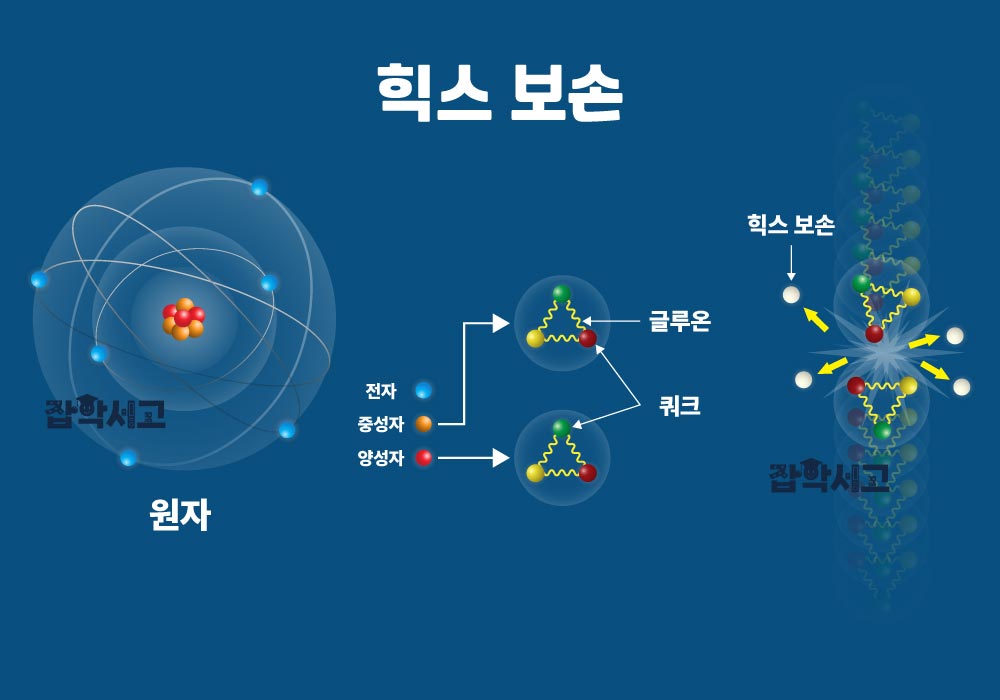
The universe is fundamentally made up of various particles, which are the smallest units that form matter and energy. These elementary particles are broadly divided into two types: fermions and bosons. Fermions are particles that make up matter, while bosons act as particles that transmit forces.
Fermions: The Particles That Make Up Matter
Fermions are further divided into quarks and leptons. Quarks are particles that make up hadrons, such as protons and neutrons, and form most of the matter we know of in the universe. For example, a proton consists of two up quarks and one down quark. These quarks combine to form larger particles, and these particles come together to make up atoms.
Unlike quarks, leptons are a group of particles that do not form hadrons; representative examples include electrons, muons, tau particles, and their neutrinos. In particular, electrons are bound to the nucleus within an atom by the electromagnetic force and are important particles that make up most of the matter we commonly encounter. Neutrinos interact very little with matter and are therefore extremely difficult to detect, but studying them provides important clues to understanding the early state and evolution of the universe.
Bosons: The Particles That Transmit Forces
Bosons fundamentally serve to transmit forces. For example, photons transmit the electromagnetic force, which maintains the bond between electrons and atomic nuclei. W and Z bosons mediate the weak interaction, a force that explains important phenomena such as radioactive decay. Gluons also transmit the strong interaction, causing protons and neutrons to bind together to form atomic nuclei.
In particular, the Higgs boson is known to play a role in giving particles mass. The Higgs particle was discovered at CERN in 2012, further establishing the scientific explanation of how particles acquire mass.
Interactions Between Elementary Particles and the Structure of the Universe
Interactions between elementary particles are important factors that determine the structure and dynamics of the universe. For example, the strong interaction binds together the protons and neutrons that make up an atomic nucleus, allowing the nucleus to exist stably. The weak interaction explains phenomena such as radioactive decay, a process closely related to nuclear transmutation and energy release in nature.
The electromagnetic force maintains the bond between electrons and atomic nuclei and is the force that forms almost all the structures of matter we encounter in everyday life. In this way, various force-carrying particles interact to form matter and create the laws that shape the universe.
The Importance of Research on Neutrinos and Dark Matter
Research on elementary particles goes beyond simply explaining the material structure of the universe and plays an important role in understanding its fundamental properties. For example, by studying the mass and characteristics of neutrinos, we can explain the state of the early universe and its evolution more clearly. Neutrinos are very difficult to detect because of their properties, but their influence on the universe is just as significant.
Particle physics also plays an important role in uncovering the nature of dark matter and dark energy. Dark matter accounts for most of the universe, but we cannot observe it directly. Evidence of its existence can be confirmed indirectly through gravitational effects, and particle physics research provides important clues in this process.
The Key to Understanding the Universe
In conclusion, elementary particles are essential to understanding the structure of the universe and how it works. By studying the interactions and characteristics of these particles, we can gain deeper scientific insights into the universe and achieve various advances in science and technology. The development of particle physics provides an important academic foundation that helps us understand the nature of the universe more clearly.
Research Methods and Tools in Particle Physics
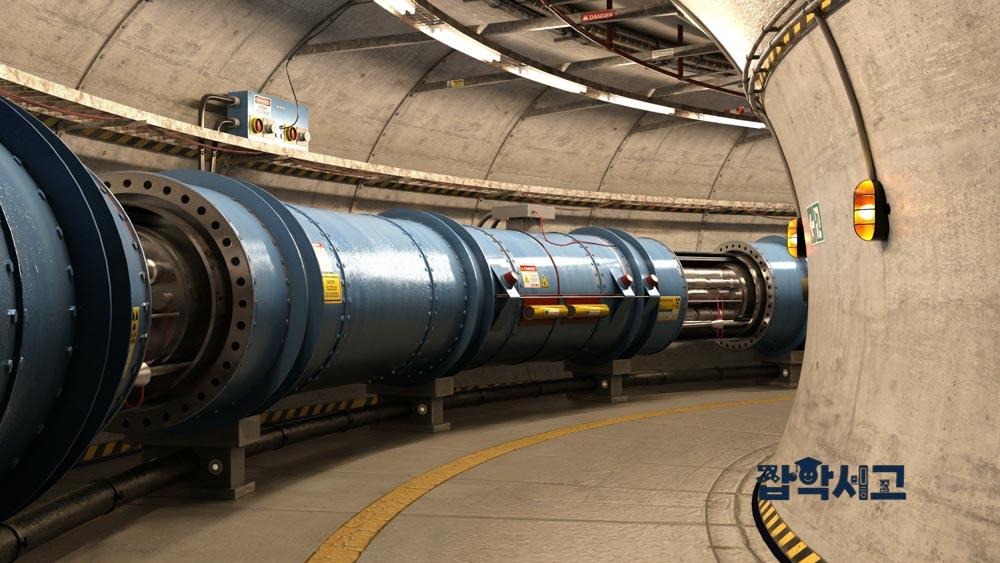
The Core Tool of Particle Physics Research: Particle Accelerators
Particle physics research is primarily conducted using large particle accelerators. A particle accelerator is a device that accelerates particles to high energies, causes them to collide, and observes the various phenomena that result. By accelerating particles and then analyzing their collisions, researchers can study the properties of particles, how they interact, and new physical phenomena.
The most prominent particle accelerator is the Large Hadron Collider (LHC) at the European particle physics laboratory (CERN). The LHC is used to discover new elementary particles and interactions by accelerating protons to nearly the speed of light and then colliding them. The discovery of the Higgs boson at the LHC is also one of the important achievements made possible by this accelerator.
Particle Detectors: Tools for Analyzing the Results of Collisions
When collisions occur in a particle accelerator, particle detectors play an important role in analyzing the results. Particle detectors precisely measure the trajectories, energies, momenta, and other properties of particles produced in collisions. By analyzing these data, researchers can identify the characteristics of particles and search for new particles or interactions beyond the Standard Model.
Representative particle detectors include ATLAS and CMS, which are installed at the LHC. These two detectors are jointly operated by scientists from around the world and make important contributions to analyzing particle motion and energy by collecting vast amounts of particle data. In this way, detectors are devices that play a central role in particle collision experiments.
Specialized Detectors for Neutrino Research
Neutrinos are one of the special subjects of research in particle physics and interact very weakly with matter. For this reason, studying neutrinos requires highly sensitive specialized detectors. Because neutrinos interact very little with other particles, detecting them requires specially designed equipment and very large detectors.
Representative neutrino detectors include Japan's Super-Kamiokande and the United States' IceCube. Super-Kamiokande is installed deep underground and uses a method that detects the faint light produced when neutrinos interact weakly with matter. IceCube is an enormous detector installed in the ice of Antarctica and plays an important role in studying the characteristics of neutrinos and how they interact with matter.
The Role of Computer Simulations and Data Analysis
The data generated in particle physics research are extremely vast and complex. Computer simulations and data analysis techniques are essential to analyzing them effectively. High-performance computing is indispensable in organizing and analyzing the various data produced in particle collision experiments, enabling researchers to test theoretical models and make new predictions.
In particular, Monte Carlo simulation is a representative method used to analyze data obtained from particle collision experiments and predict results. By predicting the various possibilities that may arise when particles collide, this simulation serves as an important tool for interpreting experimental results and comparing them with theory.
Particle Physics Research Driven by Advanced Technology
Particle physics research is a field that requires highly complex and precise equipment and technology. Advanced tools such as particle accelerators, particle detectors, and neutrino detectors play essential roles in particle physics research. Computer simulations and data analysis techniques also make important contributions to precisely analyzing the vast amounts of data obtained from experiments.
Applications of Particle Physics: Expanding Our Understanding of the Universe
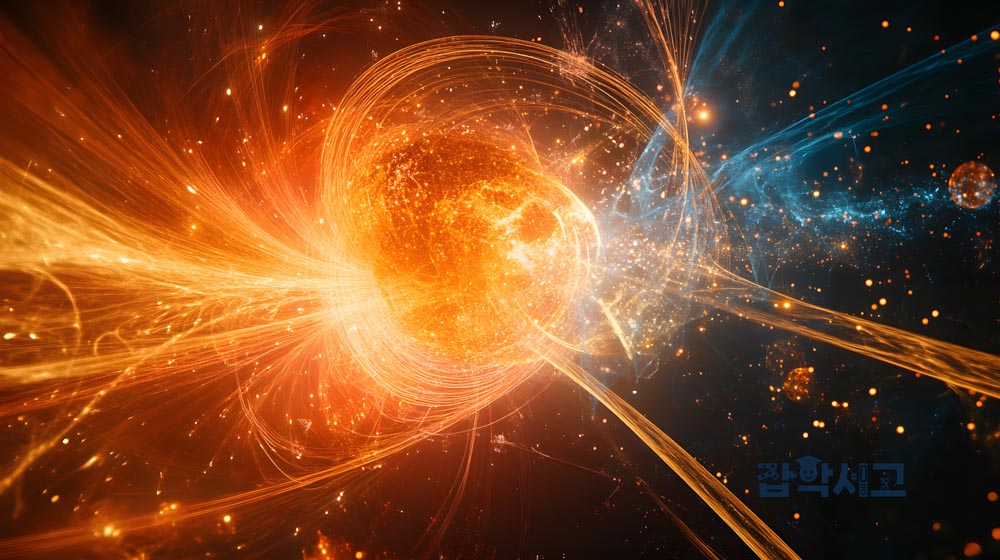
Applications of Particle Physics: A Deeper Understanding of the Universe
Particle physics plays a central role in expanding our fundamental understanding of the universe. By studying elementary particles and the interactions between them, we can gain a deeper understanding of the origin, evolution, and present structure of the universe. This research enables various scientific and technological applications and provides an important foundation for driving innovation in many fields.
The Big Bang Theory and Understanding the Early Universe
Particle physics plays an important role in testing and expanding the Big Bang theory. The Big Bang theory states that approximately 137 hundred million years ago, the universe exploded from a single small point and began to expand. Through particle physics research, we can understand the state of the early universe and its subsequent evolution more clearly. In particular, by analyzing the conditions of the early universe recreated through particle collision experiments, we can provide experimental evidence about the moment of the universe's birth. This makes a major contribution to cosmological research and helps us obtain important information about how the universe formed and has expanded.
Research on Dark Matter and Dark Energy
Most of what makes up the universe consists of dark matter and dark energy, but their nature remains unknown. Although we cannot observe dark matter directly, we can confirm its existence indirectly through forces such as gravity. Particle physics makes important contributions to understanding dark matter and dark energy. Particle physics research can discover the particles that make up dark matter or provide important clues to uncovering the properties of dark energy. It is an essential research field for understanding the unknown matter and energy that account for approximately 95% of the universe.
Neutrino Research and Analysis of the Internal Structure of Celestial Bodies
Neutrinos are particles with a very high penetrating ability and the characteristic of interacting very little with matter. These neutrinos pass through the interiors of celestial bodies and provide important information. For example, by studying the movement of neutrinos produced inside the Sun or supernovae, we can better understand the internal structure of these celestial bodies and how they operate. Neutrino detectors detect these particles and provide important data for astrophysics and cosmology. This allows researchers to analyze the Sun's energy production mechanism and the detailed processes of supernova explosions.
A Driving Force Behind Technological Innovation: Applications of Particle Physics
Particle physics research is an important driving force behind technological innovation. For example, particle accelerator and detector technologies are widely used in medical imaging equipment and radiation therapy. These technologies have driven advances in radiation therapy equipment used to treat cancer and contribute to improving the performance of high-resolution medical imaging equipment. High-performance computing and data analysis techniques developed through particle physics research also play important roles in various industries and scientific research. They are applied in many fields, including big data processing, artificial intelligence, and weather forecasting, and contribute to accelerating technological progress.
A Forum for International Cooperation: The Global Scientific Community
Particle physics provides an important scientific forum for promoting international cooperation. Large research laboratories such as CERN are places where scientists from many countries around the world collaborate on research. Through this international collaborative research, we can share scientific knowledge and make important contributions to solving problems on a global scale. Particle physics research goes beyond scientific discoveries to strengthen cooperation between countries and provides an international platform for advances in science and technology.
New Insights into the Universe
Particle physics plays an essential role in expanding our understanding of the universe. Through it, we can obtain more information about the origin and constituents of the universe, as well as unknown phenomena such as dark matter. Particle physics research also serves as an important driving force behind advances in science and technology, enabling innovative applications in various fields, including medicine, industry, and computing. Particle physics will continue to play an important role in uncovering the fundamental secrets of the universe.
Particle physics is an important research field for seeking answers to fundamental questions about the universe. By exploring elementary particles and their interactions, we can understand the origin and evolution of the universe, as well as its present structure, more clearly.
This research enables scientific and technological applications, which make major contributions to our society and technological progress. We hope that particle physics research will continue to advance and reveal more of the universe's unknown secrets.