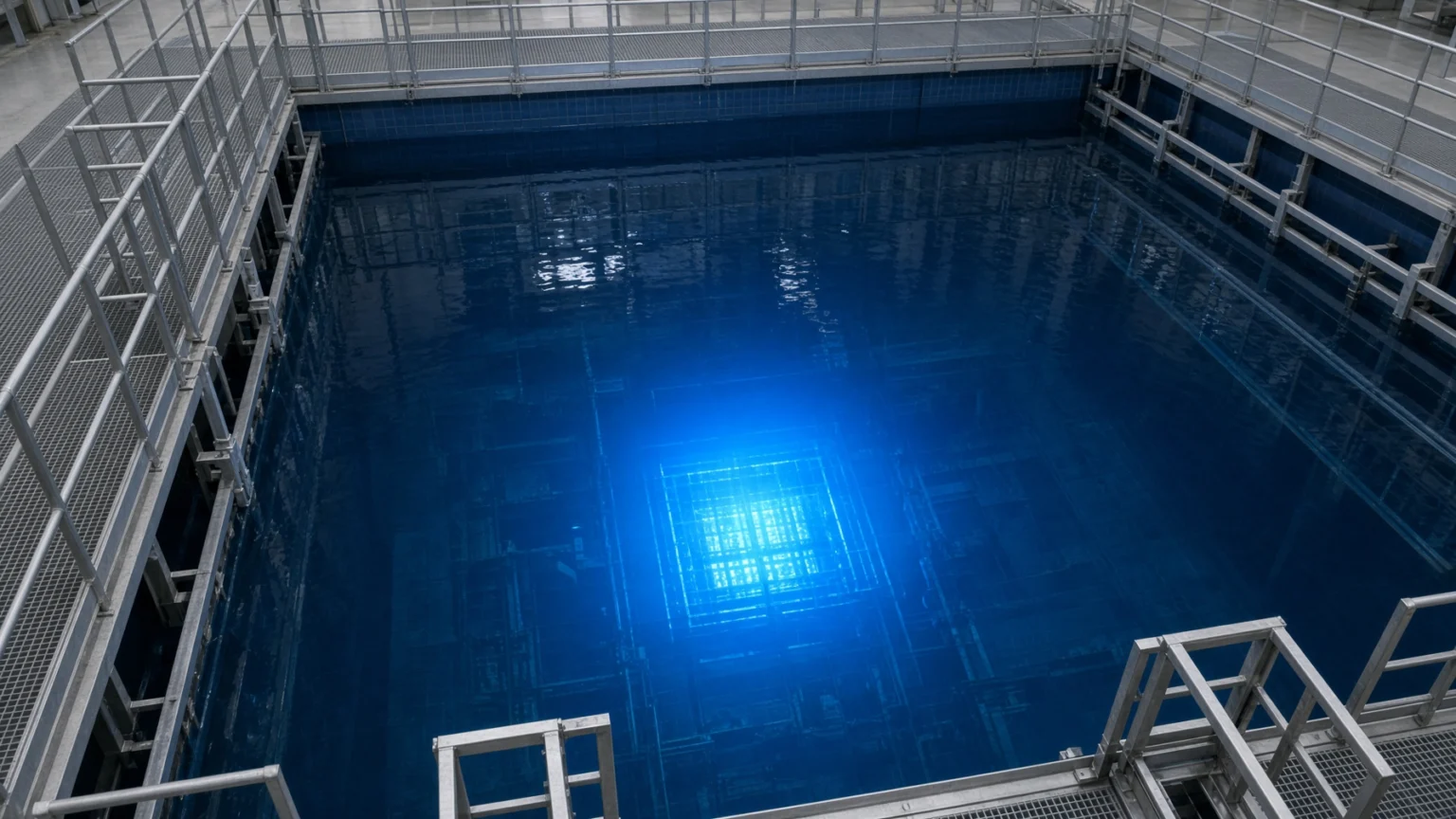
Look at a photo of a research pool in which a nuclear reactor sits underwater, and you can see the whole pool glowing with a mysterious blue light. No lamps have been switched on and no dye has been added to the water, yet the area around the reactor core is tinged blue as if it were giving off light on its own.
This light is “Cherenkov Radiation.” Cherenkov radiation is the light that spreads out in the shape of a cone when a charged particle moves through a material such as water or glass faster than light travels in that material.
In this article, we will look in turn at how Cherenkov radiation was discovered, the principle by which the light forms, why it appears blue, and the many ways this light is used to look into the universe and matter.
The Light of Particles That Outrun Light in Matter
How Cherenkov Radiation Came to Light
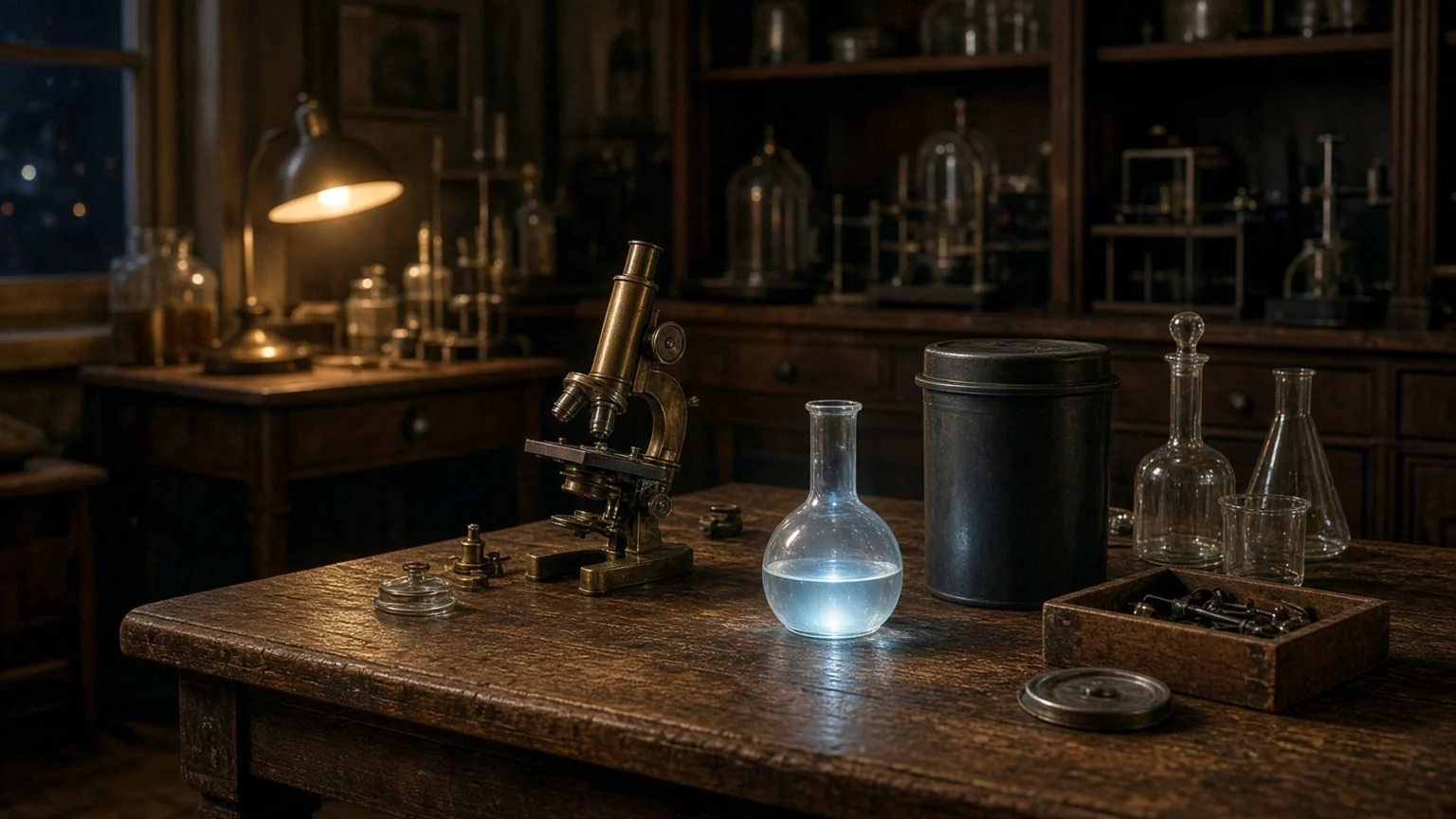
Several people glimpsed Cherenkov radiation first, but its true nature was revealed only thanks to the persistent experiments of one young researcher.
(1) Earlier Fleeting Observations
The British physicist Oliver Heaviside put forward a theory between 1888 and 1889 that such light could occur. In 1910, Marie Curie saw a faint blue light in a concentrated radium solution, but she did not investigate its cause further.
(2) Cherenkov’s Experiments
In 1934, Pavel Cherenkov of the Lebedev Institute in the Soviet Union discovered a faint blue light while observing liquids exposed to radioactive material under his supervisor, Sergey Vavilov. He confirmed that this light came out biased toward a particular direction and concluded that it was a phenomenon different from ordinary fluorescence. For this reason, the light is also called Vavilov–Cherenkov radiation.
(3) The Theory and the Nobel Prize
In 1937, his fellow physicists Igor Tamm and Ilya Frank explained how this light forms based on the special theory of relativity. For this achievement, the three shared the 1958 Nobel Prize in Physics.
What “Faster Than Light” Means
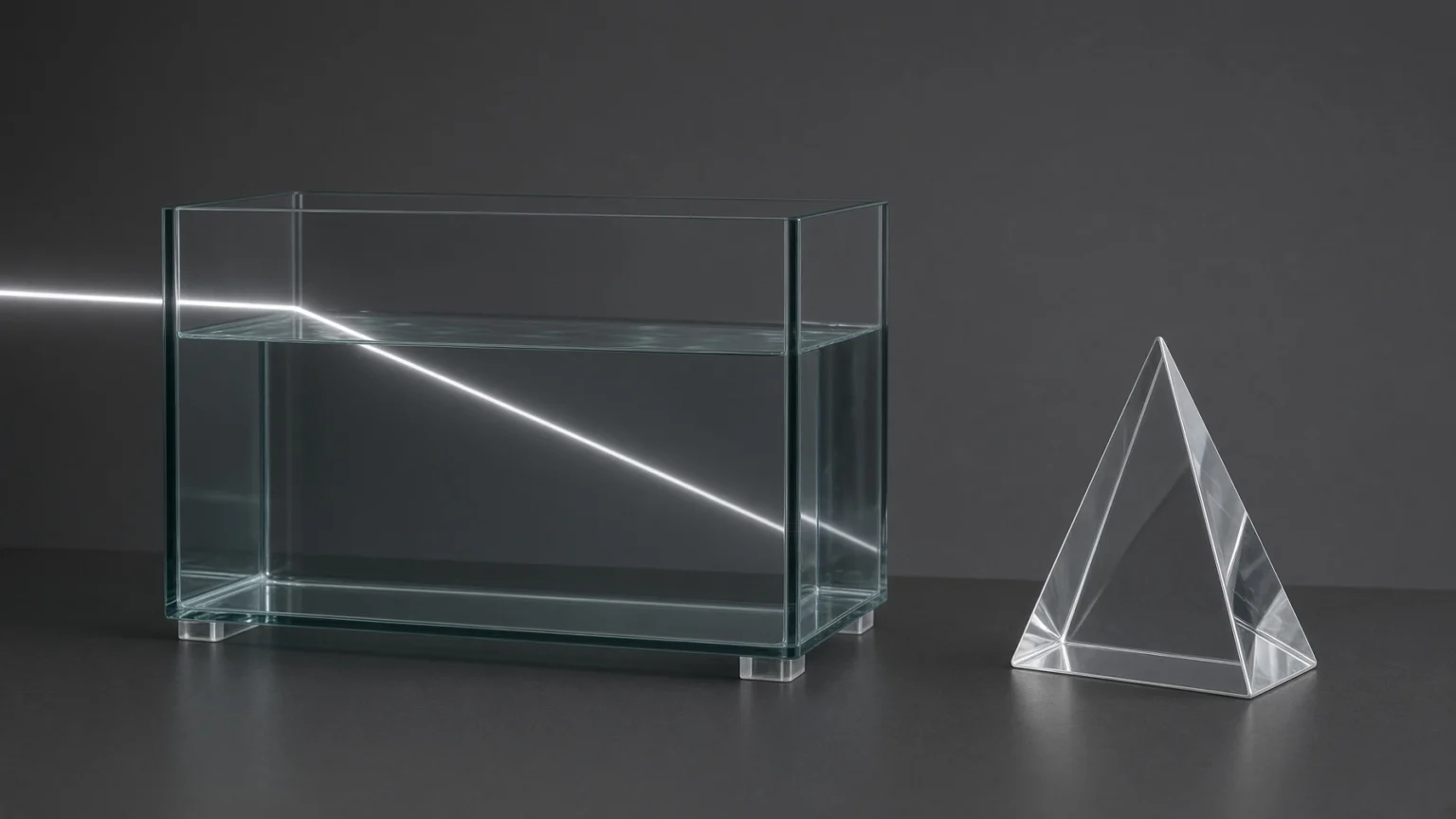
According to Einstein’s theory of relativity, no object can exceed the speed of light in a vacuum, about 300,000 km per second. Yet Cherenkov radiation is said to occur when a particle is faster than light, which at first sounds like a contradiction.
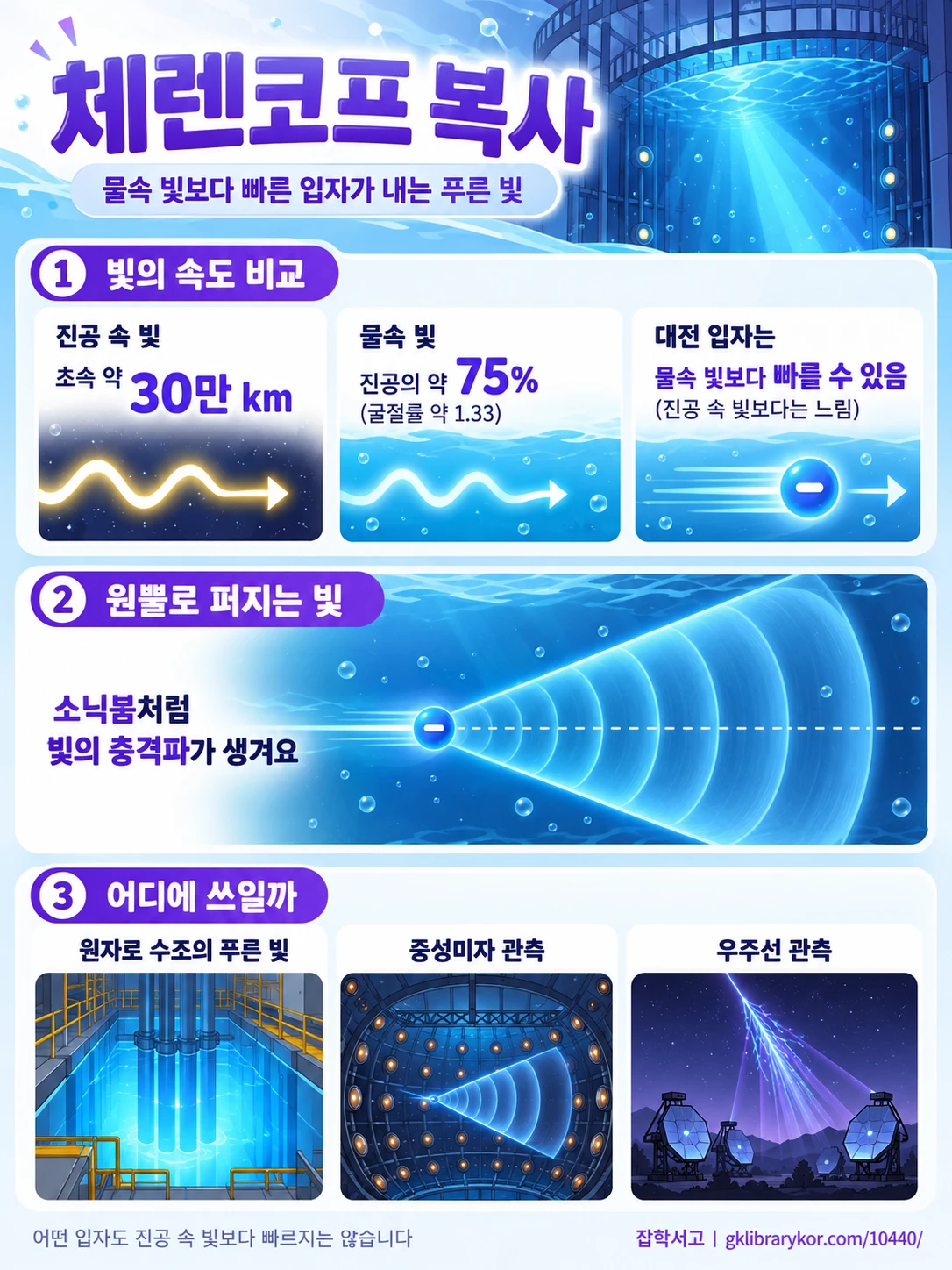
- Light in a vacuum (Speed of Light in Vacuum): About 300,000 km per second, the speed limit of the universe that no particle can exceed.
- Light in matter (Phase Velocity of Light): Light slows down when it passes through matter, and in water it drops to about 75% of its speed in a vacuum.
- Refractive index (Refractive Index): A value that shows how much light slows down in a material; for water it is about 1.33.
The key point is that the reference is not a vacuum but the material. Electrons flying out of a nuclear reactor or a particle accelerator are slower than light in a vacuum, but they can travel faster than light in water. Only then does Cherenkov radiation occur.
How the Light Spreads Out in a Cone

Cherenkov radiation forms in a way very similar to the sonic boom made by a supersonic aircraft or the V-shaped wake that spreads out behind a fast-moving boat.
(1) Light From Disturbed Matter
When a charged particle passes by, the surrounding molecules are briefly disturbed and give off faint light as they return to their original state. When the particle is slow, this light gets out of step and cancels out, so it is barely visible.
(2) Wavefronts That Overlap and Grow
If the particle is faster than light in the material, it moves ahead and emits the next light before the earlier light has had time to spread out. As a result, the wavefronts of light line up and reinforce one another, creating a cone of light with the particle at its tip.
(3) An Angle That Reveals Speed
The angle at which the cone opens is determined by the particle’s speed and the material’s refractive index. The faster the particle, the wider the cone opens, so measuring the angle lets you work backward to find the particle’s speed.
Why It Looks Blue
Cherenkov radiation produces more light at shorter wavelengths. That is why, among the light visible to our eyes, the short-wavelength blue end stands out, and a great deal of invisible ultraviolet light is mixed in as well.
Light That Lets Us Look Into Space and the Body
Cherenkov radiation is an excellent signal for catching invisible particles. Just by reading the direction and intensity of the light, you can tell where a particle came from and how fast it was going.
(1) Observing Neutrinos in a Giant Water Tank
Super-Kamiokande, located about 1,000m underground in Japan’s Kamioka Mine, has about 11,000 light detectors attached to the walls of a tank filled with 50,000 tons of pure water. It catches the Cherenkov light given off by particles knocked out when neutrinos collide with the water, and its observations revealed neutrino oscillations, leading to the 2015 Nobel Prize in Physics.
(2) Telescopes That Use Antarctic Ice and the Sky
IceCube in Antarctica buries detectors in one cubic kilometer of ice to search for neutrinos using the same principle. Ground-based telescopes that catch the extremely brief Cherenkov light produced when gamma rays from space strike the atmosphere are also operating around the world.
(3) Nuclear Reactors and Medicine
In pools holding spent nuclear fuel, the intensity of the blue glow is sometimes used to check whether the fuel is properly in place. The flashes of light that patients undergoing radiation therapy said they saw before their eyes were also explained when a 2019 study confirmed Cherenkov light produced in the vitreous body inside the eye.
Cherenkov radiation is not a phenomenon that defies the law that nothing can be faster than light, but a natural result of light slowed down in matter meeting particles that move faster than it. A single beam of blue light in a reactor pool can even bring news of particles that came from the universe on the other side of the Earth.
Knowing that even the familiar speed of light has a stage that serves as its reference: that is the first step toward understanding Cherenkov radiation.