At an auto repair shop, a passenger car weighing more than a ton glides up on a lift. A light press of the toe on the brake pedal stops a fast-moving car, and an excavator’s arm lifts a huge boulder with ease. Behind all of these scenes lies a simple principle set down by a 17th-century French scholar: “Pascal’s Principle.”
Put simply, Pascal’s principle is the law that “when pressure is added at one point in a fluid at rest inside a sealed container, that pressure is transmitted undiminished and equally throughout the entire fluid.” Because it is the basic principle behind hydraulic devices that turn a small force into a large one, countless machines today rely on it to move.
In this article, we will look in turn at the concept and origins of Pascal’s principle, how to calculate the increase in force, the question of whether anything is lost when force is multiplied, and examples of its use in everyday life.
Pascal’s Principle: Multiplying Force by Transmitting Pressure
What Is Pascal’s Principle?

The person who formulated this principle was Blaise Pascal, a French mathematician, physicist, and philosopher. Pascal completed a treatise on the equilibrium of fluids around 1653, and it was published in 1663, after his death. Today the international unit of pressure, the pascal (Pa), is also named after him.
An experiment often introduced along with Pascal’s name is “Pascal’s Barrel.” The story goes that a long, thin tube was set upright on top of a wooden barrel filled with water and sealed, and as water was poured little by little into the tube, the barrel burst from the pressure of the rising water column even though the amount of water was small. However, this experiment appears nowhere in Pascal’s own writings, so it is most likely an anecdote added in 19th-century French educational materials. Even so, it shows well that pressure depends on height and transmission rather than on the amount of water, so it still appears often in textbooks.
The core of the principle can be summed up in three points.
(1) A confined fluid
The fluid must be trapped inside the container with nowhere to leak out.
(2) Undiminished transmission
Pressure added at one point is transmitted to every point in the fluid without weakening.
(3) Force perpendicular to the walls
The transmitted pressure pushes on the container walls in the perpendicular direction.
Think of a tube of toothpaste. When you squeeze the end of the tube, pressure reaches not just the spot you pressed but all the way to the opening, pushing the toothpaste out.
How a Small Force Becomes a Large One
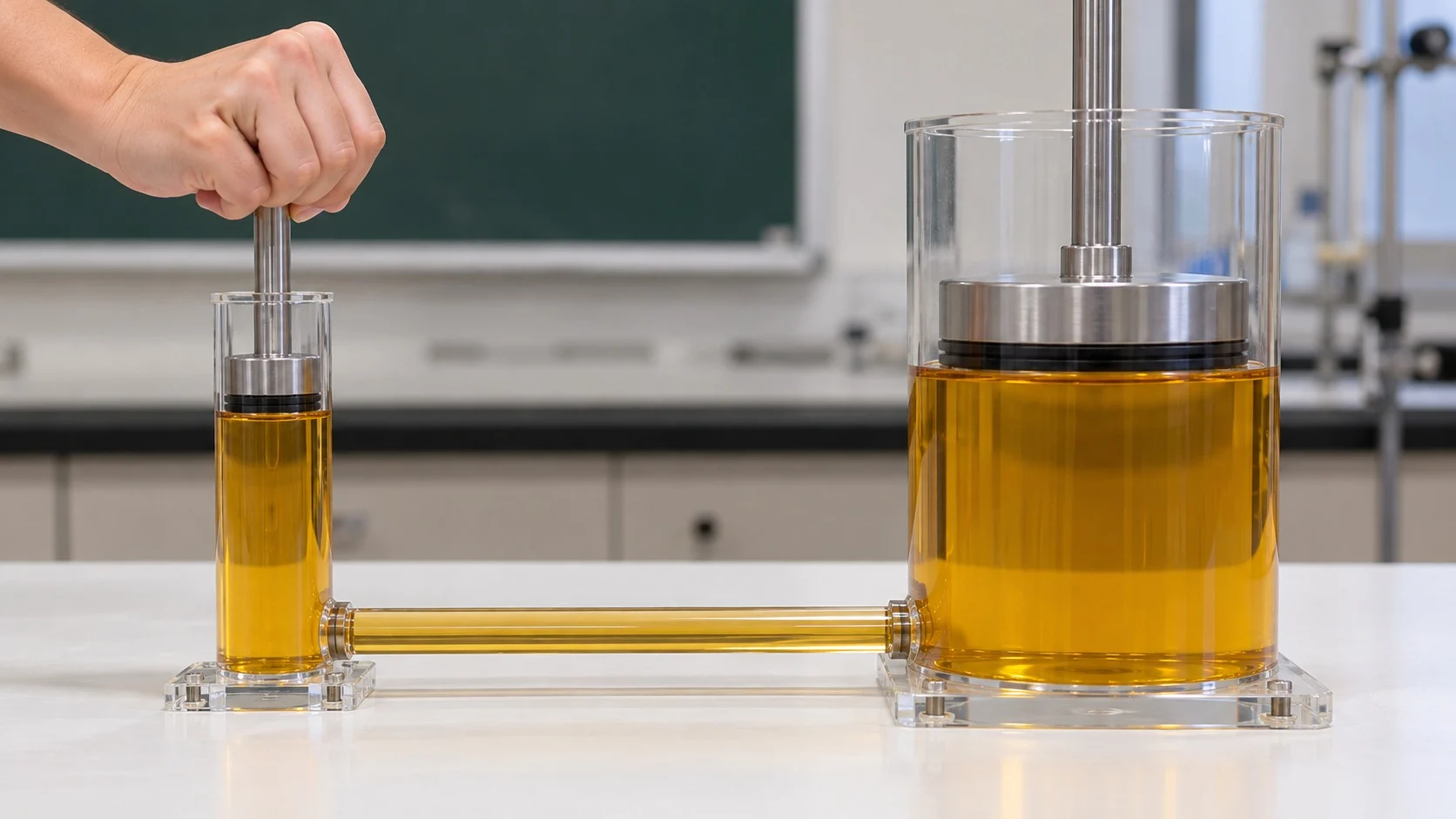
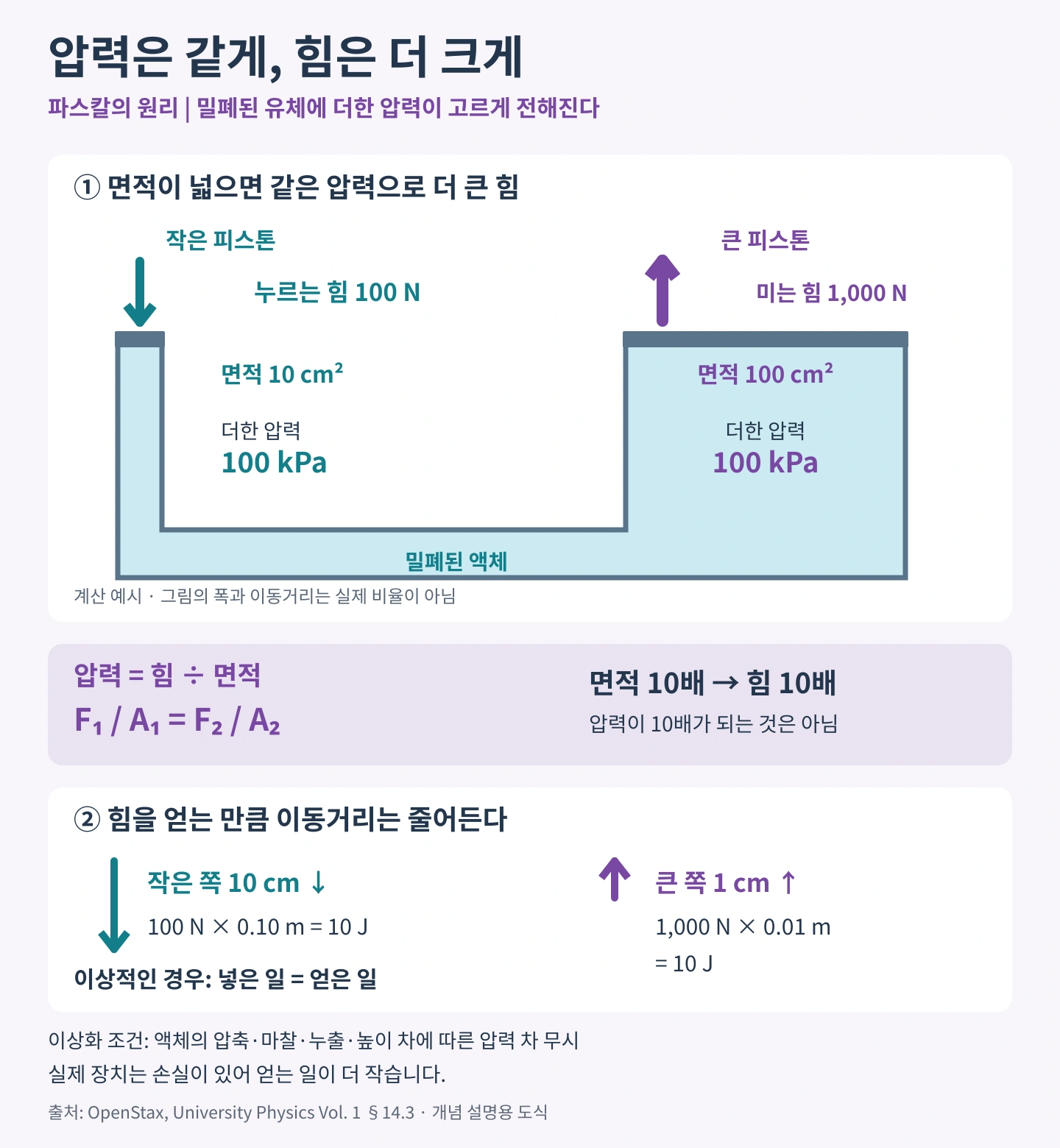
Pressure is force divided by area (pressure = force ÷ area). Imagine connecting two cylinders of different widths with a tube, filling them with oil, and fitting a piston into each. According to Pascal’s principle, the pressure on both pistons is the same, so the following holds.
- Basic relationship (Force Ratio): F1 ÷ A1 = F2 ÷ A2, so the force produced by the large piston is larger than the force applied to the small piston by the ratio of the two areas.
- Numerical example (Example): If the large piston’s area is 50 times that of the small piston, pressing the small one with 1 newton raises the large one with a force of 50 newtons.
In theory, simply increasing the ratio of the areas lets you increase the force as much as you like. The hydraulic jack (Hydraulic Jack), which lets a single person lift a car, comes straight from this calculation.
Does Force Come for Free?

A 50-fold increase in force may look like magic, but it does not break the law of conservation of energy. Instead, the price is paid in distance moved. In the example above, if you press the small piston down 100 centimeters, the displaced oil spreads out in the wide cylinder, so the large piston rises only 2 centimeters, one-fiftieth as far.
In the end, “force in × distance moved” equals “force out × distance moved.” It is the same logic as a lever that lifts a heavy stone with a long bar. That is why lifting a car with a hydraulic jack requires working the handle over and over.
Another point to remember is why oil is used as the fluid. Liquids barely shrink in volume when pressed, so they pass the pressure they receive straight to the other side. Gases, on the other hand, compress easily when pressed, and part of the force goes into reducing their volume, so devices that must transmit force precisely are mostly filled with oil.
This principle assumes that the fluid is not moving. In real devices, friction in the pipes and small oil leaks cause some losses, and if air gets mixed in, the air is compressed and pressure is not transmitted properly. This is also why air is bled out of the fluid when brakes are serviced.
Pascal’s Principle in Everyday Life

Pascal’s principle is at work all around us. Typical examples include the following.
- Car brakes (Hydraulic Brake): The force of pressing the pedal is transmitted evenly through the brake fluid to all four wheels, where wide pistons multiply that force to stop the car.
- Hydraulic press (Hydraulic Press): A device patented in 1795 by the English inventor Joseph Bramah, widely used in factories that press and stamp metal into shape.
- Construction machinery (Construction Machinery): Excavators and cranes lift heavy soil and materials with hydraulic cylinders.
- Repair shop lift (Car Lift): Compressed air pushes on oil, and the oil in turn pushes a large piston to lift the car.
Even our bodies follow a similar principle. When blood pressure is measured at a hospital, air is pumped into a cuff wrapped around the arm to raise its pressure, and that pressure is transmitted to the blood vessels inside the arm, briefly stopping blood flow. Slowly releasing the cuff and reading the pressure at the moment blood starts flowing again is the basic method of measuring blood pressure.
Pascal’s principle starts from a simple sentence: “a confined fluid distributes the pressure it receives evenly.” Yet this one sentence turns a person’s small force into a large force that moves cars and boulders, and it has become a solid foundation of modern mechanical engineering.
Of course, nature’s rule that you must give up distance in exchange for force does not change. Understanding the invisible flow of pressure and calculating its price as well: that is the first step in the technology of handling the power of fluids.