Have you ever shipped a single pillow overseas in a big box? On the scale it weighs less than 2kg, yet the weight printed on the shipping label is well over 10kg. Nobody made a mistake. Carriers count not only how heavy a parcel is but also how much space the box takes up, converting that space into weight. The value obtained by turning size into weight is called ‘dimensional weight.’
In simple terms, dimensional weight means ‘a virtual weight obtained by multiplying a parcel’s length, width and height and dividing the volume by a set number.’ In the industry it is also called ‘DIM weight’ from the first letters of the English term. Carriers charge based on whichever is larger, the actual weight or the dimensional weight, and this value is called the ‘chargeable weight.’
This article looks at why dimensional weight became necessary, how it is calculated, how it differs for ships and trucks, and what this calculation is changing today.
Even Empty Space in a Box Has a Price
Why did dimensional weight become necessary?

The cargo hold of an airplane or the bed of a truck has a weight limit, but very often the space fills up first. Load nothing but light, bulky items like cotton quilts, and you can’t fit anything more even though you are far below the weight limit.
If carriers charged by weight alone, such parcels would take up lots of room yet travel very cheaply. Either the carrier would lose money, or the cost would be passed on to people sending small, heavy parcels.
(1) Space fills before weight does
A kilogram of steel balls and a kilogram of feathers weigh the same, but they take up completely different amounts of room. What a vehicle really sells is not just weight but also ‘space.’
(2) A rule that turns space into weight
So the industry created a rule that counts a certain volume as a certain weight. This lets light, bulky parcels and small, heavy ones be compared on the same scale.
(3) A rule that spread to parcels
The method, first used mainly for air cargo, spread to small packages and parcel delivery. In the United States, FedEx and UPS began applying dimensional weight to all ground parcels from 2015, a change that greatly altered how online sellers pack their goods.
How dimensional weight is calculated

The calculation is simpler than you might think. Measure the box’s length, width and height in centimeters, multiply them, and divide by a number set by the carrier. This divisor is commonly called the ‘dimensional factor.’
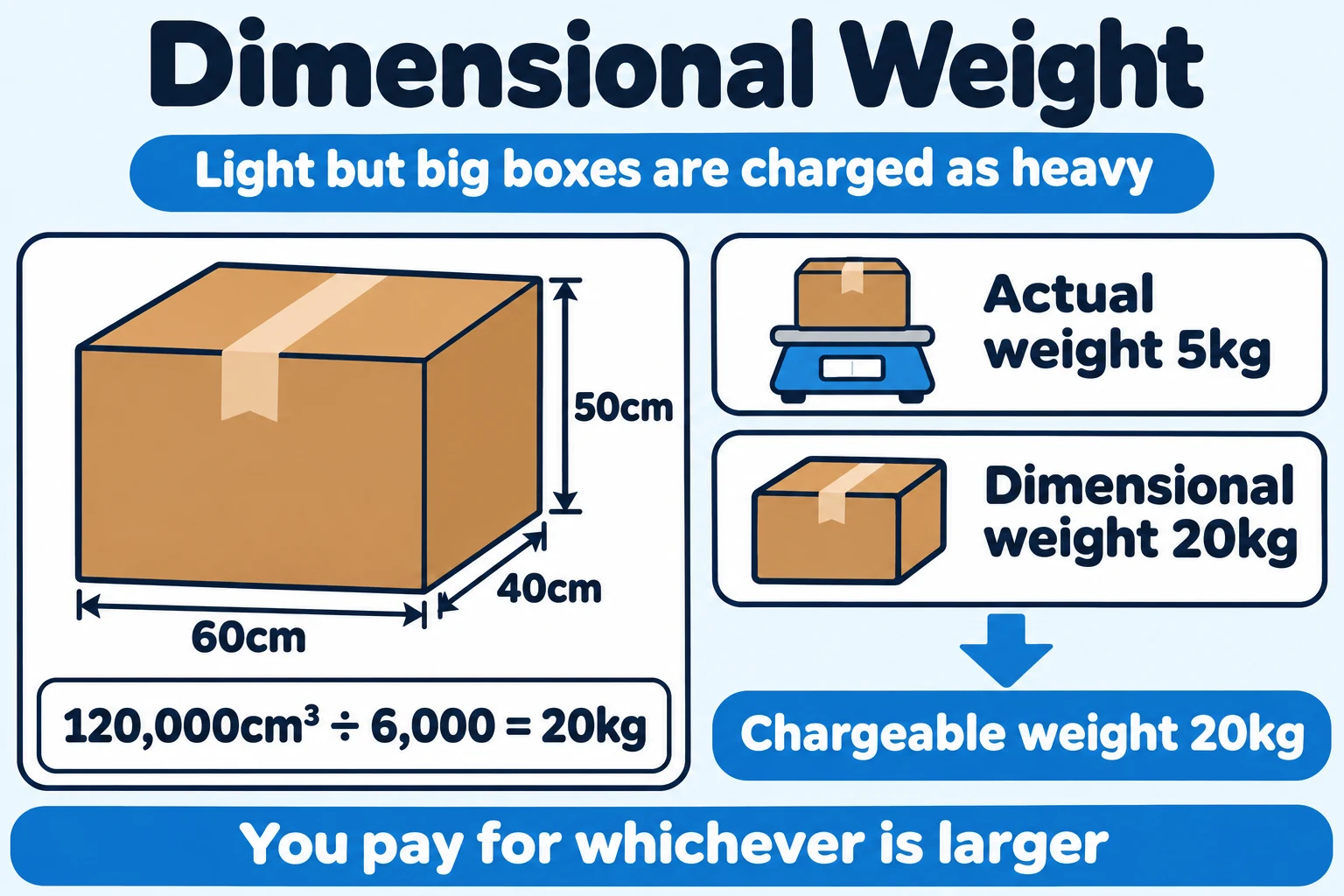
- Dimensional Factor: The number used to divide volume to convert it into weight. International air cargo commonly uses 6,000, while international express carriers often use 5,000. The smaller the number, the larger the dimensional weight of the same box.
- Actual Weight: The weight shown when the parcel is put on a scale. For small, heavy parcels this value is usually larger than the dimensional weight.
- Chargeable Weight: The larger of the actual weight and the dimensional weight. Shipping charges are calculated from this value.
For example, a box measuring 60cm long, 40cm wide and 50cm high has a volume of 120,000cm³. Dividing that by 6,000 gives a dimensional weight of 20kg. Even if what’s inside weighs only 5kg, the charge is based on 20kg. On the other hand, if the same box is packed full of books and weighs 30kg, this time the actual weight of 30kg becomes the chargeable weight.
How is it different for ships and trucks?
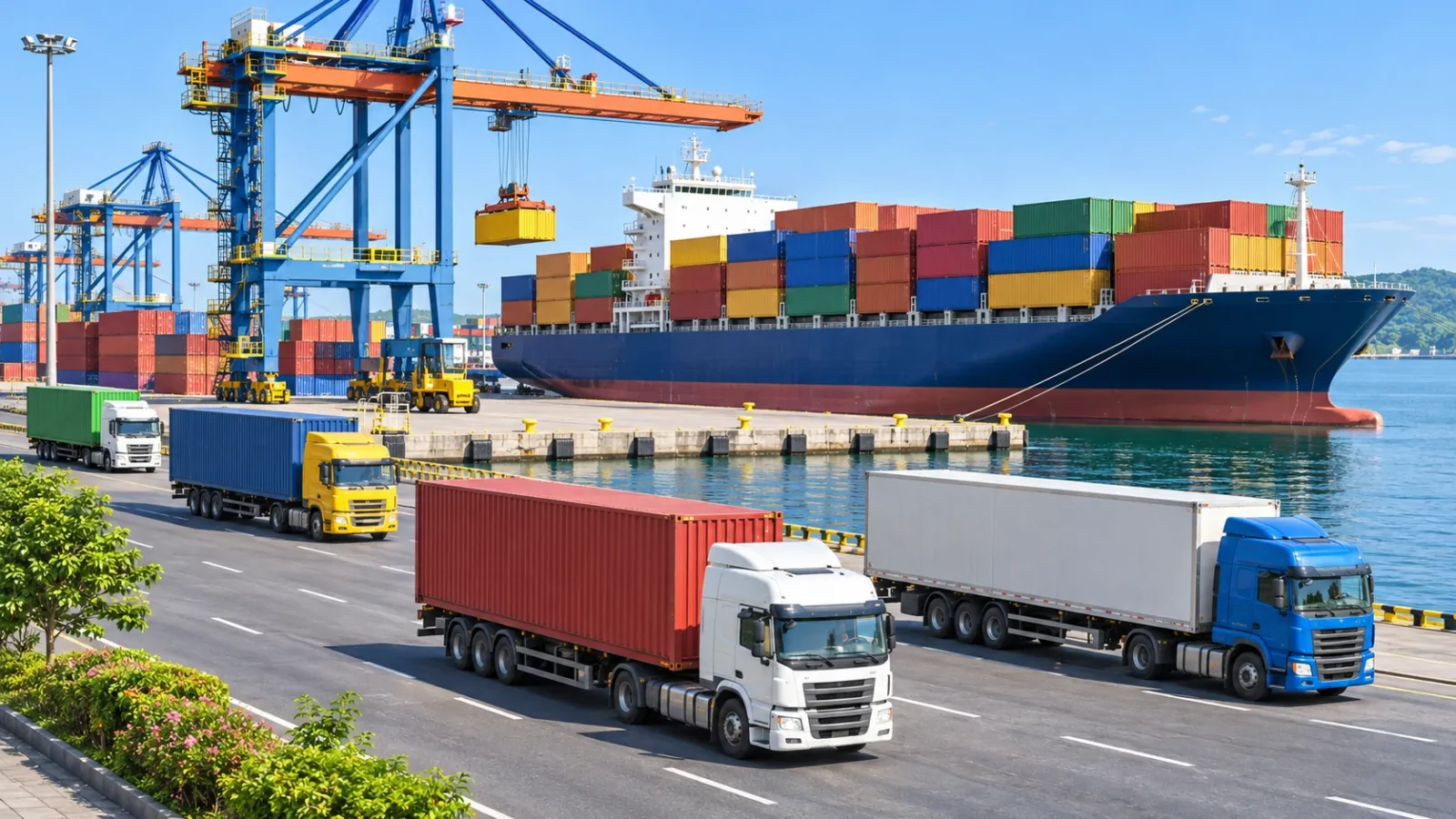
The idea of turning space into weight is the same, but each mode of transport uses a slightly different conversion standard, because the ratio between the weight and space each can carry is different.
(1) At sea, 1m³ counts like 1 ton
Small sea shipments that don’t fill a whole container usually count 1m³ as 1,000kg. They are then charged on whichever is larger, the actual weight in tons or the volume in m³. Because ships can carry very heavy loads, they use a far more generous standard than air freight.
(2) Trucks go by cargo space
Road freight often involves renting a whole vehicle, so how much of the cargo bed is filled matters most. When loads from several shippers are carried together, practices such as counting 1m³ as 333kg, as in Europe, are sometimes used.
(3) Domestic parcels use size bands
Domestic parcel services in Korea often set rates by grouping the sum of a box’s three sides and its weight into bands, rather than calculating dimensional weight directly. The method differs, but the principle that bigger boxes cost more is the same.
What is dimensional weight changing today?

Dimensional weight has gone beyond a simple pricing formula and is changing the very way goods are packed and shipped, because empty space has become a cost.
(1) Boxes that fit just right
Sellers choose boxes that match the size of their products, and some even bring in packaging machines that cut boxes to fit each item. Shrinking a box even slightly lowers costs across a huge number of deliveries.
(2) Down to product design
More and more products and their packaging are designed together from the start to reduce volume, like furniture sold flat-packed. This is because shipping costs directly affect product prices.
(3) Less over-packaging
When there is less empty space in a box, there is also less cushioning material and cardboard waste. A calculation meant to save money ends up easing the burden on the environment as well.
The simple idea that even empty space invisible on a scale has a price is the first step to understanding dimensional weight.