
Robot vacuum cleaners that wander around the floor by themselves and return to their charging dock when the battery runs low have become ordinary household items. Yet few people know that a machine showing similar behavior already existed in the late 1940s, before computers were even widely used.
Built by a British brain scientist, this machine wore a round shell and crawled slowly about on three wheels. It approached light, changed direction when it bumped into something, and went back to its home when its power ran low. Because of how it looked and moved, people called it a tortoise. These are ‘Grey Walter’s Tortoises.’
In this article, we will look in turn at the scientist who built the tortoise robots and the question he was asking, the structure of a body made of two vacuum tubes, the way the robots reacted to light and obstacles, and the legacy they left to today’s robotics.
The First Autonomous Robots, Driven by Two Nerve Cells
A Brain Researcher’s Experiment
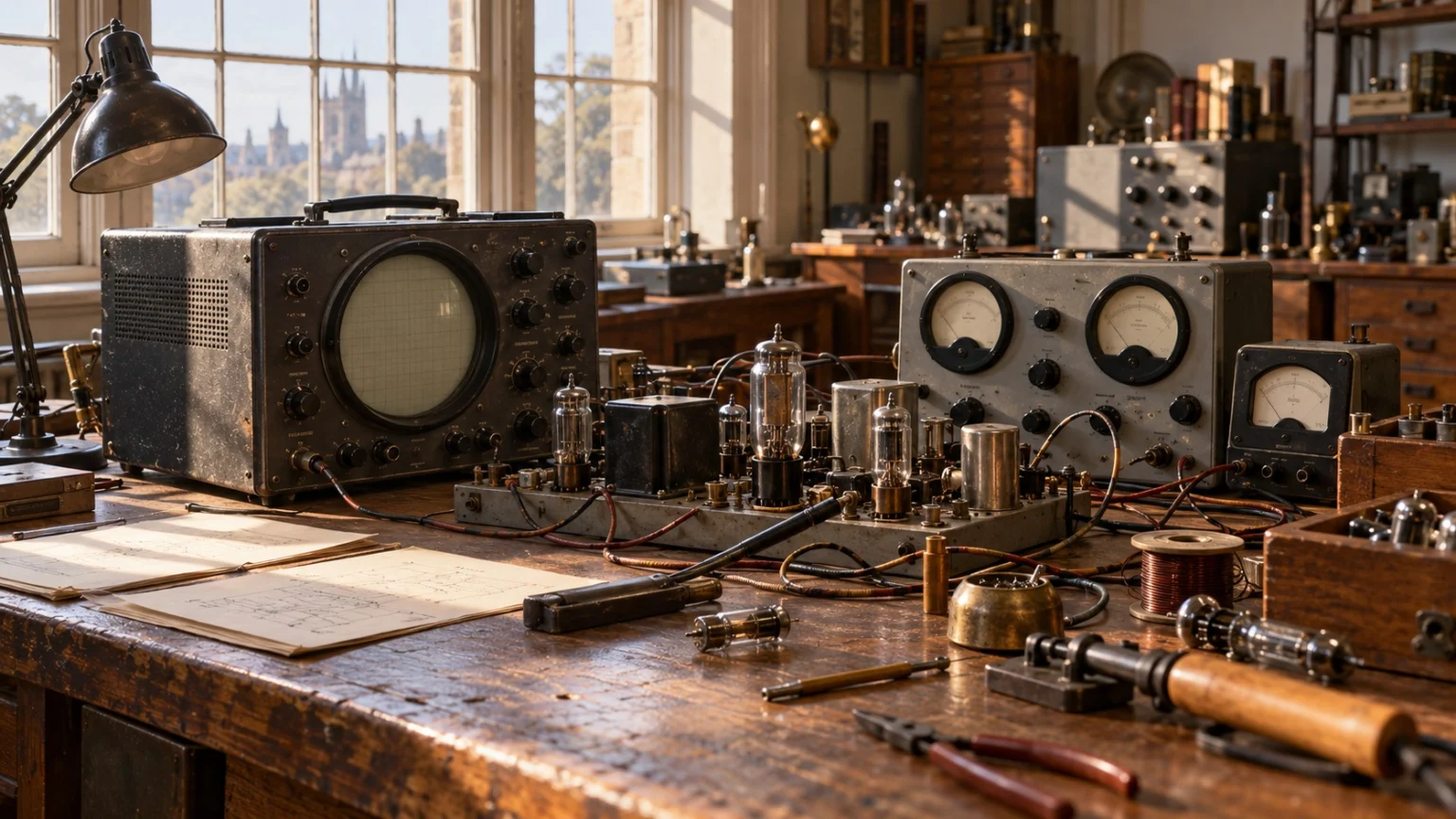
William Grey Walter, who built the tortoise robots, was a neurophysiologist born in the United States and raised in Britain. From 1939, he studied brain waves at the Burden Neurological Institute in Bristol, England.
(1) A Pioneer of Brain-Wave Research
Walter improved the EEG equipment that records the brain’s electrical activity himself and showed how brain waves could be used to locate brain tumors and the areas that cause epilepsy. He is also regarded as a pioneer of cybernetics, the field that studies control in both machines and living things.
(2) Complex Behavior from Few Neurons
He believed the secret of the brain lay less in the number of nerve cells than in how those cells are connected. To prove that even a very small number of well-connected nerves could produce complex behavior, he decided to build robots himself.
(3) The Birth of Elmer and Elsie
The first two were completed between 1948 and 1949 and named Elmer and Elsie. Walter gave them a scientific-sounding name, Machina speculatrix, meaning ‘exploring machine.’
A Body Made of Two Vacuum Tubes
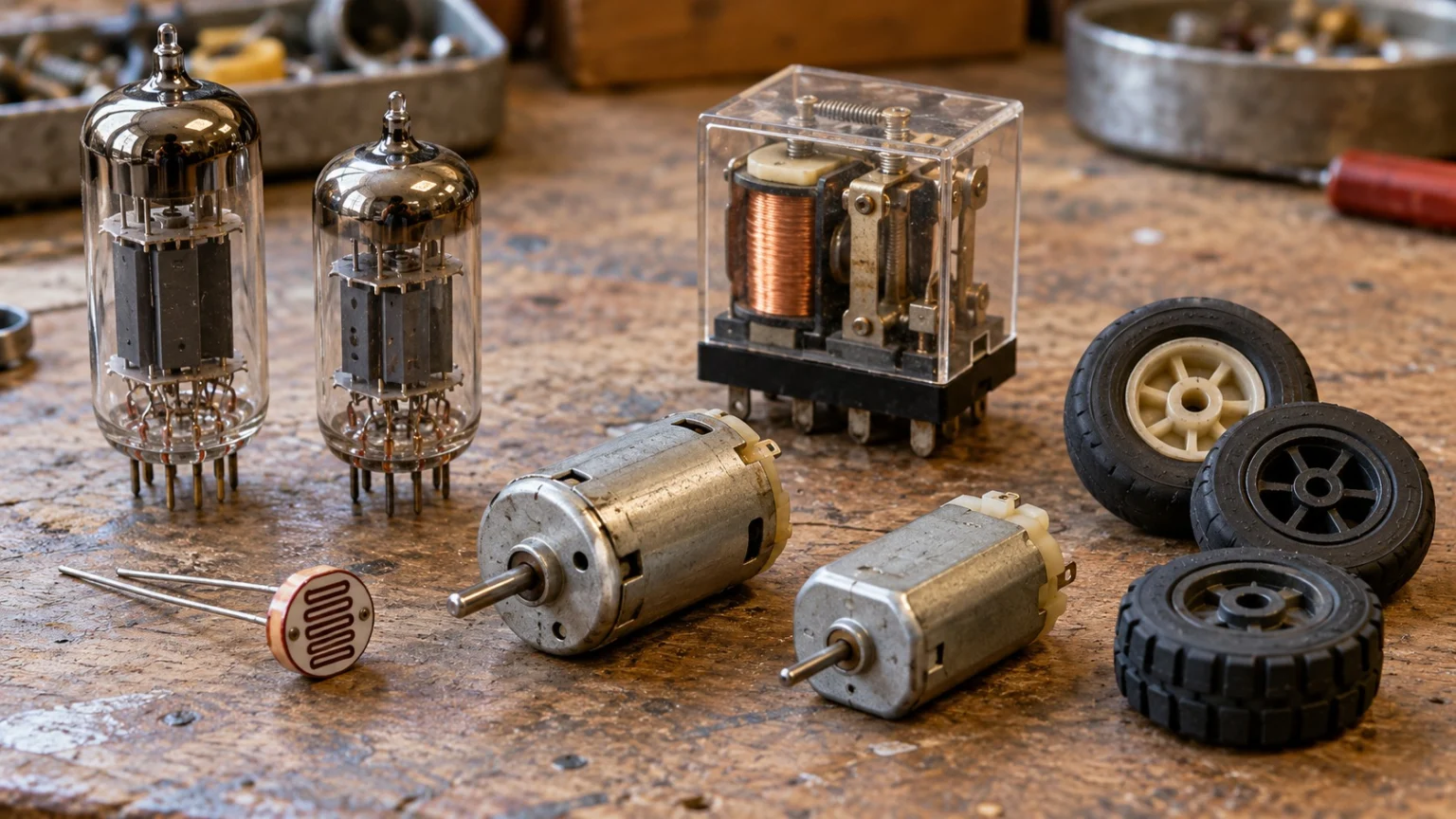
The tortoise robot’s body was remarkably simple. Walter explained that the robot’s brain was equivalent to two nerve cells.
- Vacuum Tubes: Two miniature vacuum tubes served as the brain, amplifying signals to switch the motors on and off.
- Photocell: The eye, which rotated round and round to sense the light around it.
- Touch Contact: When the shell bumped into something and was pushed, a switch closed to signal the collision.
- Two Motors: One was used to move forward and the other to turn.
Power came from a hearing-aid battery and a 6-volt battery. A small bulb on the head was wired to light up only when the steering motor was on, so observers could glimpse what the robot was doing from the outside.
Seeking Light and Avoiding Collisions
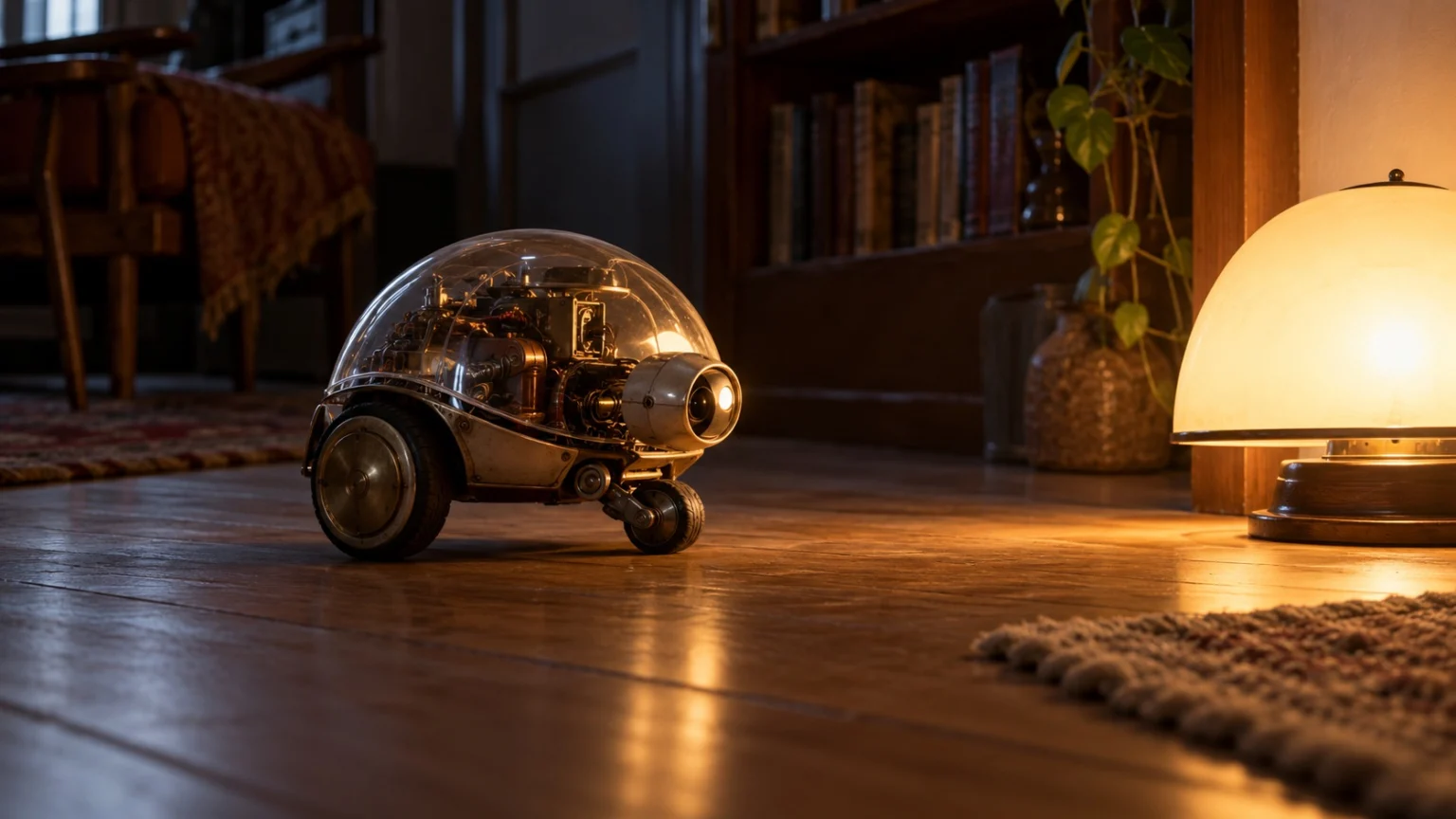
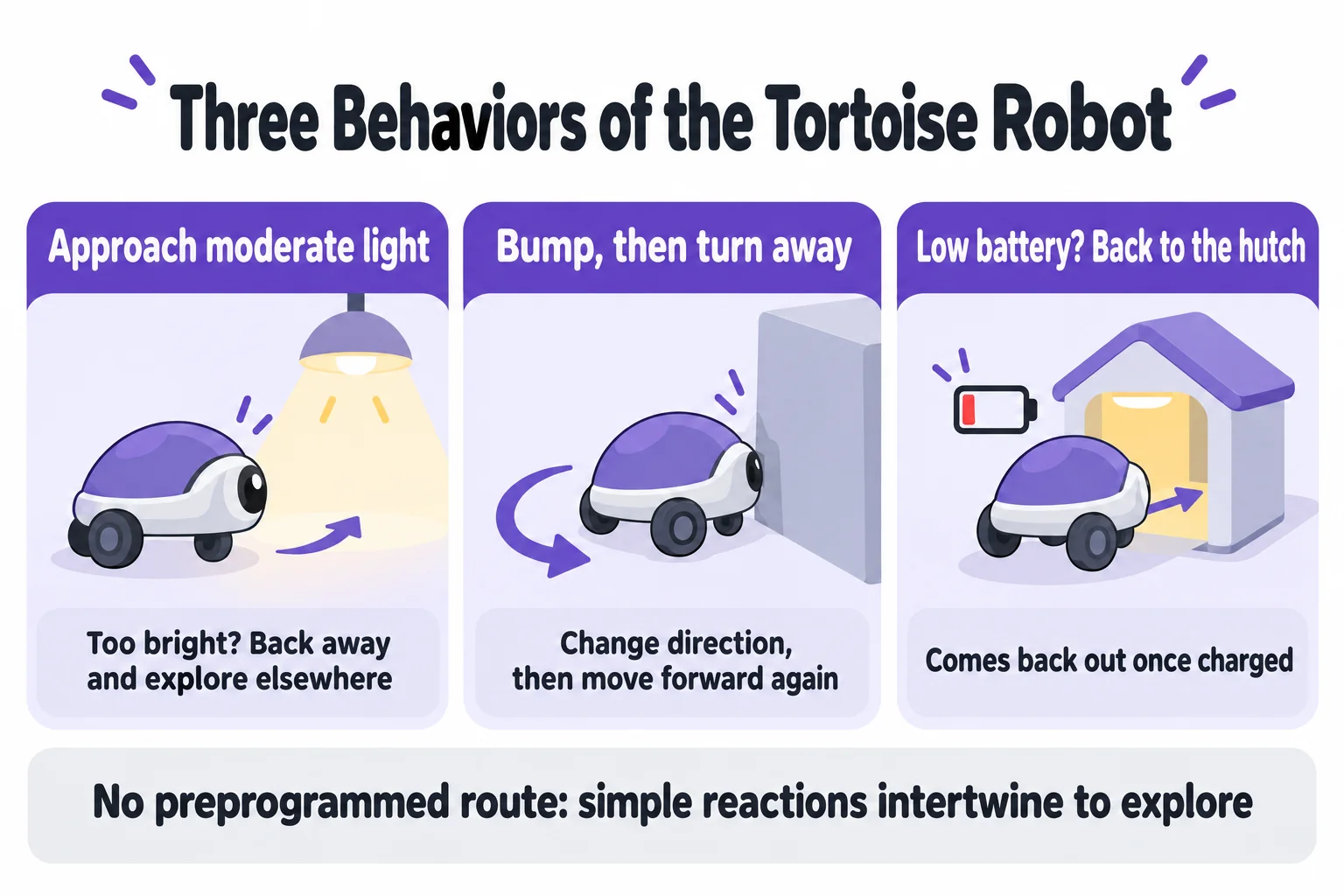
The tortoise robots had no preprogrammed route. As a few simple reactions intertwined, a behavior emerged in which they explored their surroundings much like living animals.
(1) Approaching Moderate Light
In the dark, the photocell rotated in search of light, and when it found moderately bright light, the robot moved toward it. Conversely, if the light was too bright, it backed away and explored in another direction.
(2) Turning Away After a Bump
When its shell touched an obstacle, the robot changed direction and moved forward again, repeating this over and over. Even without seeing properly ahead, it could get around obstacles this way.
(3) Heading Home When Hungry
As the battery weakened, the signal from the vacuum tubes dropped, so the robot avoided bright light less and eventually entered its lit charging hutch. Once charging was finished, it again avoided the bright light and left the hutch.
Watching a tortoise robot placed in front of a mirror flicker and jiggle in response to the light of its own head bulb, Walter wrote that if it were an animal, it might have been credited with a degree of self-awareness.
The Learning Tortoise and Its Legacy Today
Walter also tried giving the tortoise robots the ability to learn. A tortoise fitted with CORA, a circuit that learned conditioned reflexes like Pavlov’s dog, was called Machina docilis.
(1) Tortoises in the Public Eye
Walter introduced the tortoise robots in the science magazine ‘Scientific American’ in 1950 and 1951, and the British broadcaster BBC also filmed them. In 1951, newly built tortoise robots were exhibited at the Festival of Britain.
(2) A Brain Imitated in Analog
While his contemporaries Alan Turing and John von Neumann viewed mental activity as digital computation, Walter placed importance on imitating the brain with analog electronic circuits.
(3) Ancestors of Behavior-Based Robots
BEAM Robotics, which builds autonomous robots from simple analog circuits, was influenced by Walter’s work. Today’s robot vacuum cleaners that return to their charging docks on their own are also called distant descendants of the tortoise robots.
The tortoise robots were the first to show that a machine could explore its surroundings on its own, without complex calculation, simply by linking sensing and movement well. These small machines, run by two vacuum tubes, proved that the idea of an autonomous robot could actually roll along.
Firmly connecting sensing and action with only a few parts: that is the first step of autonomous robotics, in which machines move on their own.