Scroll through social media, and it can seem as though everyone else has more friends than you, gets together more often, and is always surrounded by someone. It is the moment you start wondering whether you are the only one with a small social circle. Yet behind this feeling lies not personality or luck, but the structure of numbers.
That structure is called the “Friendship Paradox.” Put simply, the friendship paradox refers to the phenomenon in which, for most people, their friends have on average more friends than they themselves do. It does not happen because anyone is particularly unpopular; it is a result that arises naturally from the very way friendships are connected.
In this article, we will look in turn at what the friendship paradox is, examine why it happens with a simple calculation, and then explore how the paradox is used in disease surveillance and public health, as well as the illusions it leaves in our minds.
Why My Friends Have More Friends Than I Do
What Is the Friendship Paradox?

The first person to formulate this phenomenon was the American sociologist Scott L. Feld.
(1) A 1991 Paper
In 1991, Feld published a paper in the American Journal of Sociology titled “Why Your Friends Have More Friends Than You Do.” He showed that if you draw friendships as lines connecting people, most people end up with fewer friends than the average of their own friends.
(2) A Relationship Map Drawn in a Classroom
If you ask children to each choose two friends they would like to sit next to and then connect those choices with lines, the lines cluster around a few children while the rest have only one or two. Even in a map like this, most children have fewer connections than the friends they are linked to.
(3) People Think the Opposite
Interestingly, when you ask people directly, many answer that they have more friends than their friends do. In other words, the actual numbers and the way people see themselves point in opposite directions.
The Principle in Numbers

You can check this paradox for yourself with a simple example.
(1) A Small Group of Five
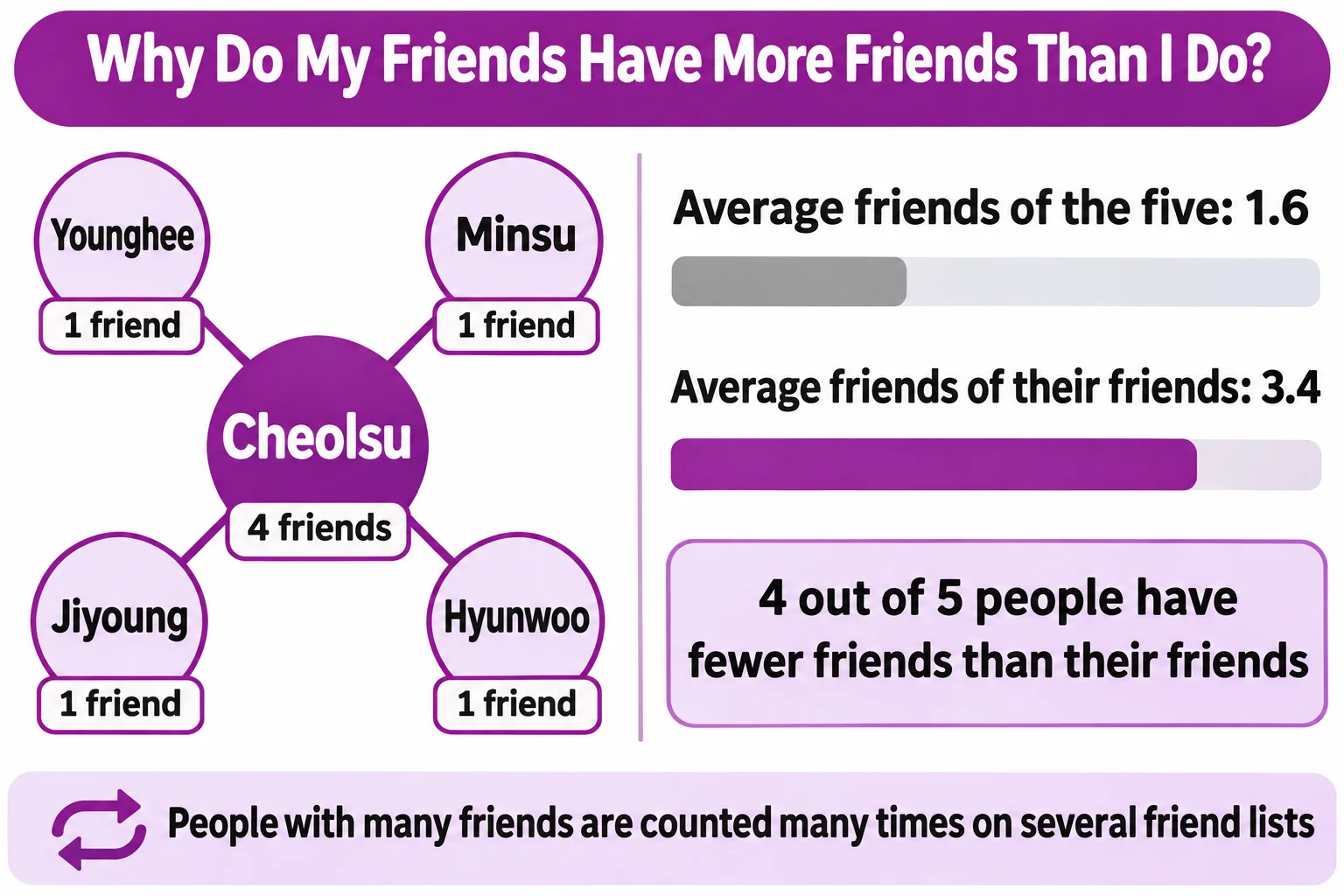
Suppose Cheolsu is friends with four people, Younghee, Minsu, Jiyoung, and Hyunwoo, and these four do not know one another. Cheolsu has 4 friends and each of the other four has 1, so the average number of friends among the five is 8 divided by 5, or 1.6.
(2) Counting Again Through Friends' Eyes
This time, look at how many friends each person's friends have. Younghee, Minsu, Jiyoung, and Hyunwoo all have Cheolsu as their friend, so their friend has 4 friends, while Cheolsu's friends each have 1. Averaging these gives 17 divided by 5, or 3.4, and four of the five people have fewer friends than their friends.
(3) Popular People Get Counted Many Times
The key point is that the more friends someone has, the more friend lists they appear on at the same time. Cheolsu appears on the friend lists of all four people, so when you average from the friends' side, Cheolsu's large number gets added in four times.
- Degree: The number of friends a person has, or the number of lines connected to a single point on a relationship map.
- Sampling Bias: A phenomenon in which, because of the way selections are made, certain subjects are picked more often than they actually occur.
Mathematically, the average number of friends that friends have equals the overall average number of friends plus the variance divided by the average. Unless everyone has exactly the same number of friends, the variance is greater than 0, so the friends' average is always larger than the overall average.
Public Health That Puts the Paradox to Work

This paradox does more than explain an illusion; it is also used as a tool for easily finding the people at the center of a social network.
(1) Watch the Friends, and You See the Outbreak First
Nicholas Christakis and James Fowler studied the flu that spread at Harvard College in late 2009. After monitoring a total of 744 students, made up of randomly selected students and the students they named as friends, they found that the outbreak progressed about 13.9 days earlier in the friend group.
(2) Finding the Center Without a Map
Surveying an entire network to figure out who is at its center takes a great deal of time and money. But if you ask a randomly chosen person to name one friend, that friend is, on average, likely to be someone with more connections. That is why this method has been proposed for choosing who should be vaccinated first or whose infection status should be monitored.
(3) A Channel for Spreading Good Habits
In large-scale field experiments in Honduras and India, Christakis's research team showed that health habits such as taking multivitamins or using iron-fortified salt could spread more effectively through people found with this method.
The Illusions the Paradox Leaves Behind

The friendship paradox also appears in other traits, and it subtly distorts the way we see the world.
(1) It's Not Just Friends
Coauthors who write papers with you tend, on average, to have more papers and citations than you, and the people who follow you on Twitter tend, on average, to have more followers than you. This is called the Generalized Friendship Paradox.
(2) The Illusion of the Majority
When a well-connected few adopt a certain behavior, it can look as though most of the people around you are doing it, even though they are actually a minority. Researchers call this the Majority Illusion.
(3) Bias That Creeps Into Surveys
Finding people through their friends ends up including too many well-connected people. So when this method is used to survey opinions or behavior, the results can be skewed to one side and need to be corrected.
The friendship paradox arises not because you are lacking, but because of a relationship structure in which well-connected people are seen more often. Once you know that the numbers you see when comparing yourself are already a skewed sample, you can be less shaken by other people's dazzling social lives.
Remembering that the most visible numbers are not the same as the average is the first step in statistical thinking that lets you read the numbers in relationships correctly.