
When we reach out to drink a glass of water, we don't think separately about how to move our shoulder, elbow, and wrist. But to have a robot arm do the same thing, you have to specify exactly which way and how far each joint must turn.
In robotics, the number of independent directions in which a robot can move is called its degrees of freedom. Degrees of freedom are the most basic measure of how many different postures a robot can take and how complex the tasks it can perform are.
This article explains, in easy-to-understand terms, what degrees of freedom are, why industrial robot arms came to have six joints, the degrees of freedom of the human arm and hand, and the benefits and challenges that come with adding more degrees of freedom.
Understanding and Applying Degrees of Freedom
How to Count Directions of Movement
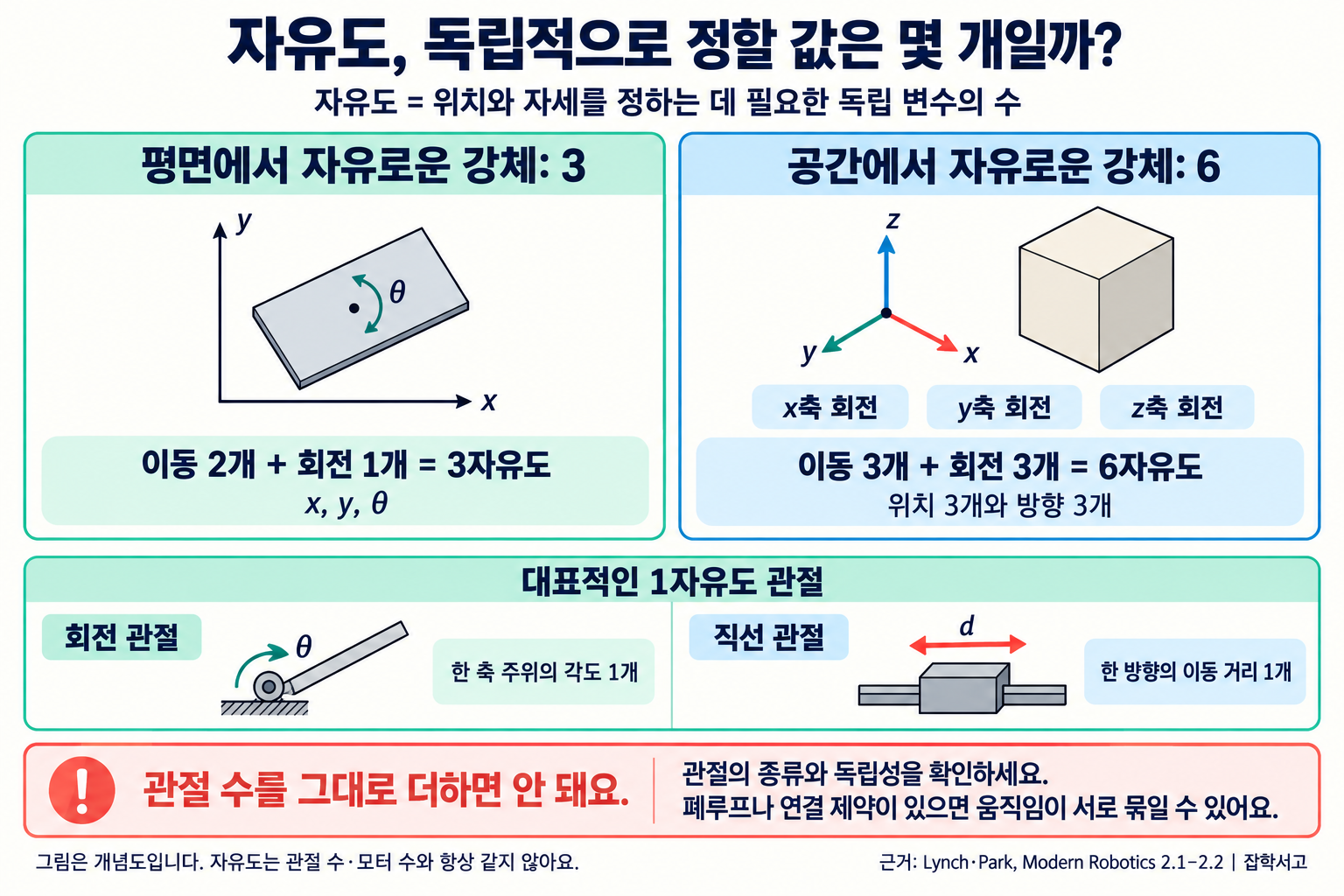
Degrees of freedom are the number of independent values needed to describe an object's position and orientation. An object floating in space can move forward and backward, left and right, and up and down, and it can also rotate about each of three axes. So a rigid object in three-dimensional space has six degrees of freedom in all: three of translation and three of rotation.
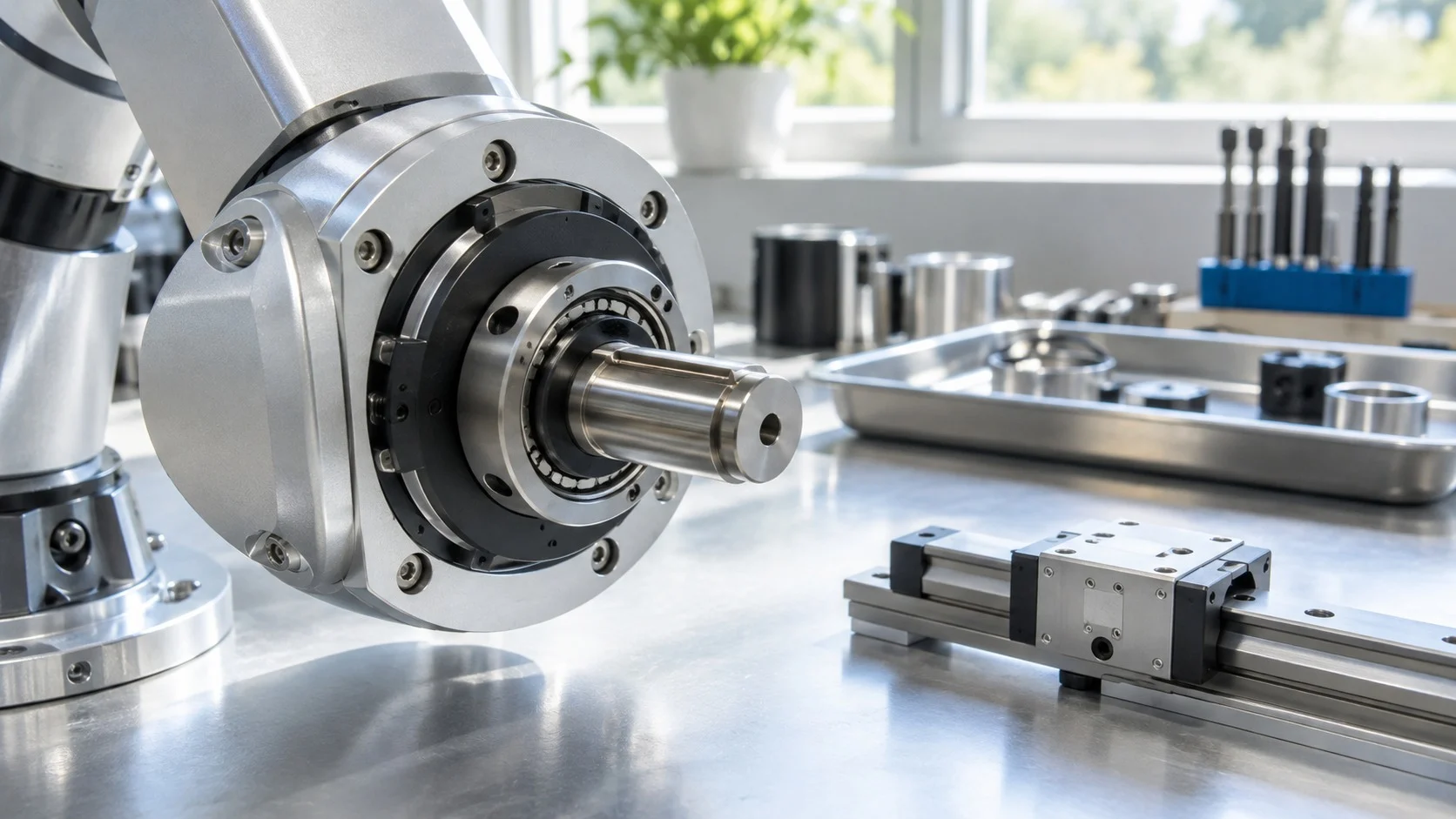
In robots, each joint usually accounts for one degree of freedom. Typical examples are the revolute joint, which turns about a single axis like a hinge, and the prismatic joint, which slides in one direction like a drawer. How many such joints are connected, and in what order, determines how far a robot can reach and what postures it can take.
Degrees of freedom are not a term used only for robot arms. A robot vacuum rolling across the floor only needs to handle movement on a plane, such as moving forward and backward and turning on the spot, whereas a drone flying through the air has to control both its position and its tilt. Even among robots, the degrees of freedom required vary greatly depending on the space they work in and the tasks they do.
Why Industrial Robot Arms Have Six Joints

Unimate, regarded as the first industrial robot, took on the job of removing hot die-cast parts at a General Motors plant in the United States in 1961. This hydraulically driven arm had five degrees of freedom.
Most of the robot arms commonly seen in factories today have six joints. As we saw earlier, freely setting the position and orientation of an object in space requires six values. The three lower joints move the end of the arm to the desired position, and the three joints in the wrist align the orientation of the tool.
This allows six-axis robots to aim a welding torch at an angled seam or to drive a screw precisely into a tilted part. Conversely, packaging robots that simply pick things up and set them down on a flat surface can manage with about four degrees of freedom, so they can be built faster and more cheaply.
Robots with fewer joints are sometimes better at particular jobs. Horizontal articulated robots known as SCARA robots (Selective Compliance Assembly Robot Arm) have a simple structure in which the arm folds and extends only horizontally, so they are widely used for tasks that repeat short, fast motions countless times, such as inserting electronic components into circuit boards.
The Degrees of Freedom of the Human Arm and Hand

The human arm is commonly described as having seven degrees of freedom: the shoulder moves in three directions, the elbow in one, and the wrist and forearm in three. That is one more than the six needed to set the position and orientation of the fingertips.
This extra degree of freedom lets us raise or lower the elbow while keeping the hand fixed in one place. It is also what allows us to twist the elbow to avoid obstacles when reaching for something deep inside a narrow shelf. In robotics, a structure with more degrees of freedom than necessary is said to have redundancy.
The hand is far more complex. With the joints of the five fingers and the wrist combined, it is known to have more than 20 degrees of freedom, so building a robot hand that can handle objects as delicately as a human hand remains a difficult challenge even today.
That is why many robot hands, instead of moving every joint separately, use a single cable to bend several joints together. Although only a few motors actually do the moving, the fingers automatically wrap around the shape of an object, so with relatively simple control they can grip everything from fragile items like eggs to tools of all different shapes.
The Benefits and Challenges of Adding Degrees of Freedom

In recent years, robot arms with seven joints, like the human arm, have become more common. Having an extra joint makes it possible to choose among several postures while keeping the hand in the same position, which makes it easier to avoid collisions in workplaces shared with people or in tight spaces.
But as degrees of freedom increase, so do the burdens. Each joint needs a motor, a reducer, and a sensor to measure its position, so the robot becomes heavier and more expensive. Small errors in each joint also add up toward the end of the arm, making precision harder to maintain.
Control becomes more complex as well. Because there are multiple combinations of joint angles that reach a single target position, the robot has to decide separately which posture is safest and takes the least effort. That is why, when designing a robot, it is important to give it only as many degrees of freedom as its task truly requires.
These considerations also come into play when people operate robots directly. Surgical robots attach a wrist joint to the tip of an instrument inserted through a small incision to reproduce the surgeon's hand movements, and the person operating the robot while watching a screen needs to know how many directions the instrument tip can move in to handle it without mistakes.
Degrees of freedom are the numbers that determine how a robot meets the world. Understanding the number and arrangement of joints explains why some robots are fast and simple, while others are slow but delicate.
Finding the number of joints that truly fits the job: that is the first step in designing a robot that moves well.