Have you ever seen a toy shop demonstration where a small doll placed on a sloped board waddles down one step at a time, with no wind-up spring or battery? Without anyone steering it, its legs swing forward in turn, and it stops only when the slope runs out. It may look like a simple toy, but it holds an important secret about the way people walk.
Roboticists studied this principle seriously and built machines that walk using only gravity and inertia, with no motors or controllers. The idea that walking happens on its own as long as the body's shape and weight distribution are right is what we call “Passive Dynamic Walking.”
This article looks at what passive dynamic walking means and how it came about, the principles that let a machine walk on its own, the examples that led to robots walking on level ground, and finally what this research has meant and where its limits lie.
The Art of Walking Without Effort: How Passive Dynamic Walking Works and How It Developed
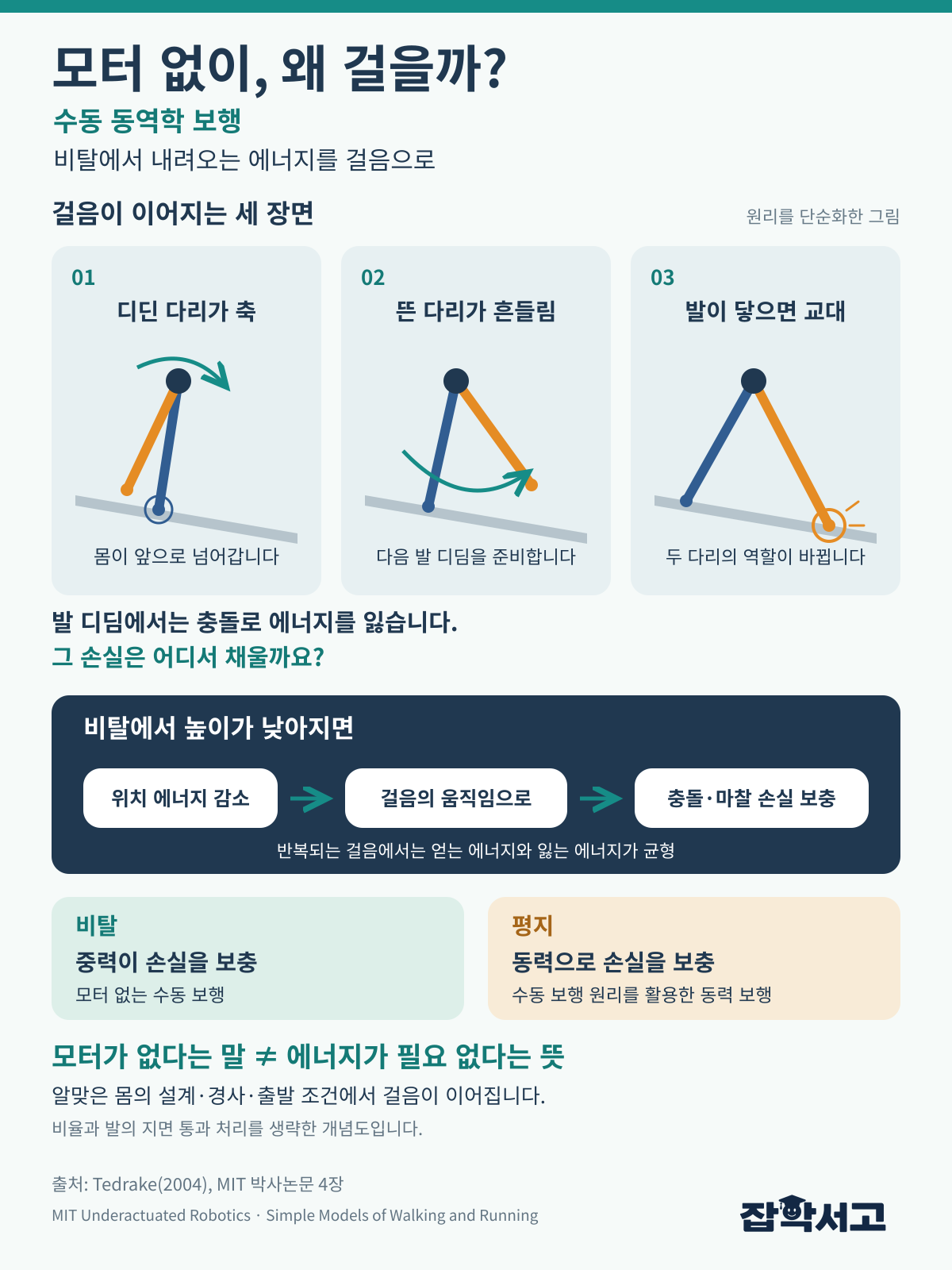
What Is Passive Dynamic Walking?
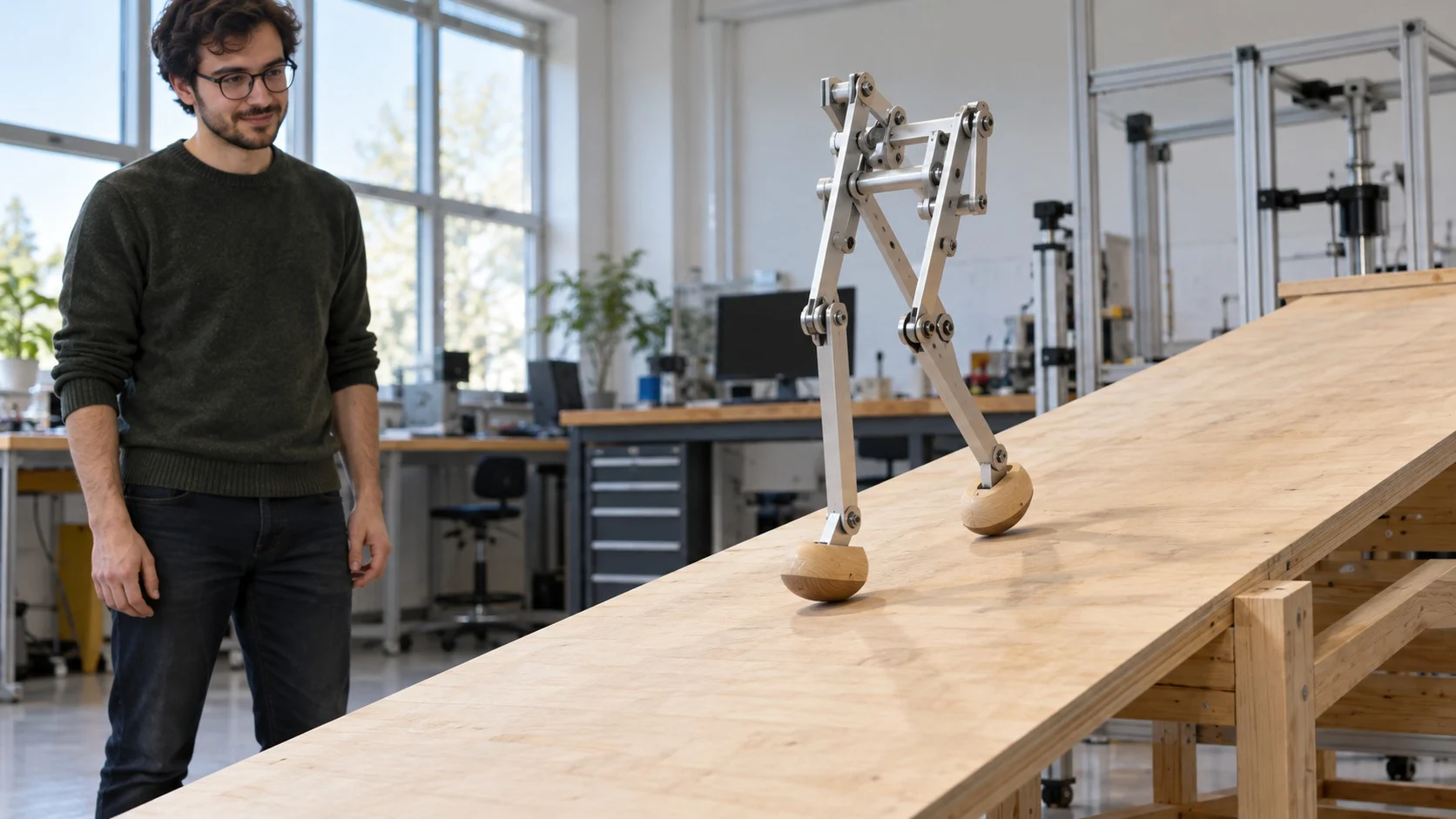
Instead of fitting a motor to every joint and setting each angle one by one, passive dynamic walking lets the physical properties of the legs and body produce the gait. Here, “passive” means the machine does not generate any power of its own.
(1) McGeer's experiment
In 1990, Tad McGeer of Simon Fraser University in Canada published a paper titled “Passive Dynamic Walking” in an international journal. He demonstrated a two-legged machine that, once started on a gentle slope, walked down it stably with a gait quite similar to a human's, without any particular control or energy input.
(2) How it differed from the mainstream approach
At the time, most walking robots precisely controlled every joint angle at every moment. A passive dynamic walker, by contrast, does not directly control a single joint. Researchers were astonished that a machine made of nothing but rigid parts and joints could walk.
(3) From toy to research
McGeer opened his paper with a drawing of a two-legged toy walking down a slope. Toys like this had existed for a long time, but the significance of McGeer's work was that he analyzed their motion using the laws of physics, calculated the period and stability of the gait, and used it as a clue for robot design.
How a Machine Comes to Walk on Its Own

As a passive walker goes down a slope, its steps continue through several physical phenomena working together.
- Inverted pendulum: The leg on the ground carries the body forward over the foot, tracing a rounded arc.
- Swinging pendulum: The leg off the ground swings forward on its own, like a clock pendulum hanging from the hip joint.
- Heel strike: When the front foot touches the ground, a little energy is lost, and the two legs swap roles.
(1) Energy supplied by gravity
The energy lost each time a foot hits the ground is made up by the potential energy gained as the walker gradually descends the slope. When the amount lost matches the amount gained, the steps continue at a steady rhythm.
(2) A gait that recovers on its own
If the leg length, center of mass, and curvature of the soles are just right, the walker returns to its original rhythm within a few steps even after a slight disturbance. In other words, stability comes from the design of the body, not from a controller.
A swing makes this easy to picture. When we ride a swing, we don't pull the ropes with our hands to move it; we simply bend and straighten our knees slightly at the right moment. We are adding force to the swing's own natural rhythm. A passive walker likewise walks in time with the rhythm at which its body naturally wants to swing.
Beyond the Slope to Level Ground: The Evolution of Walking Robots
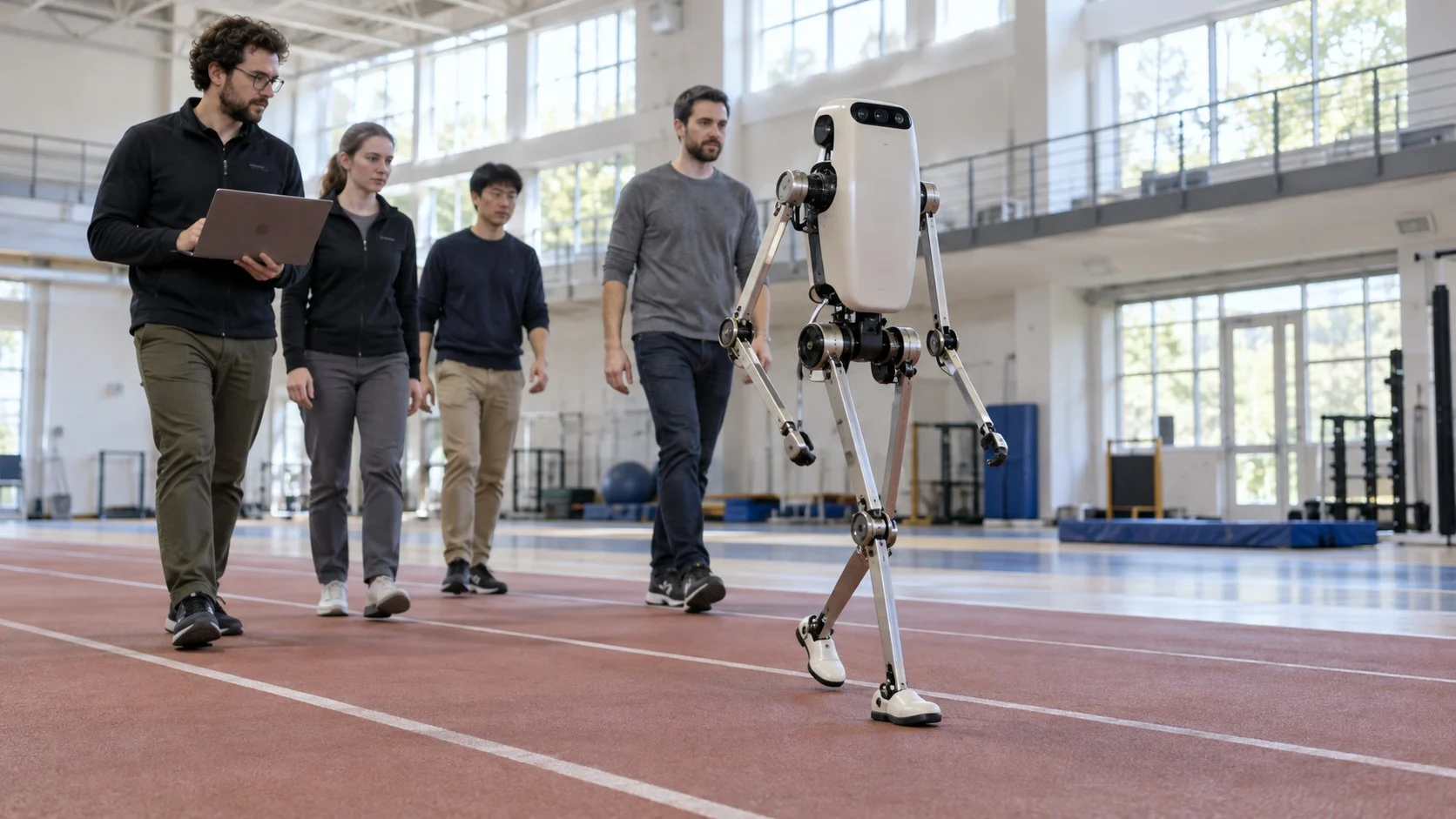
The biggest limitation of passive walkers was that they could walk only on a slope. Researchers solved this problem by adding a small amount of power in place of gravity.
(1) Three robots in 2005
In 2005, research teams from Cornell University in the US, Delft University of Technology in the Netherlands, and the Massachusetts Institute of Technology (MIT) in the US jointly presented three robots that walk on level ground in the journal Science. All of them were based on passive walkers, with only a minimal amount of power added.
(2) Using as little energy as a human
The Cornell robot used almost no power apart from pushing off the ground with one ankle when the opposite foot touched down. Its energy consumption, taking weight and distance traveled into account, was on a par with human walking, while Honda's ASIMO, estimated on the same basis, consumed more than ten times as much.
(3) A robot that walks for a long time
Ranger, a robot from Professor Andy Ruina's lab at the same Cornell University, was built on a simple walking model. In May 2011, on a single charge, it walked more than 186,000 steps over 30 hours and 49 minutes, covering about 65 km.
What Passive Dynamic Walking Has Meant, and Its Limits

Passive dynamic walking is both a technology for building walking robots and a window into understanding how humans walk.
(1) A model of human walking
When people walk, they too rely heavily on the natural swinging of their legs rather than pushing each leg forward with muscle. That is why this research serves as a reference for designing prosthetic legs, rehabilitation devices, and wearable assistive devices.
(2) Remaining challenges
However, these robots struggle with uneven ground, stairs, and sudden changes of direction. So today, researchers are also studying approaches that make use of the body's natural swing while adding control only when it is needed.
(3) Compared with the zero moment point approach
The Zero Moment Point approach, which keeps a robot from falling by continuously calculating the point of force balance beneath the soles of its feet, is stable but uses a lot of energy. Passive dynamic walking, in which the robot falls slightly with every step and catches itself again, is highly efficient. The two approaches are closer to complementing each other's weaknesses.
Passive dynamic walking shows that clever control isn't always the answer. With a well-designed body, the laws of physics take over much of the work.
Rather than trying to hold on to every movement, trusting the body's natural flow and letting it do its work is the first step toward lightweight, efficient robot design.