When you put an item you like into your cart at an online store and a ‘temporarily out of stock’ notice pops up, you move to another store without hesitation. For a business, a stockout means losing not only that day's sales but also the customer. That is why warehouses always hold a little more than they normally expect to sell. This cushion is called safety stock.
Put simply, safety stock is ‘extra inventory held to prepare for unexpected situations, such as a sudden jump in demand or a delayed delivery.’ Too little leads to stockouts, while too much drives up storage costs and ties up cash, so deciding how much to keep is a central task in logistics and inventory management.
This article explains, in easy-to-understand terms, what safety stock is and why it is needed, how it relates to the reorder point, how to calculate it with numbers, and management strategies for keeping it at the right level.
Safety Stock: The Concept and How to Calculate It
What Is Safety Stock?
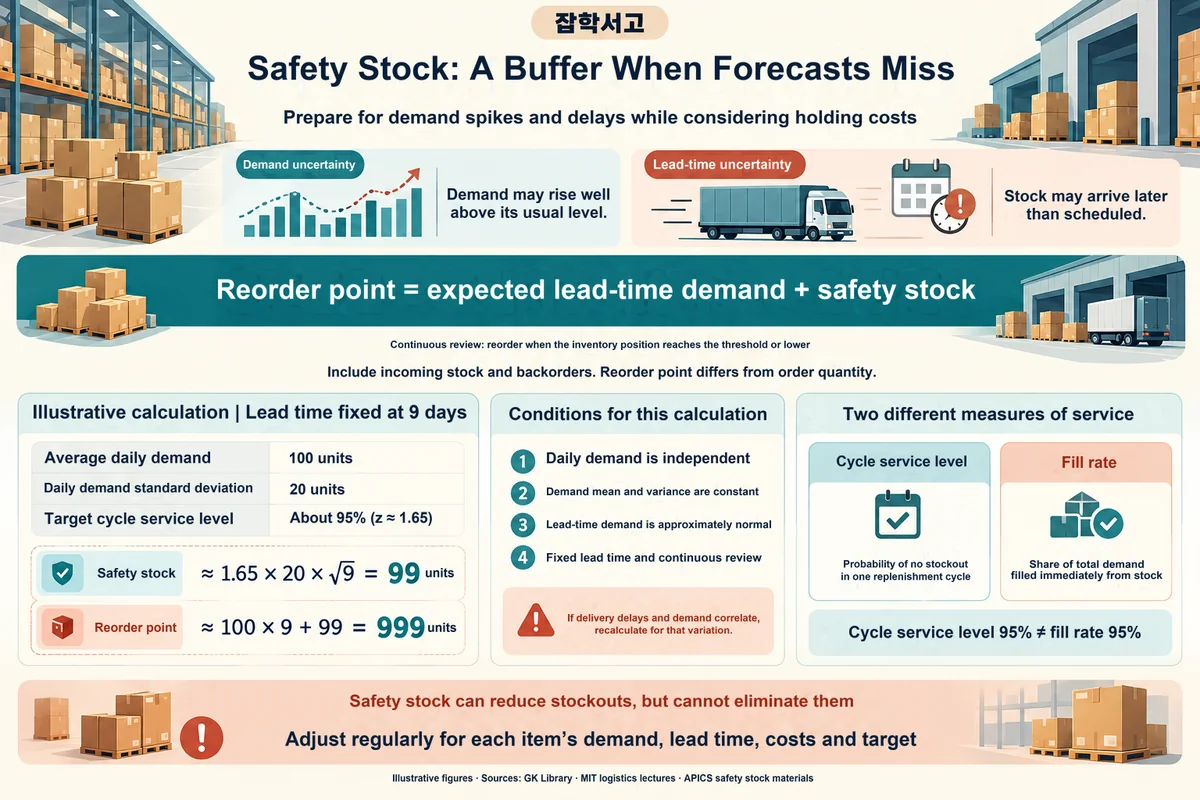

Inventory in a warehouse can be broadly divided into two parts: stock that covers normal sales, and stock that guards against forecasts going wrong. Safety stock is the latter. Like an emergency fund, it is left untouched in normal times and drawn on only when trouble comes.
- Cycle stock: Inventory that covers average sales until the next delivery arrives.
- Safety stock: Buffer inventory held against uncertainty in demand and supply.
- Stockout: A situation in which inventory runs out and orders cannot be filled.
Uncertainty comes from two directions. One is variability in demand, when sales suddenly jump because of the weather, trends, or a discount promotion. The other is variability in supply, when goods arrive later than promised because of production problems at a factory, port congestion, or customs delays.
How Safety Stock Relates to the Reorder Point

Safety stock is also used when deciding ‘when to order again.’ A new order is placed when inventory drops to a certain level, and this threshold is called the reorder point.
(1) Lead time
The time it takes for goods to arrive at the warehouse after an order is placed is called the lead time. Sales continue during this period, so you need to keep enough on hand to cover what will be sold in the meantime.
(2) The reorder point formula
The reorder point is found by multiplying average daily demand by the lead time and adding the safety stock. Written as a formula: reorder point = average daily demand × lead time + safety stock.
(3) The role of safety stock
If everything goes as expected, the amount left in stock when the new goods arrive will be equal to the safety stock. Even if demand suddenly rises or a delivery is late, this cushion prevents a stockout.
Calculating Safety Stock with Numbers

Safety stock is usually calculated statistically rather than set by gut feeling. When only demand variability is considered and the lead time is assumed to be constant, the most widely used formula is as follows.
Safety stock = service level factor × standard deviation of daily demand × √lead time
Here, the ‘service level’ means the probability of not running out of stock during the lead time. Based on the normal distribution, the factor is about 1.28 for 90%, about 1.65 for 95%, and about 2.33 for 99%.
There is a reason the lead time sits under a square root. Day-to-day swings in demand, with some days high and some days low, partly cancel each other out, so when the period becomes four times longer, the standard deviation, which measures the size of the overall variability, grows only twofold, not fourfold. If the lead time itself is erratic, a more complex formula that also reflects that variability must be used.
[Example] Bottled water that sells 100 units a day on average
Suppose a product sells an average of 100 units a day, the standard deviation of daily sales is 20 units, and the lead time is 9 days. The square root of 9 is 3, so with a 95% service level the safety stock is 1.65 × 20 × 3, or about 99 units. The reorder point is 100 × 9 + 99, or about 999 units, so you should place an order when inventory has fallen to around 1,000 units.
If the service level for the same product is raised to 99%, the safety stock rises to about 140 units. In other words, cutting the probability of a stockout by 4 percentage points requires holding more than 40% more safety stock. This shows that costs climb steeply the closer you get to perfection.
Four Management Strategies for Reducing Safety Stock

Safety stock is insurance against stockouts, but like any insurance premium, it costs money. So companies look for ways to keep less stock on hand without taking on more risk.
(1) Improve forecast accuracy
Analyzing sales history together with seasons and promotion schedules reduces forecast errors, which shrinks the standard deviation and lowers the safety stock required.
(2) Shorten the lead time
Moving to suppliers closer by or changing the mode of transport shortens the lead time, which makes the square-root term in the formula smaller.
(3) Differentiate by item
Set a high service level for key items that make up a large share of sales and a lower one for slow-moving items, so that limited warehouse space and capital are used efficiently.
(4) Share information
Sharing sales data with suppliers in real time reduces the bullwhip effect, in which small fluctuations grow larger as they travel up the supply chain, and cuts unnecessary inventory.
Safety stock is a buffer for keeping promises in an uncertain world. As supply chains were shaken in the wake of COVID-19, many companies moved away from minimizing inventory and began once again to value having slack to prepare for crises. They started adding the wisdom of ‘just in case’ to the ‘just in time’ approach of bringing in only what is needed, exactly when it is needed.
That said, simply piling up more inventory is not the answer. Safety stock comes from three numbers: demand variability, lead time, and the target service level. Only by checking and adjusting these numbers steadily can a business find the right balance between cost and peace of mind.
Considering how far off you might be before considering how much you will sell: that is the first step toward logistics without stockouts.