
Hello! The world of logistics is vast and complex, but its beginning and end are ultimately connected by 'transportation.' The most common means of transportation we see on the road is undoubtedly the 'truck.' But did you know that not all trucks are the same? Although they may look similar, the cargo bodies behind them come in dozens of types depending on the kinds and characteristics of the goods they carry.
Just as a chameleon changes its color to match its surroundings, trucks change their cargo bodies to suit the freight they transport. Today, we'll explain the essential points about 'truck body types' in an easy-to-understand way—the heart of the trucks that carry all the goods in our lives. After reading this article, you'll see the trucks on the road in a whole new light!
Why Are There So Many Different Truck Bodies?

First, we need to understand why trucks look so different from behind. 'Efficiency' and 'safety' are at the heart of freight transport.
You wouldn't load electronics that must stay dry onto a truck without a roof, or put milk, whose freshness is essential, onto an ordinary truck, would you? Truck bodies have evolved to provide the space best suited to the characteristics of the cargo, including its volume, weight, condition, and sensitivity to temperature.
It's like choosing the size of our bags based on how much luggage we have when traveling, or using different hangers for different types of clothing. Choosing the right truck body is a direct way to reduce logistics costs and prevent damage to cargo.
4 Common Types of Truck Bodies
Now, let's introduce 4 common types of truck bodies you're most likely to encounter on the road.
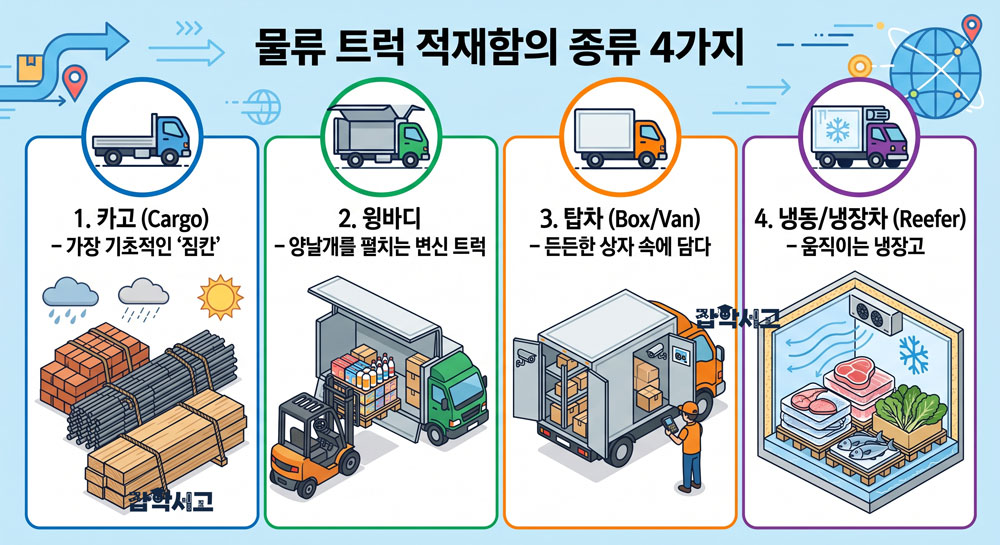
1. Cargo Truck (Cargo) - The Most Basic 'Load Bed'
- Features: This is the most basic form, with only a floor and low rails, without a roof or walls. The term 'cargo truck' usually refers to this type.
- Advantages: It is the most convenient for loading and unloading. With all sides open, cargo can be loaded from any direction using a forklift or crane.
- Disadvantages: Cargo is directly exposed to rain, snow, wind, and sunlight. It is vulnerable to dust and contamination, and securely fastening the load to prevent it from falling off is essential.
- Examples: It is used to transport construction materials such as bricks, reinforcing bars, and timber, or large machinery for which contamination is not a concern.
2. Wing Body Truck (Wing Body) - A Transforming Truck That Spreads Its Wings
- Features: This is a cargo truck fitted with a roof and walls. Its defining feature is that 'the entire side of the cargo body opens upward like a bird's wing.'
- Advantages: It protects cargo from rain and snow like a box truck, while allowing quick loading and unloading from the side with a forklift like a cargo truck. Loading and unloading are highly efficient.
- Disadvantages: The cargo body itself is heavy, so fuel consumption is slightly higher than that of other trucks, and enough space must be available for the wings to open.
- Examples: It is most widely used to transport most standardized cargo that is bulky and needs protection from rain and snow, such as boxed home appliances, food and beverages, and household goods.
3. Box Truck (Box/Van) - Packed Inside a Sturdy Box
- Features: The entire cargo body is enclosed in the form of a rigid box. Cargo is loaded through the rear doors or a small side door. Unlike a wing body truck, the entire side does not open.
- Advantages: It offers the highest level of security. It completely encloses the cargo, protecting it from theft, contamination, and changes in the weather.
- Disadvantages: Cargo must be stacked neatly starting from the inside, so loading and unloading take longer than with wing body or cargo trucks. Forklift use may be limited.
- Examples: It is used for cargo where security and protection from contamination are the top priorities, such as valuables, clothing, documents, and small parcel shipments.
4. Freezer/Refrigerated Truck (Reefer) - A Refrigerator on Wheels
- Features: It looks similar to a box truck, but its cargo body walls contain heat-resistant material, such as Styrofoam, and it has a separate refrigeration unit attached. It can maintain a constant interior temperature.
- Advantages: It can transport temperature-sensitive cargo over long distances while keeping it fresh or frozen.
- Disadvantages: Operating the refrigeration unit requires additional fuel costs, and maintenance costs are high. The cargo space may be slightly smaller than that of an ordinary box truck.
- Examples: It is essential for transporting fresh foods such as ice cream, meat, fish, and vegetables, or medicines that require temperature control.
Truck Body Comparison Examples at a Glance

To make this easier to understand, let's use the 'milk' we drink every day as an example.
- What if boxes of milk were loaded onto a cargo truck? On a sunny day, the milk would spoil. If it rained, the boxes would get wet and tear, wouldn't they? (Unsuitable)
- What if they were loaded onto an ordinary box truck? They would be protected from rain and snow, but during long-distance transport, the interior temperature would rise and the milk could spoil. (Unsuitable)
- What if they were loaded onto a freezer/refrigerated truck? A cool temperature could be maintained all the way to the destination, allowing fresh milk to be delivered. (Ideal!)
As these examples show, the 'nature' of the cargo is the most important criterion for choosing a truck body.
The World of Logistics: Understanding Helps You Notice It, and Noticing Makes It Interesting
Today, we explored 4 main types of truck bodies—the chameleons of the road—and their features: cargo, wing body, box, and freezer/refrigerated trucks.
Isn't it fascinating that even the seemingly simple rear of a truck hides countless logistics considerations and technologies for efficient transportation? Each cargo body faithfully fulfills its role, delivering the goods we need in our lives as safely and quickly as possible.
Now, when you come across a truck while walking along the road, take a moment to imagine what kind of cargo body it has and what might be inside. You'll gain a renewed sense of how closely logistics is connected to our everyday lives!
I hope today's material has helped you expand your knowledge of logistics a little further. We'll be back next time with more interesting and informative stories about logistics. Thank you!