
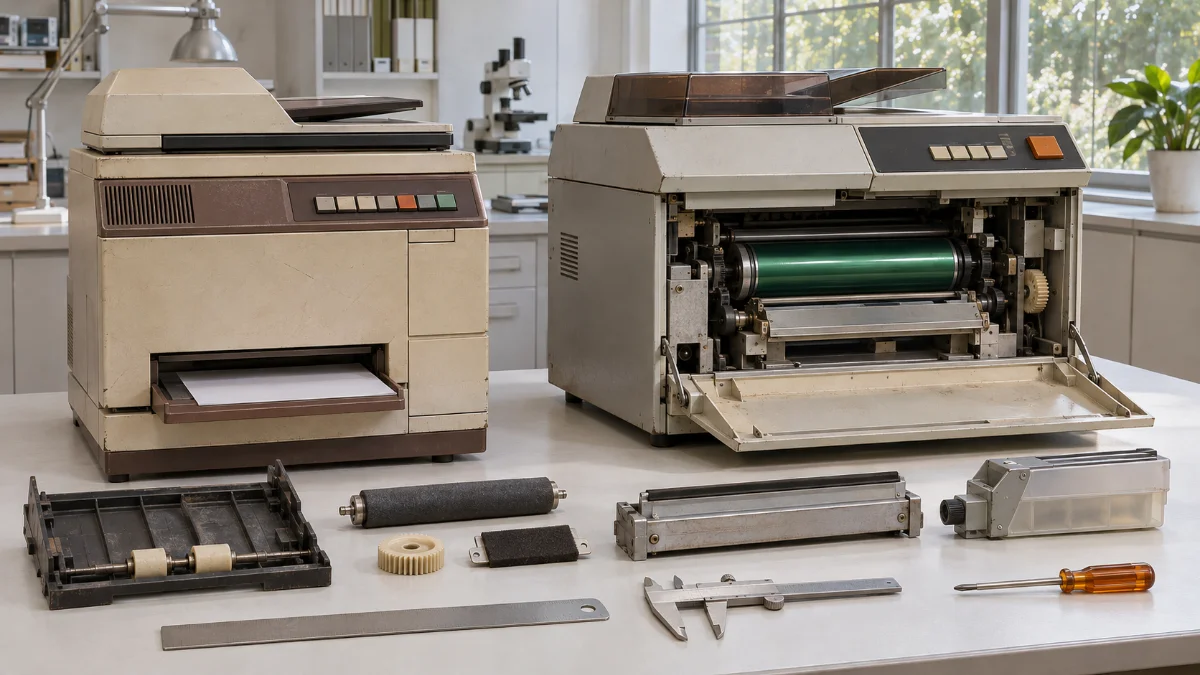
In 1979, engineers at Xerox, the company whose name was practically synonymous with photocopiers, were buying rival copiers and taking them apart down to the last screw. Small, inexpensive machines from Japanese companies were spreading quickly through offices.
After launching the 914, a copier that printed on plain paper, in 1959, Xerox had the market almost to itself for years. In English, the company name “xerox” even came to be used as a verb meaning “to photocopy.”
What they found was a shock. Japanese competitors could sell finished copiers at about what it cost Xerox just to build one. Robert C. Camp, who later led this effort, recalled that the company’s market share had shrunk from 80% to 18% around that time.
Xerox’s answer was unexpected. It set its pride aside, chose the companies that did things best as its standard, and decided to measure the gap and learn from them. This is how benchmarking, now used by companies, schools and public agencies alike, became widely known.
What Happened Back Then
Benchmarking is not secretly copying someone else’s work. The Xerox experience shows how a method was born that asks, in order, “Who does it better, why do they do it better, and what do we need to change?” Below, we look at the event that started it, the principle behind it, and how it shows up around us today.
Taking Rival Copiers Apart
Xerox’s manufacturing division put competitors’ products side by side with its own, comparing the number of parts, the way they were assembled and even the cost of making them. Once the vague feeling that “Japanese products are cheap” was checked item by item in numbers, it became clear where and by how much Xerox had fallen behind.
Once the gap could be seen in numbers, the goal changed too. The new standard was no longer “a little better than last year” but “as good as the best.” The company turned its eyes away from its own past and toward the best level outside.
The comparison did not stop at products. For each stream of work, such as design, parts purchasing, production, sales and service, Xerox looked for the best performer and set targets and deadlines to close the gap. A method that began as one department’s experiment started to become the way the whole company worked.

Around 1981, Camp extended the method to the logistics division. The partner he studied was not a copier maker but L.L.Bean, a company that sells outdoor clothing by mail order. Picking ordered items in a warehouse is similar across industries, so the idea was to learn from whoever did that job best.
Camp summed up this experience in his 1989 book Benchmarking: The Search for Industry Best Practices That Lead to Superior Performance.
The title is practically a definition: benchmarking is the process of finding the best ways of working in an industry and turning them into better results. That same year, Xerox received the Malcolm Baldrige National Quality Award, the United States’ national quality prize.
The Principle Behind Benchmarking
Benchmark was originally a surveying term. Surveyors carved a horizontal line into stone buildings or rocks, with an arrow-shaped mark below it, and used it as a reference point for height. When an angle iron was set into that groove, it became a small support for the leveling rod, that is, a “bench.”

If everyone measures height from the same point, heights can be compared with one another. Benchmarking in management works the same way. You first set the standard to compare against, measure the gap, learn the methods that created the gap, and adapt them to your own situation. Because the best level also moves over time, each cycle ends by recalibrating the standard.
Just as you cannot say what is high or low without a reference point, a goal becomes blurry without a gap measured in numbers. That is why benchmarking always begins by deciding what to measure and in what units, choosing comparable figures such as the time it takes to process one order, the defect rate or how long customers wait.
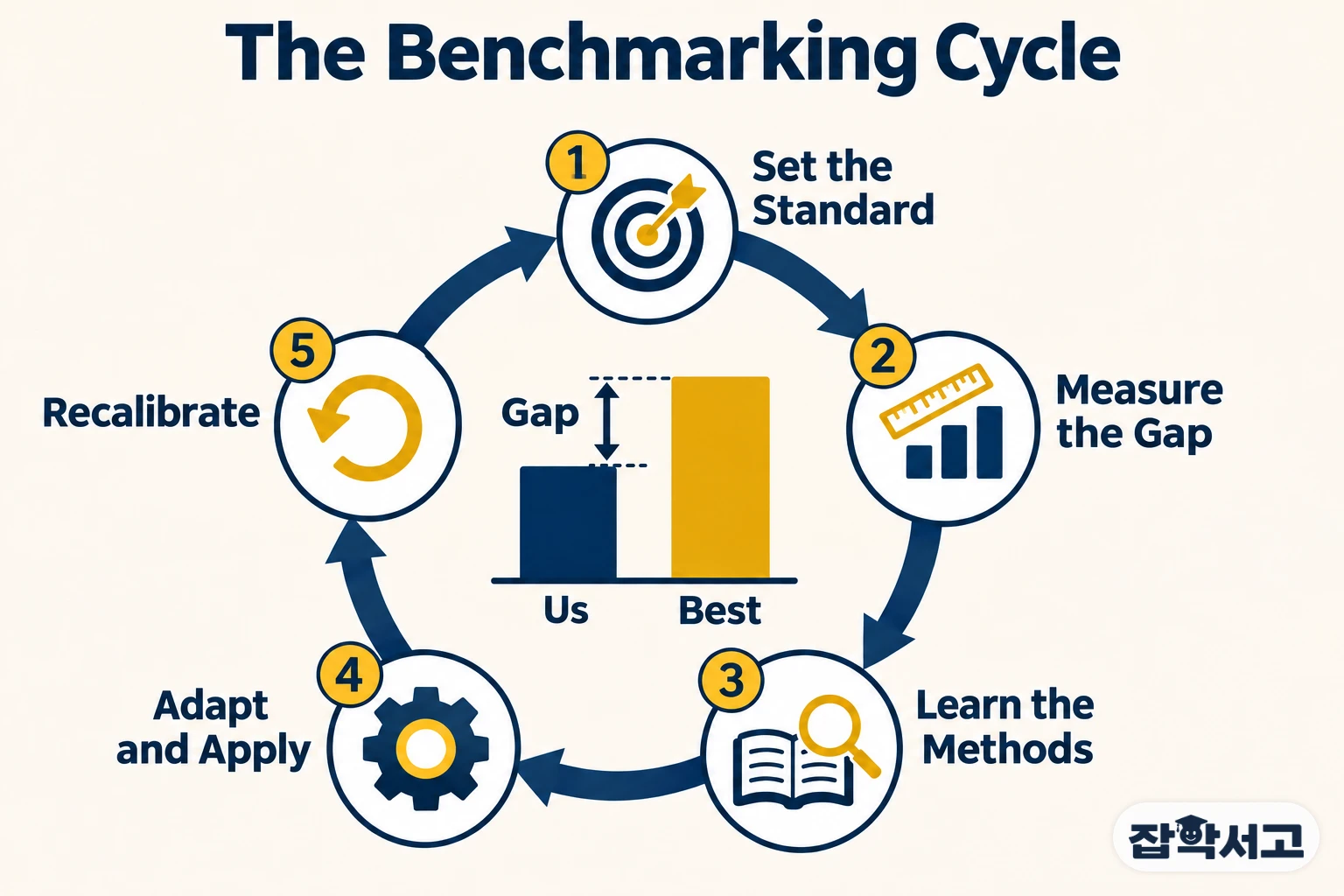
Camp divided this process into 10 steps and made the last one “recalibration,” resetting the standard.
He also divided benchmarking into four types according to whom you compare with: internal benchmarking against other departments in the same company, competitive benchmarking against direct rivals, comparison with non-competing companies, and generic process benchmarking, which compares the same work process regardless of industry.
For example, a company’s Seoul branch learning how its Busan branch serves customers is internal benchmarking, while a ramen maker comparing its packaging process with another ramen maker’s is competitive benchmarking.
The key is to look at the process rather than the result. Simply knowing that a rival’s prices are low teaches you nothing. Only when you find out why it can make things cheaply, and what working methods lie behind that, can you bring the lesson home.
That is why copying only the surface often fails. When the size of the company, its customers and the experience of its people differ, the same method produces different results. This is why benchmarking puts more weight on asking “Why did they do it that way?” than “What did they do?”
Benchmarking Around Us Today
In business, it is common to learn from other industries. A hospital, for instance, can learn how to welcome visitors from a hotel front desk, and a restaurant can learn how to handle a rush of orders from a logistics warehouse. The work may look different on the surface, but the processes underneath are similar.
The same flow works when you write a benchmarking report at work. If you set out, in order, what you will compare (targets and items), how big the gap is now (numbers), where the gap comes from (methods) and what you will change by when (an action plan), readers can see right away what to do next.

The “benchmark tests” used for computers and smartphones come from the same root. When everyone runs the same test program to get a score, the performance of different devices can be compared on a single scale. Just as the surveyor’s mark was a common yardstick for height, the test program becomes a common yardstick for performance.
Schools and public agencies also often call study visits to places with successful practices “benchmarking.” In Korea, phrases like “overseas benchmarking” and “benchmarking of advanced cases” are often used for field trips and training tours. But if it ends with just looking around, it is benchmarking in name only; it becomes real benchmarking only when you measure the gap and decide what to change.
You can use it in everyday life too. Rather than copying a top student’s notes word for word, real benchmarking means looking at when that friend reviews and what they organize first. Secretly taking someone else’s confidential information, however, is not benchmarking but cheating, so learn only from public information and within the limits the other side allows.
If kaizen, which steadily piles up small improvements, is the power to get better from within, benchmarking is the power to use the best level outside as a mirror. What Xerox learned in front of its rivals’ copiers was, in the end, that catching up begins the moment you admit someone else does it better.
Recommended reading