Toward the end of spring, there are days when the sea off the eastern coast of Gangwon Province is cool, while the regions to the west, beyond the mountains, are as hot and dry as midsummer. The same wind has merely crossed a high mountain range, yet the weather on either side feels completely different. The classic phenomenon that explains this curious difference is the “foehn effect.”
Put simply, the foehn effect refers to “the phenomenon in which moist air crosses a mountain and a hot, dry wind blows down the slope on the side the wind is heading toward.” The name foehn comes from the word once used for the warm wind descending from the mountains in the Alps, and today it is used broadly to describe winds that follow the same principle in mountain regions around the world.
This article explains, in easy-to-understand terms, everything from the basic definition of the foehn effect and the principle by which air changes temperature as it climbs and descends a mountain, to Korea’s Nopsae wind and Yanggan wind, and what the phenomenon means for preparing against drought and wildfires.
The Foehn Effect: The Changing Face of the Wind as It Crosses a Mountain
What Is the Foehn Effect?
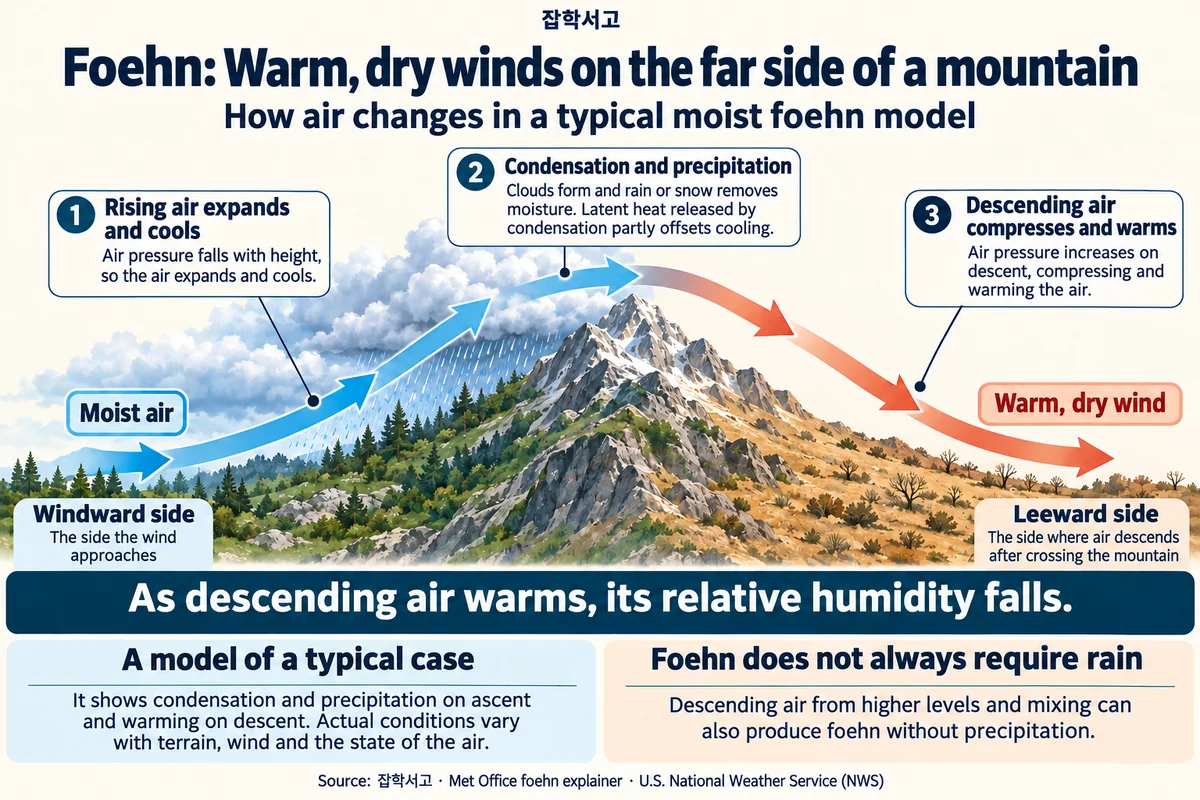

When wind meets a mountain, it cannot pass straight through, so it climbs up along the slope. The slope facing the oncoming wind is called the windward side (Windward), and the slope on the far side, down which the air descends after crossing the mountain, is called the leeward side (Leeward). The foehn effect is the process by which air that has lost its moisture by dropping rain or snow on the windward side descends to the leeward side and becomes a much warmer and drier wind than it was at the start.
What makes this phenomenon interesting is that the same air creates different weather on either side of a single mountain. Clouds and rain are frequent on the windward side, while the leeward side tends to have a run of clear, dry days. In effect, the mountain range acts as a boundary line for the weather. The names differ from region to region, such as the foehn of the Alps and the chinook of the Rocky Mountains, but the principle is the same. It can occur anywhere a mountain range blocks the path of the wind, making it an essential concept for understanding weather in mountainous areas.
Related concepts worth knowing alongside it are as follows.
- Windward side (Windward): The slope where the wind blows in and the air climbs up the mountain.
- Leeward side (Leeward): The slope down which the air descends after crossing the mountain.
- Rain shadow (Rain Shadow): A dry area behind a mountain range that receives little rain.
- Chinook (Chinook): A foehn-type wind that blows on the eastern side of the Rocky Mountains in North America, famous for rapidly melting accumulated snow.
How Air Temperature Changes as It Rises and Descends a Mountain

The key to the foehn effect is the adiabatic process (Adiabatic Process), in which air changes temperature as it moves up or down without exchanging heat with its surroundings. As air rises, the air pressure drops, so it expands and cools; as it descends, it is compressed and warms up.
(1) Dry adiabatic lapse rate
Air in which water vapor has not condensed cools by about 1℃ for every 100 m it rises. It warms at the same rate as it descends the mountain.
(2) Moist adiabatic lapse rate
When air cools to its dew point, clouds form, and from that point on, water vapor turns into water droplets and releases latent heat. As a result, the air cools by only about 0.5℃ per 100 m, cooling much more slowly.
(3) The difference between rising and descending
For example, suppose air at 20℃ begins forming clouds at an altitude of 1,000 m and crosses a 2,000 m mountain peak. It becomes 10℃ at 1,000 m and 5℃ at the summit. When this air, which has dried out by dropping rain, descends 2,000 m on the other side, it warms by 1℃ every 100 m and reaches about 25℃ at the foot of the mountain. It is now a full 5℃ warmer than when it started, and its humidity has dropped significantly.
In short, the foehn effect occurs because air cools slowly inside clouds as it climbs the mountain, then warms quickly as dry air on the way down. Having shed moisture as rain and snow on the windward side is another reason the leeward side becomes dry. The higher the mountain and the stronger the wind, the more pronounced this difference becomes.
The Foehn Effect in Korea: The Nopsae Wind and the Yanggan Wind

On the Korean Peninsula, the Taebaek Mountains, which stretch long from north to south, are the stage for the foehn effect. Which side becomes hot and dry depends on the direction from which the wind blows.
(1) Nopsae wind
Between late spring and early summer, when cool, moist air from the Sea of Okhotsk rides a northeasterly wind across the Taebaek Mountains, a hot, dry wind blows over the Yeongseo region on the western side of the range. This wind is the Nopsae wind, and it creates a contrast in which the Yeongdong region is cool and cloudy while the Yeongseo region is hot and dry. If it lasts a long time, crops can dry out and suffer damage. The name Nopsae comes from a native Korean word for the northeasterly wind.
(2) Yanggan wind
In spring, when wind blowing from the west crosses the Taebaek Mountains and descends to the east coast, it becomes a dry and very strong wind. It is called the Yanggan wind, meaning the wind that blows between Yangyang and Ganseong, and it is often cited as a cause of wildfires spreading widely in the Yeongdong region during this season.
The key point is that even with the same mountain range, when the wind direction changes, the side that becomes hot and dry is completely reversed.
The Foehn Effect and Preparing for Drought and Wildfires

The foehn effect does not stay confined to graphs in textbooks. When temperatures rise and humidity falls on the leeward side, crops dry out, and when strong winds sweep over dry forests, even a small spark can quickly grow into a large wildfire. In snowy mountain areas, warm winds can also melt snow rapidly, raising the risk of avalanches and river flooding. This principle is also often used to explain why weather forecasts show a wide temperature gap between the east coast and inland areas, or why dry weather advisories are issued.
Points worth remembering as you read are as follows.
- The weather beyond a mountain can be different. When reading the weather forecast, it helps to keep in mind that terrain changes temperature and humidity.
- When spring dry weather advisories coincide with strong wind forecasts, the risk of wildfires becomes very high. Managing any source of fire near mountains is especially important.
- When the Nopsae wind persists, it helps to water crops sufficiently and to make a habit of drinking water often for your health.
The foehn effect shows that a single mountain can change the character of the wind and even shake up a region’s weather and way of life. Understanding how wind changes as it crosses a mountain and turning those signals into everyday preparedness is the first step toward developing an eye for reading the weather.