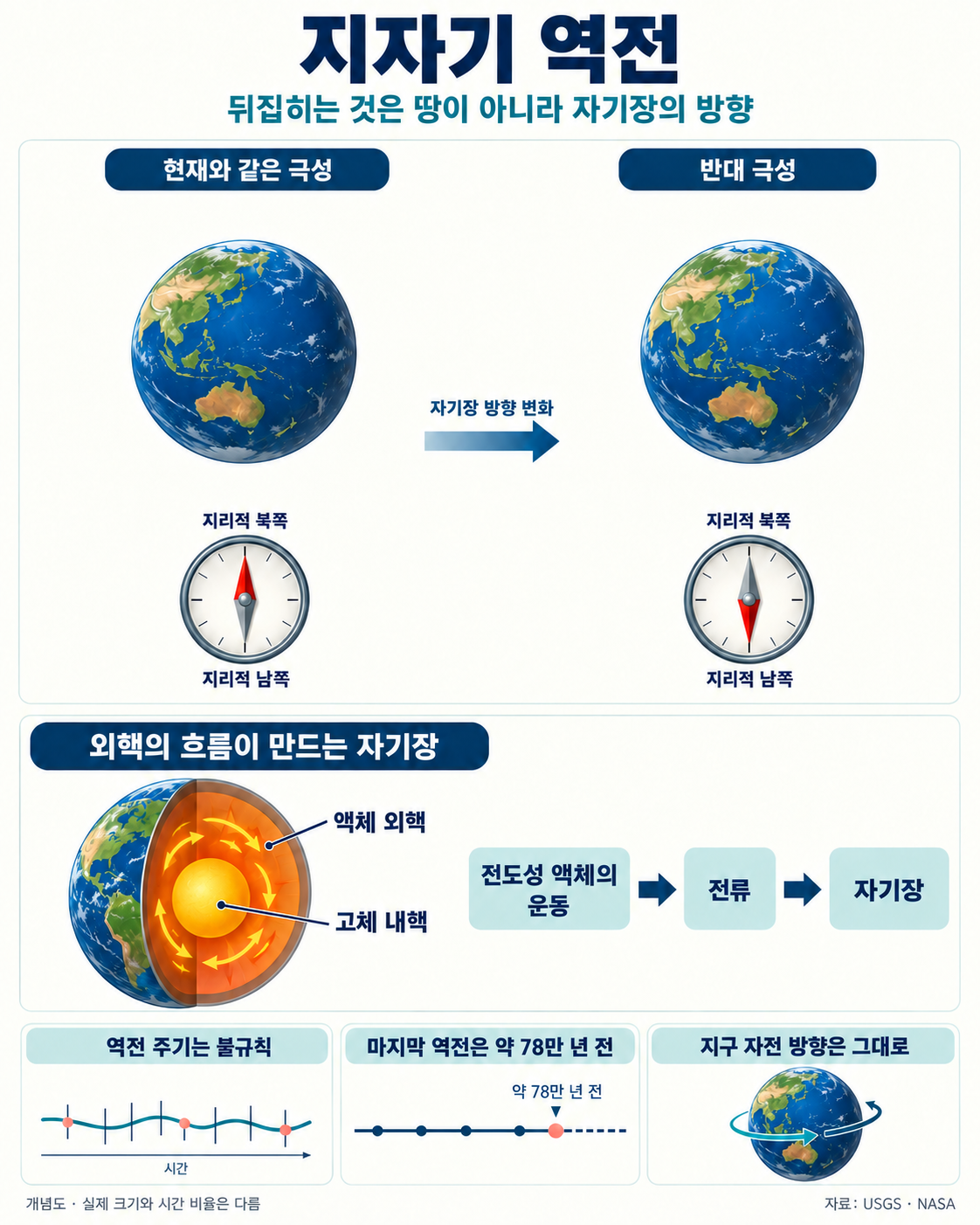
A compass needle always points north. Hikers and sailors of old alike trusted this fact to find their way. But if we trace Earth’s long history back, there were many periods when the compass needle would have pointed south, exactly the opposite of today. This astonishing phenomenon, in which Earth’s magnet flips over entirely, is called ‘Geomagnetic Reversal.’
Put simply, a geomagnetic reversal means ‘the north and south poles of Earth’s magnetic field trading places.’ The north and south poles here do not mean the geographic poles on a map but the direction of the magnetic field. The ground does not move and Earth does not spin backward; only the direction of the magnetic field generated inside Earth is reversed.
In this piece, we will look in turn at how Earth’s magnetic field is made, how scientists found traces of reversals, what happens while a reversal is under way, and the current state of Earth’s magnetic field.
The Secret of Earth’s Flipping Magnet
How Is Earth’s Magnetic Field Made?
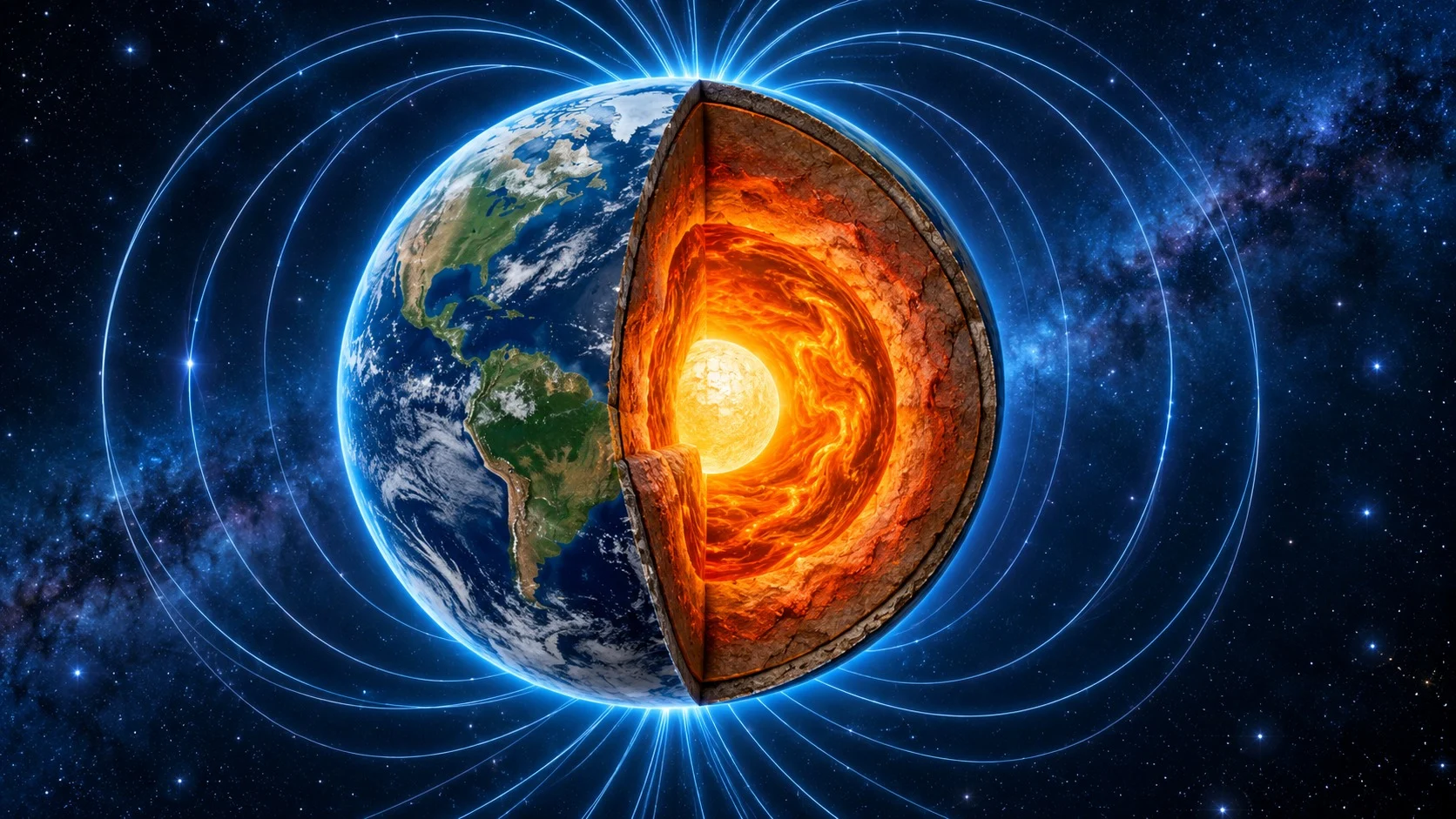
Deep inside Earth is a core made of iron and nickel. The inner core at the center is solid, but the outer core surrounding it is hot, molten liquid metal. As this liquid metal keeps moving, Earth’s magnetic field is created.
(1) The Geodynamo
Heat makes the molten iron churn up and down in convection currents, and Earth’s rotation twists that flow into swirls. When electrically conductive metal moves like this, electric currents flow, and those currents in turn generate a magnetic field. This self-sustaining process is called the geodynamo.
(2) A Tilted Bar Magnet
Earth’s magnetic field is often compared to a giant bar magnet placed at the center of the planet. This magnet is tilted about 11 degrees from the rotation axis, so the magnetic north a compass points to is slightly off from the North Pole on a map.
(3) An Ever-Changing Field
Because the flow in the outer core never stops even for a moment, the strength and direction of the magnetic field keep changing little by little. A geomagnetic reversal can be seen as a case where such change goes to the extreme.
Traces of Reversals Recorded in Rocks and the Seafloor

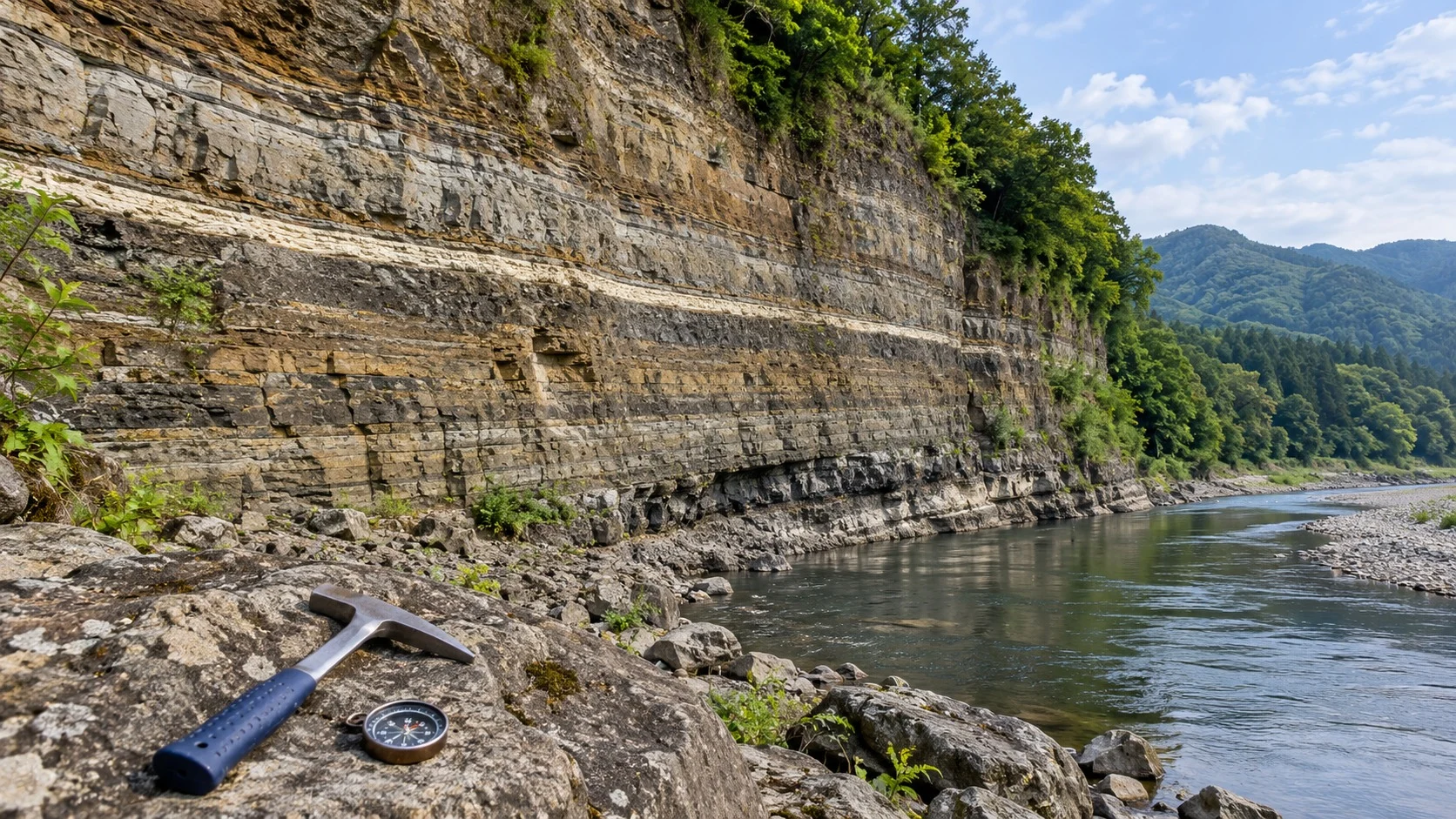
Scientists discovered reversals that happened long before humans were born through tiny magnetic grains in rocks. When lava cools and hardens, the iron-bearing minerals inside it line up with the magnetic field of that moment and freeze in place.
(1) Reversely Magnetized Volcanic Rocks
In the early 20th century, French geophysicist Bernard Brunhes first noticed that some volcanic rocks were magnetized in the direction opposite to today’s magnetic field. In the late 1920s, Motonori Matuyama of Japan showed that reversely magnetized rocks all came only from older strata.
(2) Zebra Stripes on the Seafloor
In the 1950s~60s, research vessels measured the magnetic field beneath the ocean and mapped it, revealing stripes along mid-ocean ridges in which normal and reversed directions alternated. In 1963, Frederick Vine and Drummond Matthews explained this as the result of new oceanic crust formed at the ridges spreading out to both sides while recording the magnetic direction of its time. This interpretation became decisive evidence supporting seafloor spreading and plate tectonics.
How Often and How Long Do Reversals Take?
Geomagnetic reversals happen irregularly, with no fixed cycle. They occurred at least 183 times over the past 83 million years, which works out on average to about once every few hundred thousand years, but there were also periods of tens of millions of years with no flip at all.
- The last reversal (Brunhes–Matuyama Reversal): It happened about 780,000 years ago and is called the Brunhes–Matuyama reversal after the two scientists. Because this reversal is clearly preserved in strata in Chiba Prefecture, Japan, in 2020 the geological age defined by these strata was named the ‘Chibanian.’
- Time a reversal takes (Transition Duration): Most are estimated to take about 1,000 to 10,000 years. One study suggests the last reversal took about 22,000 years.
- Brief departures (Geomagnetic Excursion): There are also events like the Laschamp Excursion about 41,000 years ago, in which the magnetic field swung sharply for a short time and then returned to its original direction.
The magnetic field does not disappear completely during a reversal. However, its strength weakens greatly, and small poles appear chaotically in many places before the field settles into its new direction over time.
Is Earth’s Magnetic Field Flipping Now?
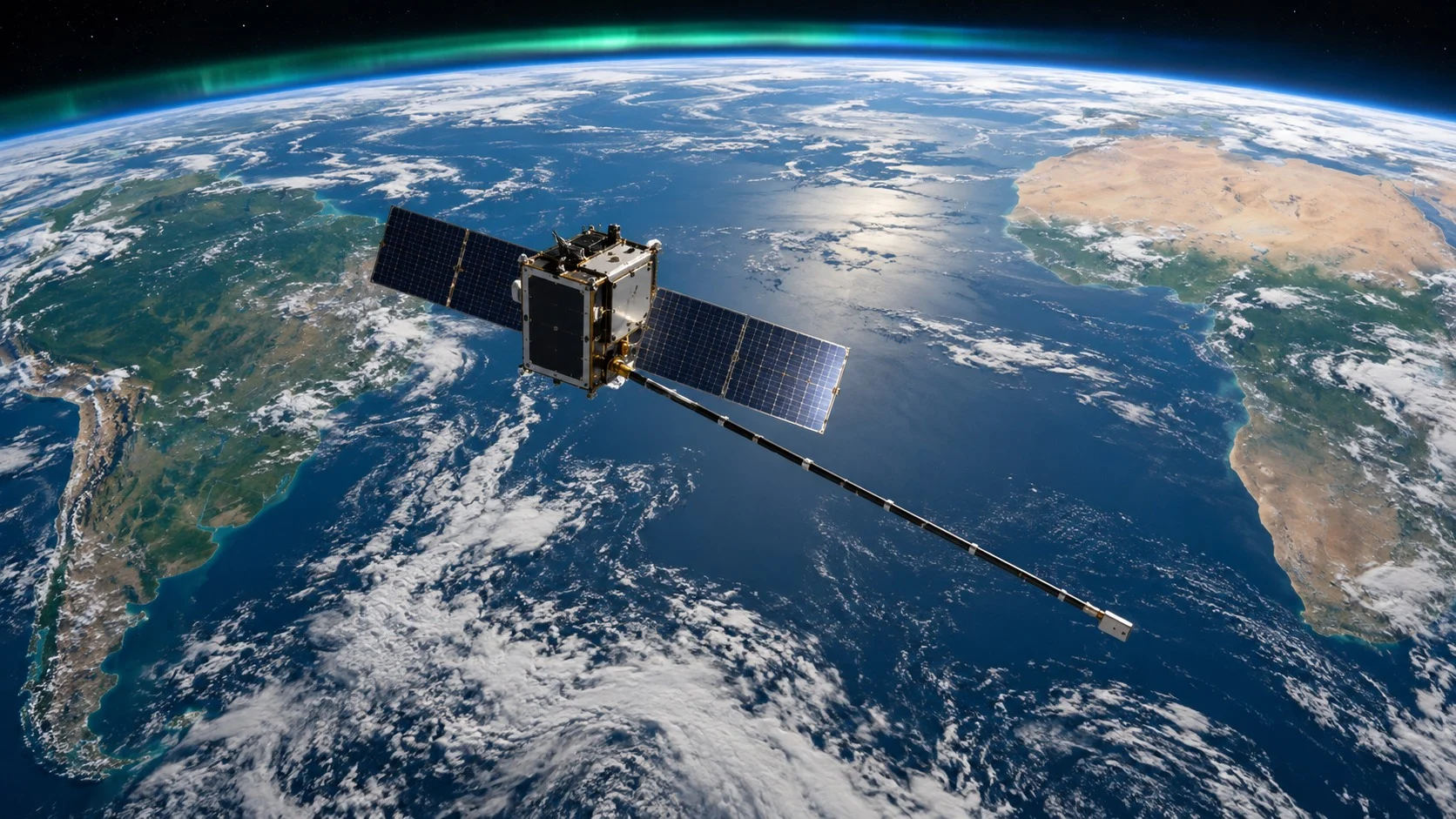
According to observations by the European Space Agency (ESA)’s Swarm satellites, Earth’s magnetic field has weakened by about 9% on global average over the past 200 years. That is why talk often comes up that a reversal might be about to begin.
(1) The South Atlantic Anomaly
In the skies between Africa and South America lies a wide region where the magnetic field is unusually weak. Satellites passing through it are more exposed to particles streaming in from space and are more prone to malfunctions.
(2) Not Yet a Cause for Worry
Scientists consider the current weakening to be within the range of natural variation. The present field is actually stronger than its long-term average, so there is little basis for thinking a reversal is about to begin.
(3) How It Relates to Our Lives
It has no noticeable effect on people at Earth’s surface, but changes in the magnetic field do affect satellite operations and navigation systems. That is why the World Magnetic Model, produced jointly by U.S. and U.K. agencies, is revised every five years and applied to smartphone maps and to navigation for aircraft and ships.
Geomagnetic reversal shows that liquid metal moving thousands of kilometers beneath our feet can affect the whole of planet Earth. Thanks to the records of tiny magnets left in rocks and the seafloor, scientists have become able to read even the history of drifting continents and the ages of rock layers.
Knowing that the long history of Earth is contained even in a familiar compass needle is the first step of earth science toward understanding our planet.