When you order late-night delivery food and then fall asleep, you may sometimes feel that your body reacts differently than it would if you had eaten the same calories during the day. Recent nutrition science is looking more closely at the fact that not only ‘what and how much we eat’ but also ‘when we eat’ affects metabolism and health. That is precisely ‘Chrononutrition.’
Simply put, chrononutrition refers to ‘research and practice that seeks to understand the effects of nutrition by aligning meal times and patterns with our body’s biological clock (circadian clock).’ It starts from the premise that hormones, digestive enzymes, and insulin sensitivity rise and fall in a rhythm that follows the 24-hour day.
This article lays out chrononutrition in an easy-to-understand way, from its concept and the structure of the body clock, to the key principles by which meal timing affects metabolism, common everyday examples, and points to keep in mind when putting it into practice.
The Concept and Practical Principles of Chrononutrition
What Is Chrononutrition?
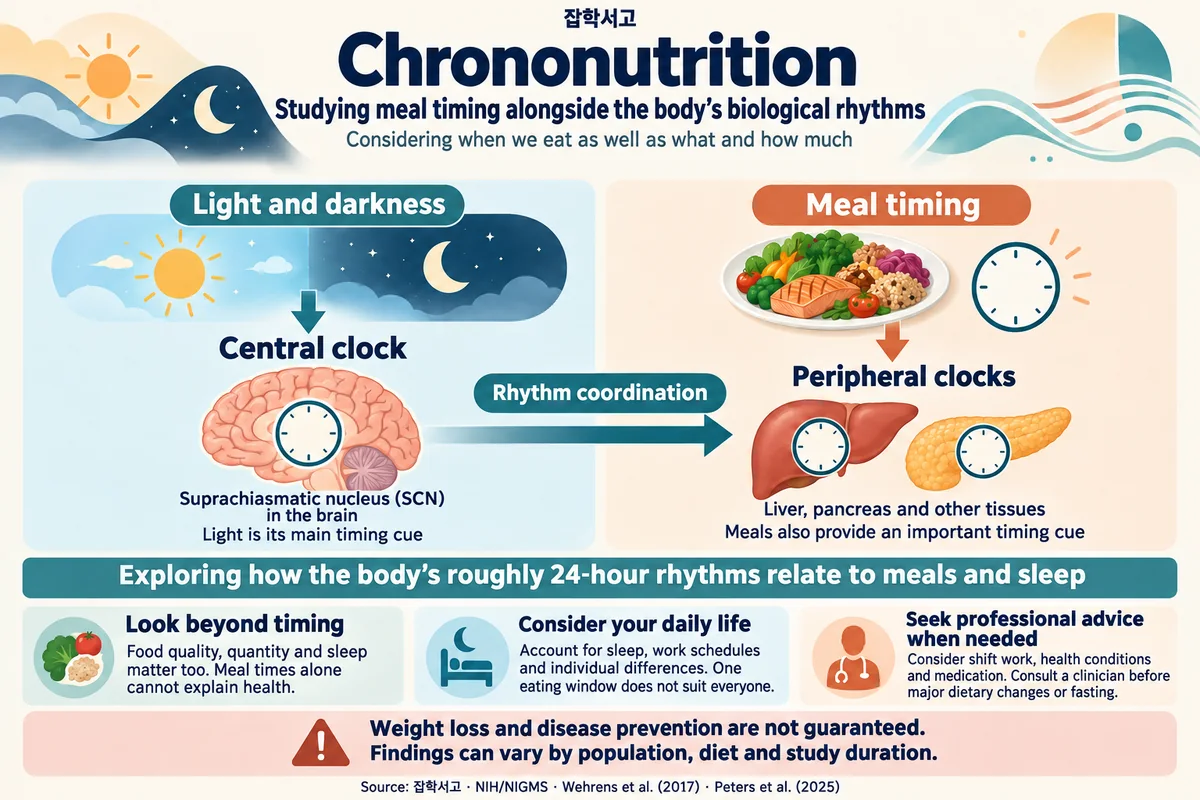

Chrononutrition is a field where chronobiology and nutrition science meet. In our bodies, the ‘suprachiasmatic nucleus (SCN)’ of the brain’s hypothalamus acts as the central clock, and peripheral organs such as the liver, pancreas, adipose tissue, and gut also have clocks of their own. Light strongly sets the central clock, while meal timing strongly sets the peripheral clocks.
In the morning, cortisol is relatively high and insulin sensitivity tends to be comparatively good, whereas at night melatonin rises and digestive and metabolic activity tends to slow down. Studies showing that even the same carbohydrate can produce different post-meal blood sugar responses depending on when it is eaten support this pattern. The fact that clock genes coordinate the timing of metabolic enzyme activity inside cells also shows that ‘when you eat’ is not merely a habit.
- Central clock: Sets the baseline of the daily rhythm in line with light and darkness.
- Peripheral clocks: Respond to meal and activity times to coordinate the metabolic timing of each organ.
The Key Principles by Which Meal Timing Drives Metabolism

The core focus of chrononutrition is not only ‘the amount of nutrients’ but also ‘the time at which nutrients come in and the intervals between them.’ In effect, it adds to the diet a time axis that calorie counting alone cannot reveal.
(1) The Daily Rhythm of Insulin Sensitivity
Many studies report that the ability to process glucose tends to be relatively better in the morning and early afternoon than in the evening and at night. This is why a high-carbohydrate meal late at night can place a greater burden on blood sugar and insulin than the same amount eaten during the day.
(2) The Eating Window and the Fasting Period
Narrowing the time of day during which you actually eat lengthens the overnight fasting period. This overlaps in part with intermittent fasting, but chrononutrition places more importance on ‘whether that window aligns with the body clock’ than on ‘how many hours you fast.’ Even with the same 8-hour window, starting in the morning and starting late in the afternoon can be read as different signals.
(3) Resetting the Peripheral Clocks
When meal times are erratic, as with irregular late-night snacking or shift work, the peripheral clocks can fall out of sync with the central clock. Observational studies continue to link this ‘circadian misalignment’ to metabolic burden.
(4) Interaction with Sleep
Overeating right before bed harms sleep quality, and lack of sleep can in turn upset the balance of appetite hormones and food choices. Meal timing goes hand in hand with sleep hygiene.
Understanding Chrononutrition Through Simple Examples

[Case 1] Same Calories, Different Times
A bibimbap eaten at lunch and the same bibimbap eaten at midnight are identical on a calorie chart. But at night, melatonin rises and digestive and insulin responses may differ from those during the day, so a ‘meal that is the same only in numbers’ can be read by the body as a different event.
[Case 2] Skipping Breakfast and Eating It All at Night
A pattern of having only coffee on a busy morning and then eating most of the day’s intake late in the evening is common. Even if the total amount is right, when the eating window is pushed later, from the chrononutrition perspective the risk of falling out of sync with the peripheral clocks increases.
[Case 3] An Eating Rhythm That Changes Only on Weekends
If you eat regularly on weekdays but repeatedly have late-night snacks only on weekends, your body can experience confusion similar to ‘social jet lag.’ In other words, even without traveling somewhere far across time zones, a disrupted eating rhythm alone can bring on a mild form of jet lag.
Points to Keep in Mind and Realistic Application

Chrononutrition is not an absolute rule such as ‘always eat a lot in the morning, and no dinner.’ Since sleep, work, and health conditions differ from person to person, you should refer to the principles but avoid excessive restrictions.
(1) Place Your Eating Window Toward the Daytime Whenever Possible
For the same total amount, distributing it across breakfast, lunch, and an early dinner rather than late at night is reported in many studies as a favorable signal. This does not mean you must eat a big breakfast; it is closer to the idea of shifting the day’s center of gravity earlier.
(2) Cut Back on Overeating 2–3 Hours Before Bed
If complete fasting is difficult, it is realistic to lower the burden with a light option instead of a heavy late-night meal. Falling asleep before digestion is finished can also affect the depth of sleep and how you feel the next day.
(3) Regularity Comes Before Extreme Fasting
Maintaining a consistent window of your own helps align the body clock more than having meal times that swing widely from day to day. The key is to keep weekends not too different from weekdays.
(4) Make Exceptions for Illness, Medication, and Shift Work
In special situations such as diabetes, pregnancy, a history of eating disorders, or night work, individualized consultation is needed. Rather than simply following trendy ‘time-restricted eating,’ it is safer to consult an expert.
Chrononutrition is a lens that broadens a meal plan from ‘a list of menu items’ to ‘a design of time and rhythm.’ If you consider when to sit down at the table along with what to choose, the signals the same food sends to your body can change.
Try moving your last meal before bed a little earlier, even just this evening. Slowly aligning your body’s clock with the clock of your dining table: that is the first step toward starting chrononutrition.