You have probably experienced it: the moment an ambulance approaching from a distance passes in front of you, its “wee-woo” siren suddenly turns lower and more drawn out. The ambulance didn’t change the pitch of its siren, so why does it sound so different to our ears? The law of physics hidden behind this familiar phenomenon is the “Doppler Effect.”
Put simply, the Doppler effect means “the phenomenon in which the observed frequency of a wave changes when the object emitting the wave, or the person observing it, is moving.” This principle applies equally not only to sound but also to light and radio waves, and it is widely used in everything from speed enforcement equipment to weather forecasting, hospital examinations, and even the astronomy that revealed the expansion of the universe.
This article lays out the Doppler effect in an easy-to-understand way, from its basic concept and working principle to the redshift and blueshift that appear in light, and examples of its use in everyday life.
The Principles and Applications of the Doppler Effect
What Is the Doppler Effect?

The Doppler effect is named after the Austrian physicist Christian Doppler. In a paper published in 1842, he proposed the hypothesis that “if a star moves toward or away from us, the color of its light will appear different.”
Three years later, this hypothesis was first proven with sound. In 1845, the Dutch scientist Buys Ballot put trumpet players on a moving train and had them keep playing the same note, while musicians with perfect pitch standing beside the tracks judged the pitch of the note. The result was just as predicted: the note sounded higher as the train approached and lower as it moved away.
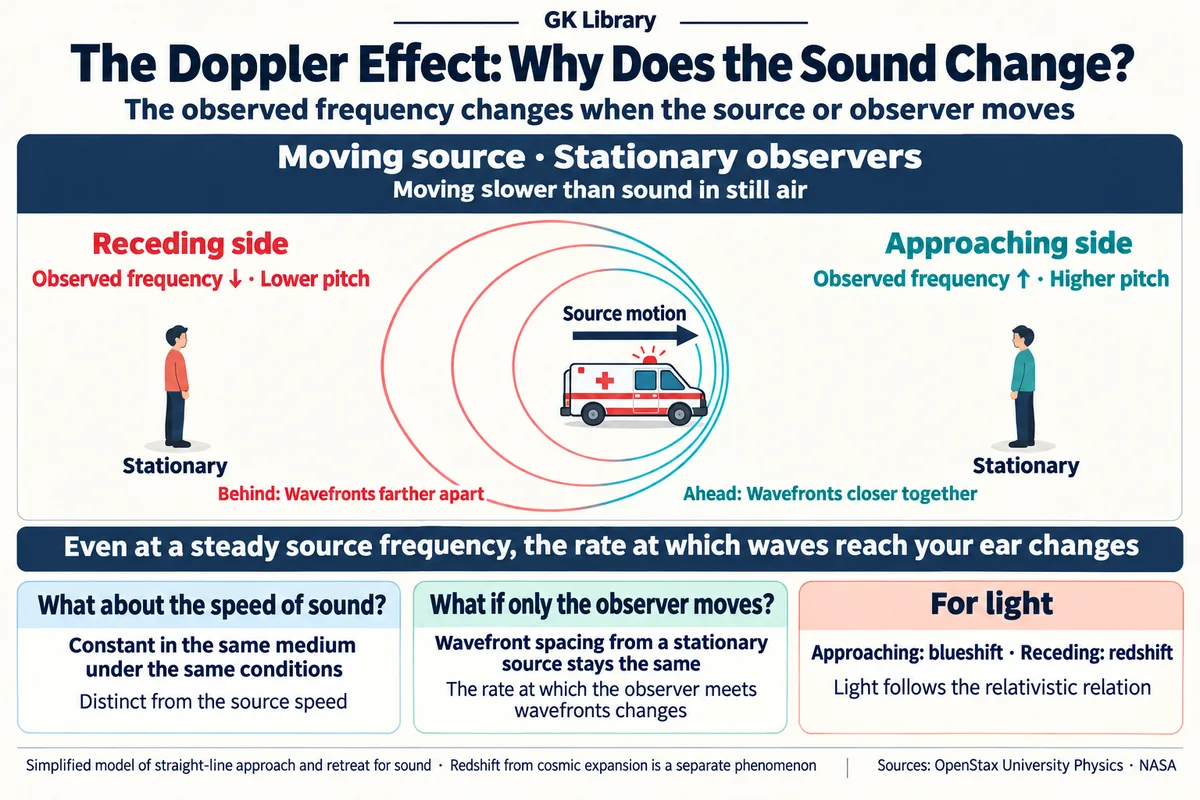
- Approaching: The spacing between waves becomes tighter, so the sound is heard as higher.
- Receding: The spacing between waves becomes wider, so the sound is heard as lower.
- Stationary: The sound is heard at its original frequency.
The Core Mechanism Behind the Change in Pitch

Sound is a wave that spreads through the air, and the higher its “frequency (Hz),” which indicates how many times it vibrates per second, the higher the pitch we hear. The key to the Doppler effect is that when the sound source moves, this frequency reaches the observer differently.
(1) The waves are compressed toward the front
When a sound source makes sound while moving forward, it emits each next wave while chasing after the wave it sent out just before. As a result, the waves ahead of it in the direction of travel bunch up tightly like ripples, while those behind it stretch out loosely.
(2) The shorter the wavelength, the higher the pitch
Because the speed of sound is constant at about 340m/s in the same air, when the spacing between waves (the wavelength) gets shorter, the number of waves reaching the ear each second increases. This is perceived as a higher pitch.
(3) An example in numbers
Let’s assume an ambulance sounding a 700Hz siren is traveling at 72km/h (20m/s). As it approaches, the siren is heard at about 744Hz, and as it moves away, at about 661Hz, so the moment it passes, the pitch drops sharply by more than about 80Hz.
If a sound source moves at the same speed as sound (Mach 1), the compressed waves pile up layer upon layer in one place, creating a huge shock wave. The “Sonic Boom” that thunders with a “boom” when a supersonic fighter jet slices through the sky is exactly the Doppler effect in its most extreme form.
The Doppler Effect in Light: Redshift and Blueshift
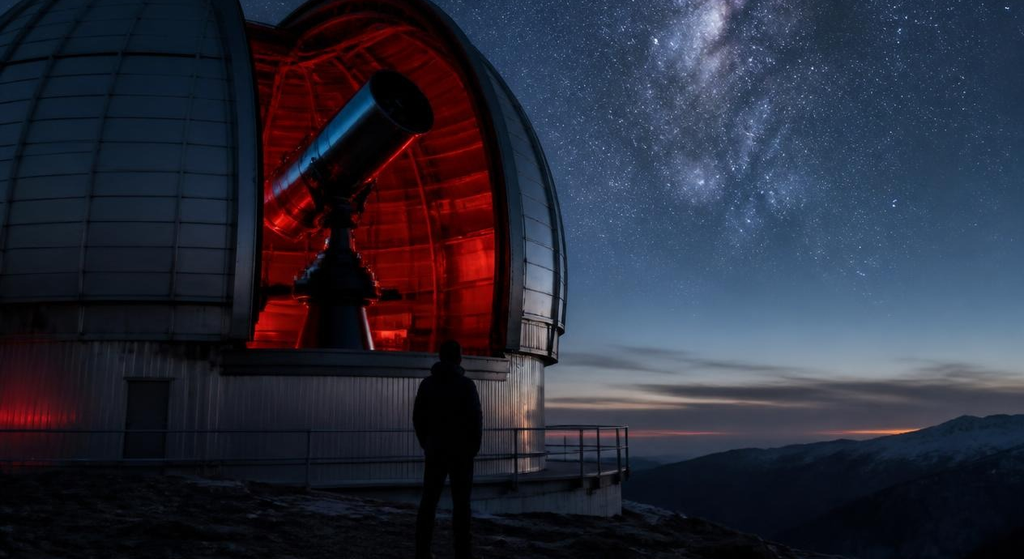
Just as Doppler first imagined, light is also a wave, so the same principle applies. However, because light travels at about 300,000km per second, we cannot perceive the change in everyday life; it is clearly observed in celestial objects such as stars and galaxies that move at tremendous speeds.
- Blueshift: When a celestial object approaches, the wavelength of its light becomes shorter and its spectrum shifts toward blue.
- Redshift: When a celestial object moves away, the wavelength of its light becomes longer and its spectrum shifts toward red.
In 1929, the American astronomer Edwin Hubble discovered that the farther away a galaxy is, the greater its redshift. This became decisive evidence that galaxies are moving away from us and that the universe as a whole is expanding. Strictly speaking, this is a “cosmological redshift” caused by the stretching of space itself, but the starting point for its interpretation was the Doppler effect.
In addition, in 1995 Michel Mayor and Didier Queloz analyzed tiny Doppler changes in starlight and found, for the first time, an exoplanet orbiting a Sun-like star, an achievement for which they received the 2019 Nobel Prize in Physics. They managed to read even the tremor in the light produced when a planet makes its star wobble slightly.
3 Everyday Applications of the Doppler Effect

The Doppler effect doesn’t stay as a theory in textbooks; it is used throughout our daily lives as a tool for accurately measuring the “speed” of moving objects from a distance.
[Case 1] Speed Guns for Speed Enforcement
A police speed gun fires radio waves at a moving car and then measures how much the frequency of the reflected radio waves has changed. A greater change in frequency means the car is moving faster, so its driving speed can be calculated in an instant.
[Case 2] Weather Doppler Radar
Weather radar analyzes radio waves reflected off raindrops in clouds to determine in which direction and how fast rain clouds are moving. This makes it possible to predict in advance the rotation of a typhoon or the approach of localized heavy rain.
[Case 3] Medical Doppler Ultrasound
A Doppler ultrasound exam at a hospital sends ultrasound waves at the red blood cells flowing through blood vessels to measure the flow and speed of the blood. On the screen, blood flowing toward the probe is usually shown in red and blood flowing away in blue, which helps locate places where blood vessels are narrowed or blocked.
The Doppler effect starts from the simple principle that “motion changes waves.” Yet with this single principle, we have come to understand an ambulance’s siren, measure the speed of cars on the road, look into the flow of blood inside our bodies, and even discover that galaxies billions of light-years away are moving away from us.
The next time you hear a siren drop in pitch as it fades into the distance, try to remember that within that sound lies the key that revealed the expansion of the universe. Asking “Why?” about familiar phenomena is the surest first step toward reading the world through the eyes of science.