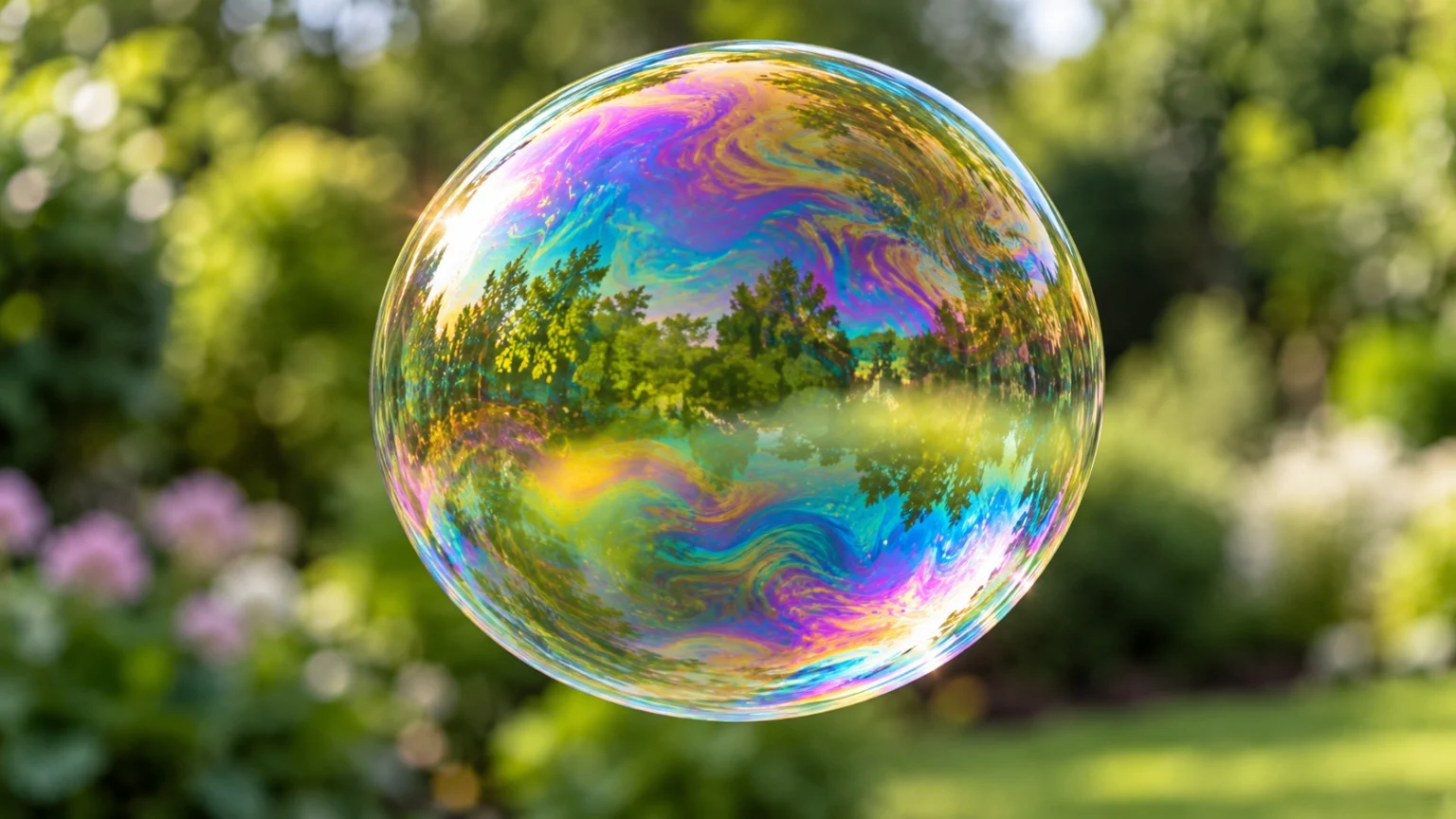
When you blow a soap bubble, pink, green, and blue hues swirl across its transparent film. After it rains, a little oil spreading over a puddle on the asphalt can leave a rainbow-colored stain. Soapy water and oil are almost colorless to begin with, so why do such brilliant colors appear?
The secret lies not in paint or pigment but in the nature of light. When light reflected from the top surface and the bottom surface of a very thin film overlaps, some colors grow stronger and others grow weaker. This phenomenon is called ‘Thin-Film Interference.’ It refers to what happens when a film is so thin that its thickness is close to the wavelength of light.
In this article, we will look in turn at the basic principle behind thin-film interference, the conditions that decide the color, everyday examples such as soap bubbles and oil slicks, and the uses hidden in eyeglass lenses and in living things in nature.
The Colors of Light Made by a Thin Film
Light That Reflects Twice
To understand thin-film interference, we first need to remember that light is a wave that rises and falls like ripples on water. When waves meet, they either add up or cancel each other out.
(1) The Top Surface and the Bottom Surface
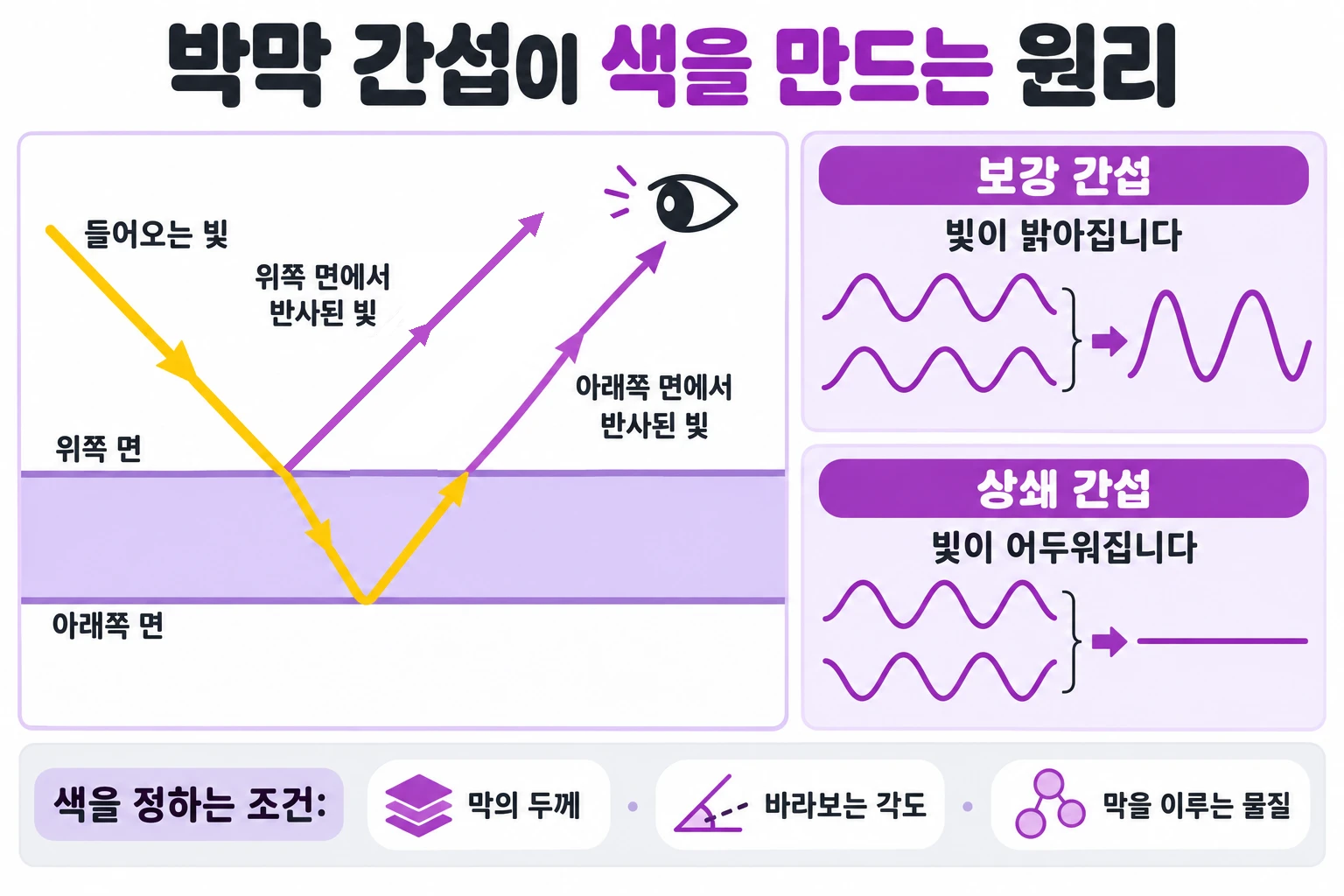
When light reaches a thin film, part of it reflects straight off the film’s top surface, while the rest enters the film, reflects off the bottom surface, and comes back out. So two beams of light that started out the same but traveled slightly different paths reach our eyes together.
(2) Constructive and Destructive Interference
When the crests of the two beams line up, the light becomes brighter; this is called constructive interference. On the other hand, when the crest of one overlaps the trough of the other, the beams cancel each other and the light grows dim; this is called destructive interference. The colors we see in thin-film interference are the result of these two effects happening differently for each color.
(3) Evidence for the Wave Theory
The colors of thin films were also observed by Robert Hooke and Isaac Newton in the 17th century. When Thomas Young explained these colors as the interference of light in the early 1800s, thin-film interference became important evidence that light is a wave.
The Conditions That Decide the Color
Sunlight is a mix of light of many colors, and each color has a different wavelength. The color we see depends on which color’s wavelength matches the extra distance the light has traveled inside the film.
(1) Film Thickness
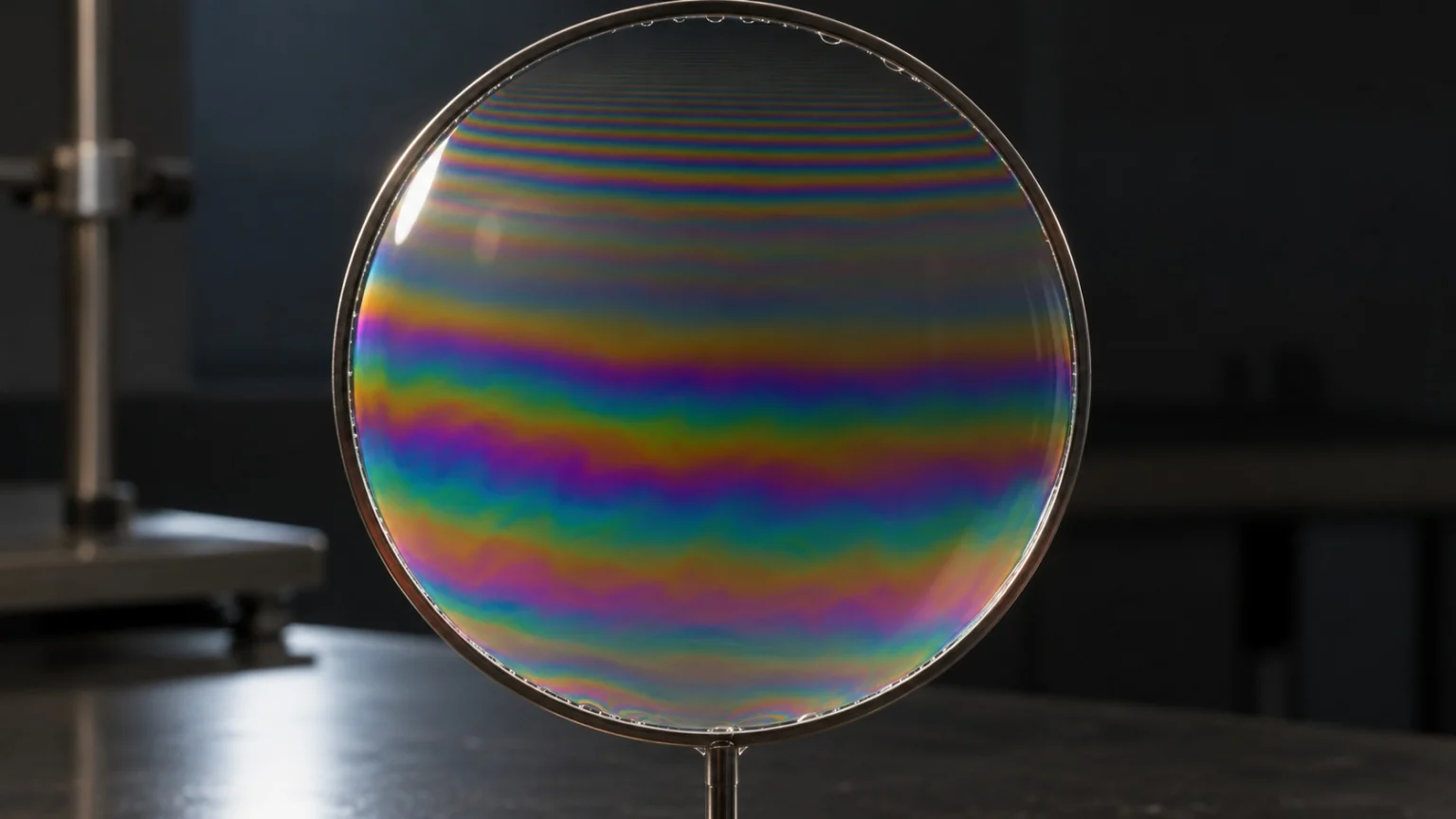
When the thickness of the film changes, the path difference between the two beams changes too. That is why, in a film of uneven thickness, a different color is strengthened at each spot, creating bands of many colors.
(2) Viewing Angle
Even with the same film, looking at it at a slant changes the distance the light travels inside it. This is also why the colors seem to shift when you turn a soap bubble this way and that. Simply moving where the viewer stands can change the color of the same spot.
(3) The Material of the Film
Light slows down inside a material, so even at the same thickness, the path difference varies with the material’s refractive index. In addition, when light reflects off the surface of a material with a higher refractive index, its wave is flipped by half a wavelength, and this effect also influences which colors remain. In a film surrounded by air, such as a soap film, only the light reflected from the top surface is flipped, so when the film has almost no thickness, the two beams cancel each other out.
Rainbow Colors in Everyday Life

Thin-film interference can be seen more often in daily life than in the laboratory. What all these cases have in common is a film about as thin as the wavelength of light.
- Soap Bubble: A soap film flows downward because of gravity and grows thinner from the top, and the bands of color move as its thickness changes.
- Black Film: When the film becomes far thinner than the wavelength of light, the two reflected beams cancel each other and it looks black, and around this point the bubble soon bursts.
- Oil Slick: A very thin film of oil spread over water creates patterns of different colors depending on its thickness.
- Newton’s Rings: When a convex lens is placed on a flat piece of glass, the thin layer of air between them creates a pattern of concentric rings, and the very center, where the lens touches the glass, looks dark.
Thin-Film Interference in Technology and Nature
People make use of thin-film interference, with its ability to cancel light or strengthen only the desired colors, in many technologies. Living things in nature have also long used the same principle.
(1) Anti-Reflective Coatings
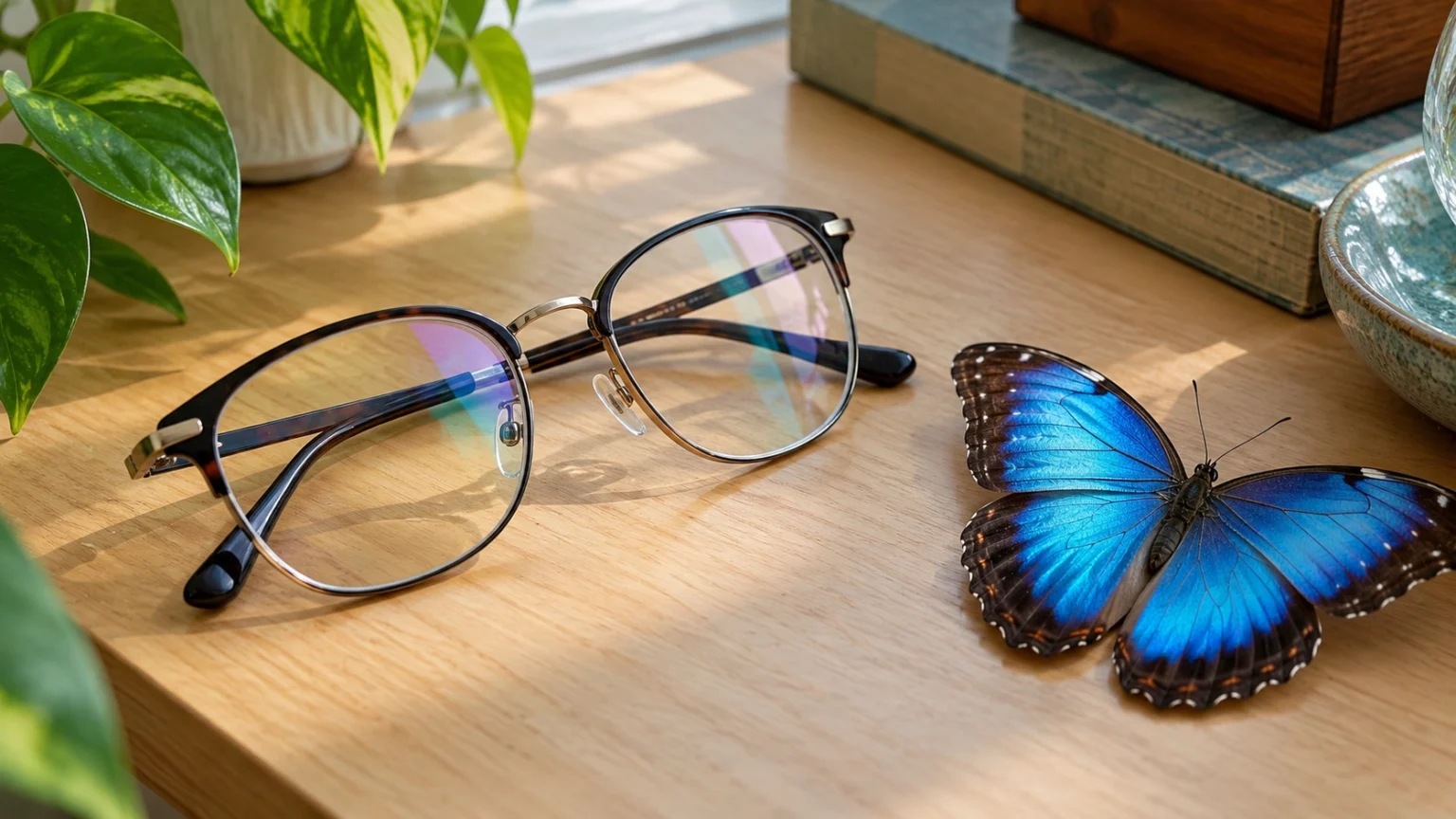
The surfaces of eyeglass and camera lenses are coated with a very thin film. When the thickness of the film is set just right, the light reflected from the surface cancels itself out, reducing glare and letting more light pass through the lens. The faint green or purple tint you see when you look at a coated lens at an angle also comes from reflected light of a few colors that were not canceled out.
(2) A Tool for Measuring Thickness
By turning around the fact that color changes with thickness, you can analyze reflected light to measure the thickness of a film too thin to see. This method is also used to check film thickness in semiconductor manufacturing processes.
(3) Color Without Pigment
The wings of the morpho butterfly and the shells of some insects produce shining colors not with pigment but with structures made of many thin layers stacked on top of one another. Colors like these are called structural colors, and the same principle as thin-film interference lies behind them.
Thin-film interference is a phenomenon in which the thickness of an invisible film and the wavelength of light meet to create color. It is fascinating that the rainbow colors of a soap bubble and the coating on an eyeglass lens come from the same principle.
Knowing that even a single familiar color hides the path that light has traveled is the first step of science in exploring the world of light.