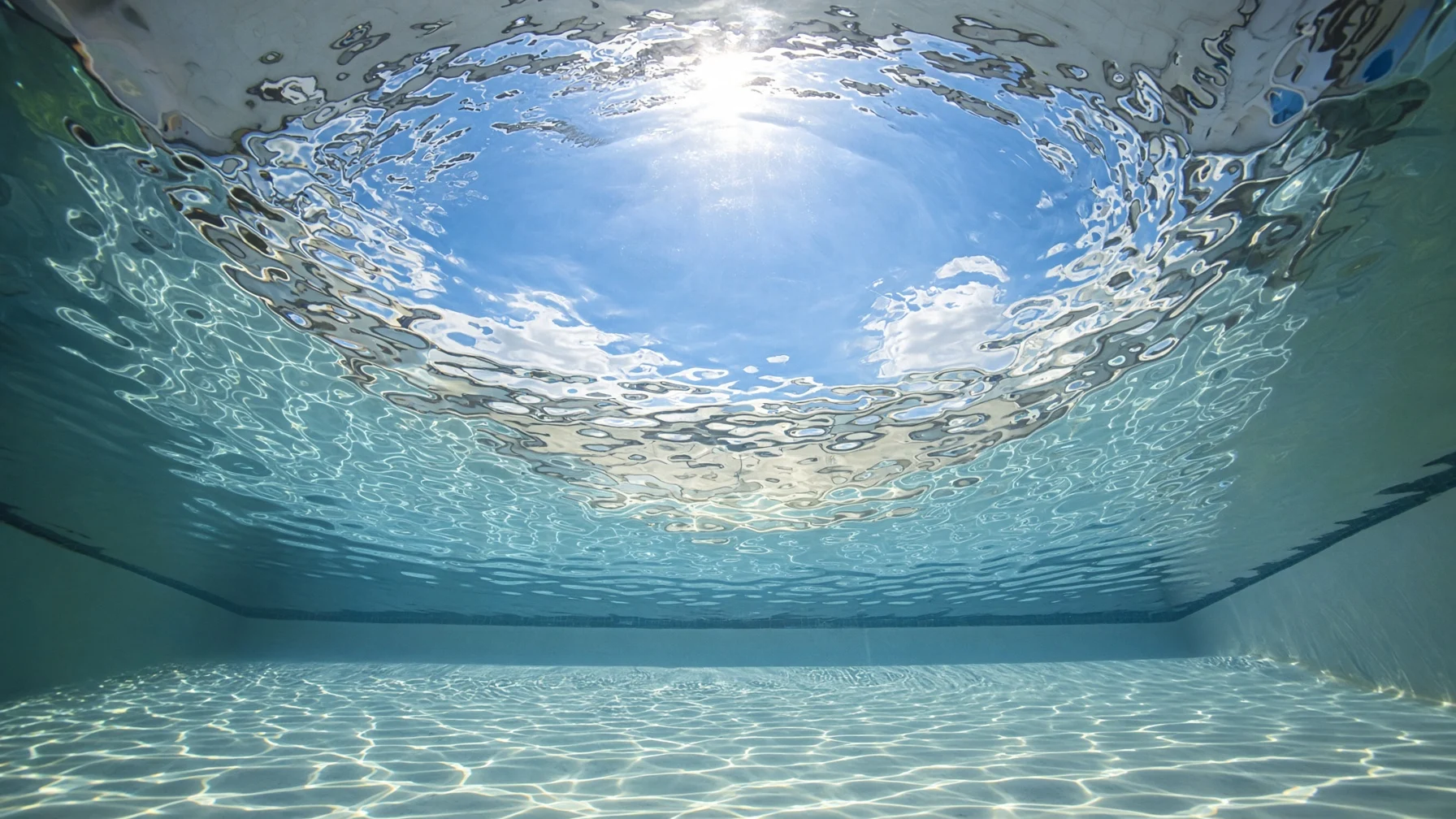
Have you ever sunk to the bottom of a swimming pool and looked up at the water’s surface? Overhead, the sky appears as a round window, while the surface outside it reflects the pool floor like a mirror. This happens because light in the water cannot pass through the surface and all of it comes back, and this phenomenon is ‘Total Internal Reflection.’
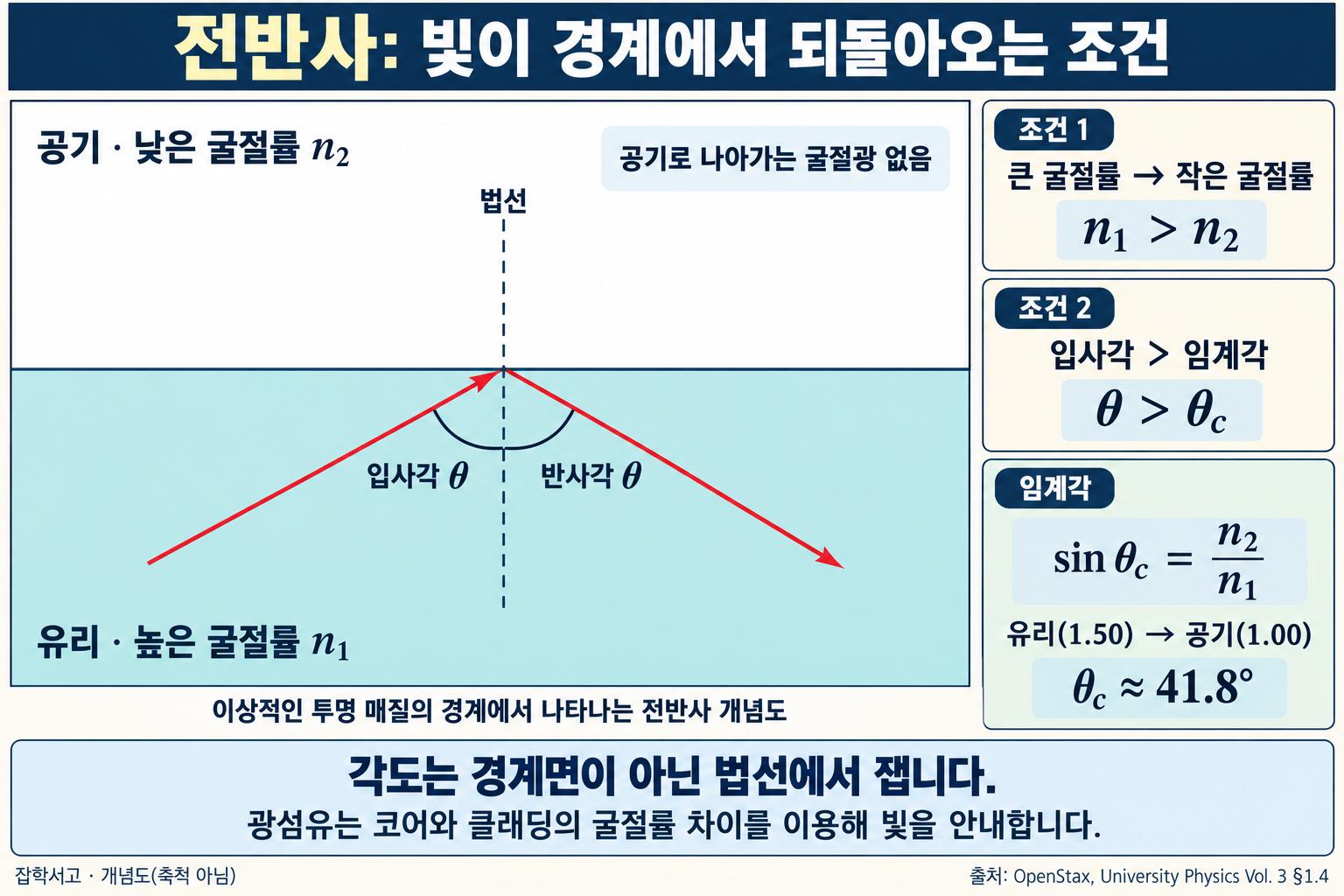
Put simply, total internal reflection means ‘the phenomenon in which light traveling from a material with a higher refractive index toward one with a lower refractive index cannot escape and is reflected entirely when it strikes the boundary at an angle larger than a certain value.’ Because it sends light back without loss even without a silvered mirror coating, it is widely used to carry light over long distances or bend it in a desired direction.
In this piece we will look in turn at the principle behind total internal reflection, the history of its first discovery inside a stream of water, the optical fibers that hold up the internet, and everyday examples in diamonds and binoculars.
The Principle and Uses of Total Internal Reflection, Which Traps Light
What Is Total Internal Reflection?
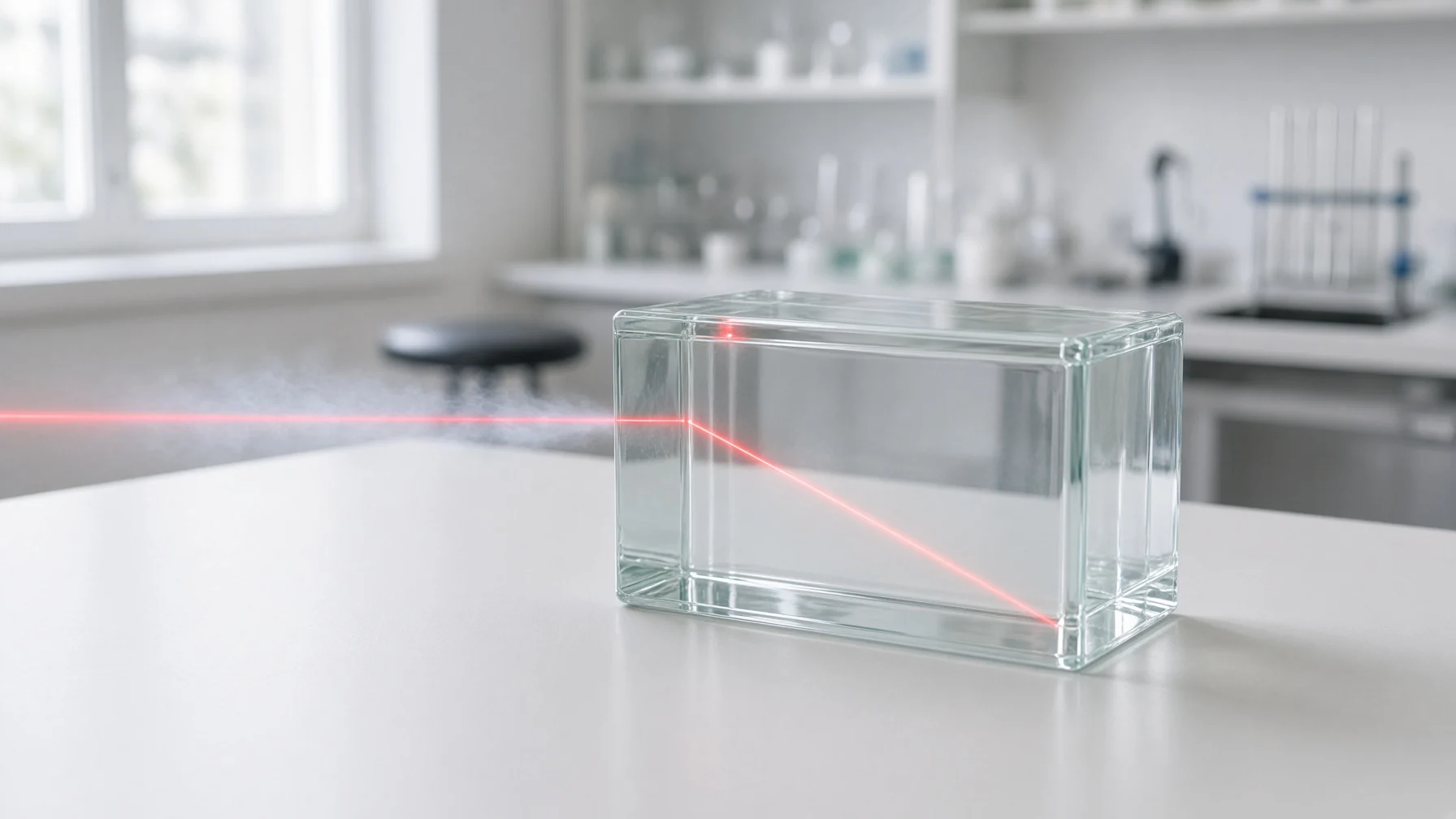
Light travels at different speeds in different materials, so its direction bends at the boundary when it passes from one material into another. This is refraction, and total internal reflection appears when this refraction can no longer occur.
(1) Refractive Index and Snell’s Law
The refractive index is a value showing how much light slows down in a material compared with a vacuum: about 1.0 for air, about 1.33 for water, and about 1.5 for glass. According to the law worked out in the early 17th century by the Dutch scientist Willebrord Snellius, when the refractive indices of two materials are n1 and n2, n1 × sin(angle of incidence) = n2 × sin(angle of refraction) holds.
(2) Critical Angle
Light going from water into air bends at the boundary, tilting further toward the surface. As the angle of incidence is gradually increased, there comes a moment when the refracted light travels flush along the surface, and the angle of incidence at that point is the critical angle. Once the angle of incidence exceeds the critical angle, not a single ray escapes and all of the light is reflected back inside.
- Water to Air: The critical angle is about 48.6 degrees.
- Glass to Air: The critical angle is about 42 degrees.
- Diamond to Air: The critical angle is very small, at about 24.4 degrees.
Total internal reflection occurs only when light goes from the side with the higher refractive index to the side with the lower one. Light entering water from the air is never totally reflected, however obliquely it shines.
Light That Curved Along a Stream of Water
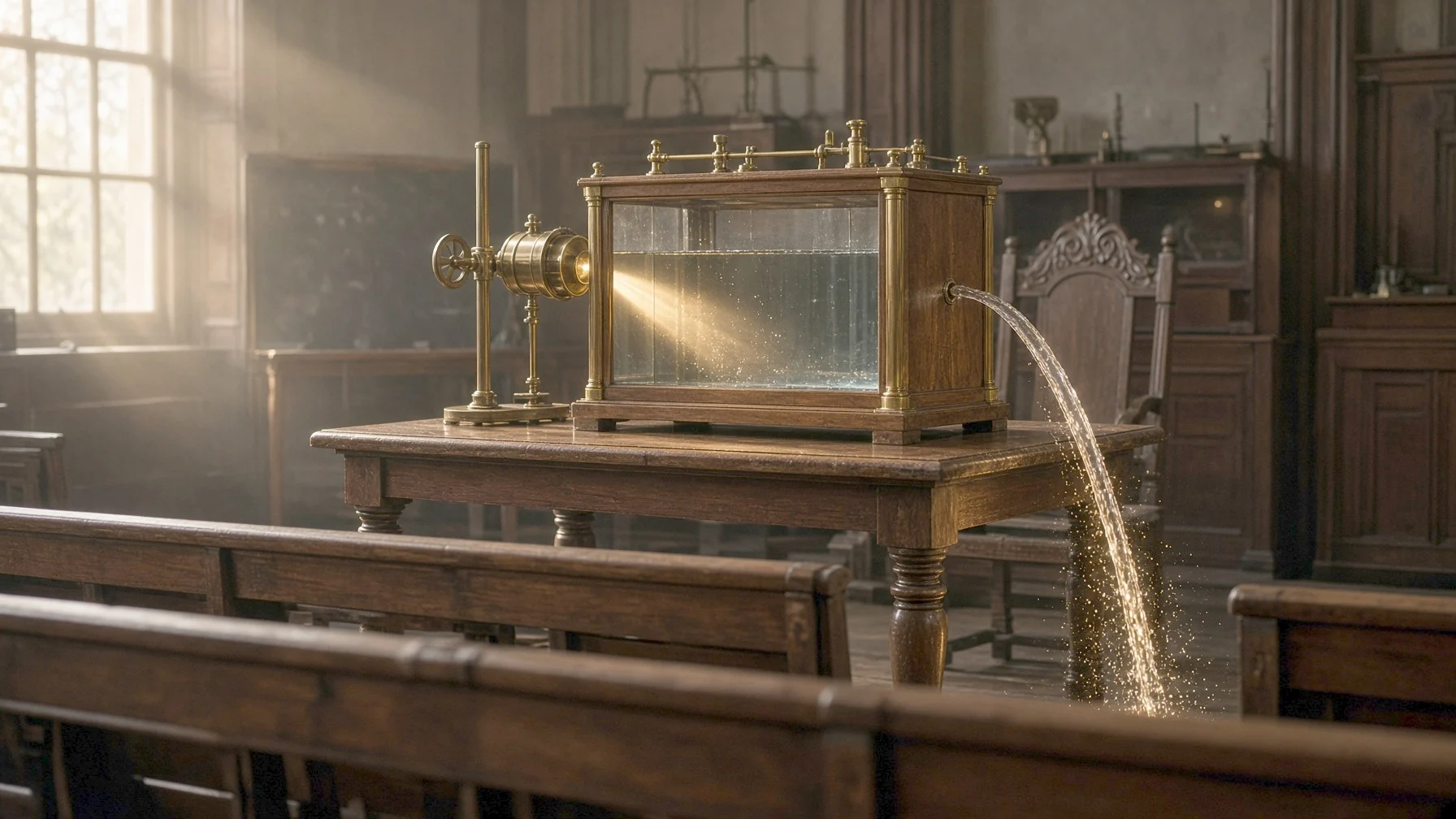
In an age when light was thought to travel only in straight lines, the first person to show that light could follow a curved path was the Swiss physicist Daniel Colladon. In 1841, while lecturing at the University of Geneva on streams of water spouting from a hole in a tank, he gathered sunlight and shone it from behind the tank to make the stream easier to see in the dark lecture hall.
The light then stayed trapped inside the stream as it fell in a parabola, curving along with it, and sparkled out at the end where the stream broke apart. This was because light reaching the inner wall of the stream struck it more obliquely than the critical angle and was totally reflected again and again. Colladon reported this experiment in 1842 in the journal of the French Academy of Sciences.
- Tyndall’s Demonstration: In 1854 Britain’s John Tyndall performed the same experiment in a lecture at the Royal Institution in London, making it widely known, and for a time it was even mistakenly said that Tyndall had discovered it first.
- Luminous Fountain: At major exhibitions in London and Paris in the late 19th century, this principle was used to carry light through every jet of a fountain, creating spectacular illuminated fountains.
Optical Fiber, Connecting the World with Light
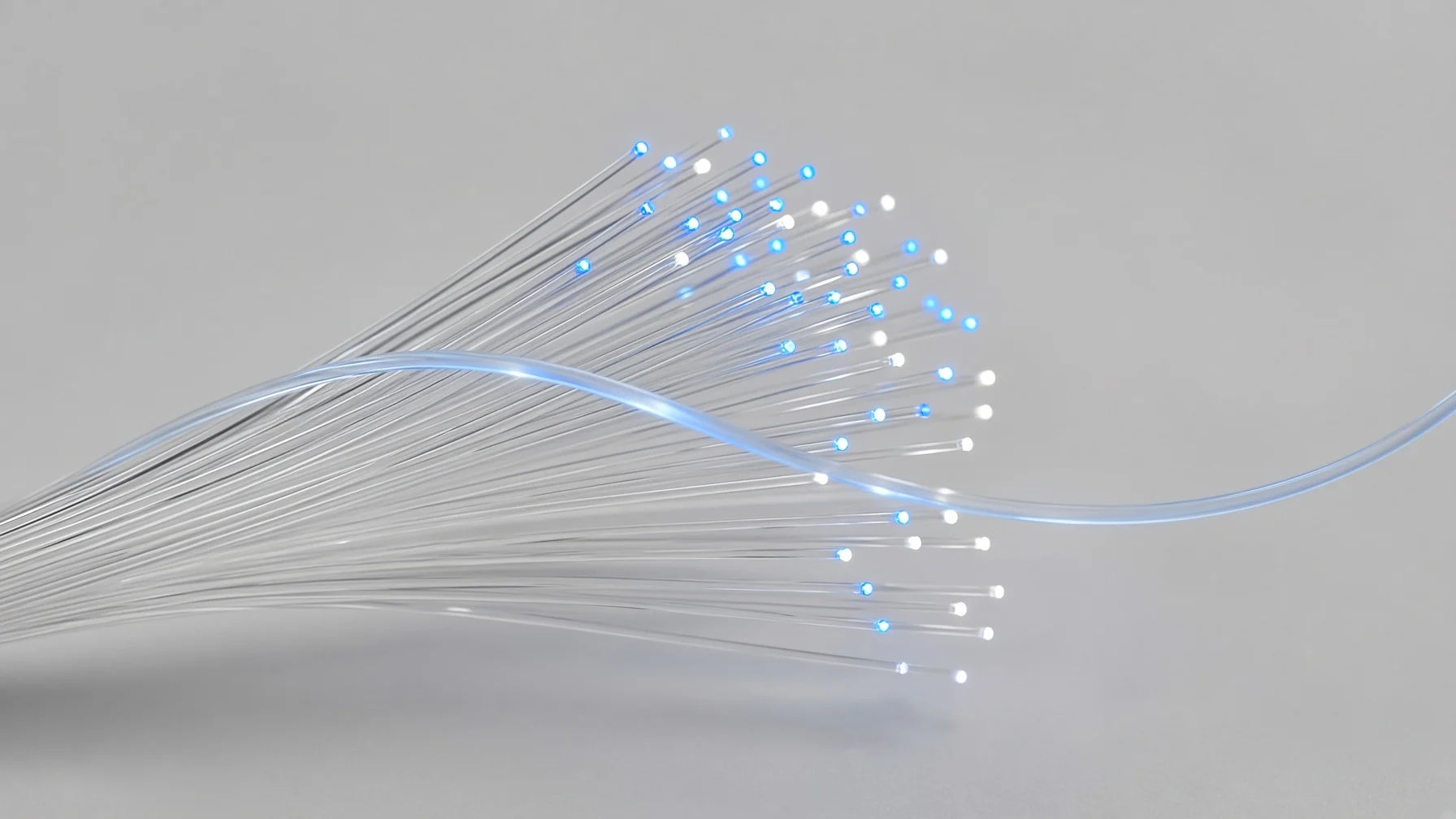
The place where total internal reflection does its biggest job is optical fiber. An optical fiber is a glass thread as thin as a hair, made up of a central part with a slightly higher refractive index and an outer layer around it with a slightly lower refractive index.
(1) Core and Cladding
A light signal travels along the central core, and each time it strikes the boundary obliquely it is totally reflected back inward. That is why, even when an optical fiber is gently bent, the light does not leak out and runs for tens of kilometers.
(2) The Challenge of Clear Glass
In 1966 Charles K. Kao and George Hockham published a paper showing that if impurities in glass were removed thoroughly enough, light loss could be cut to around 20 decibels per kilometer, making it usable for communication. Twenty decibels means that one hundredth of the light remains after one kilometer, but at the time the most transparent glass lost about 200 decibels per kilometer. In 1970 researchers at Corning in the United States made an optical fiber that lowered the loss to about 17 decibels, surpassing this goal, and Kao received the 2009 Nobel Prize in Physics for this achievement.
Today, the submarine cables that cross the ocean floor to connect continents are also made of optical fiber, so most of the data we exchange travels on totally reflected light.
Total Internal Reflection in Everyday Life
Total internal reflection is close to us outside laboratories and communication networks, too. Thanks to its advantage of sending light back fully without a silvered mirror, it is used in many optical instruments and in gem cutting.
- Diamond: With a small critical angle of about 24.4 degrees, light entering from above is totally reflected again and again off several facets before gathering and coming out through the top. The angled facets of the brilliant cut are designed to maximize this effect, creating the diamond’s signature sparkle.
- Binocular Prism: The right-angle prisms inside binoculars are positioned so that light strikes them at 45 degrees. Because this is larger than glass’s critical angle of about 42 degrees, they bend the light and set the image upright without any mirror.
- Snell’s Window: Looking up from underwater, the entire world above the surface appears packed into a circle about 97 degrees wide, while the surface outside it reflects the underwater scene like a mirror. The sky appears open only across twice the critical angle of 48.6 degrees.
- Endoscope: Bundles of thin optical fibers send light into the body and bring images back, making it possible to look inside the stomach or intestines without an incision.
Total internal reflection is the phenomenon in which light traveling from a material with a higher refractive index to one with a lower refractive index, striking the boundary more obliquely than the critical angle, comes back without a single ray leaking out. Beginning with a stream of water in a lecture hall, this discovery is still creating paths for light today in optical fibers, endoscopes, and sparkling gems. If we know the angle at which light cannot escape, we can also design the path light will take.
Understanding how light behaves when it turns back at a boundary is the first step in the technology of handling light.