Life consists of checking your smartphone as soon as you open your eyes each morning, working in front of a monitor all day, and enjoying content until bedtime. This routine is all too familiar to people today. To understand the blue light emitted by displays, we need to distinguish the evidence on screen-related eye strain, nighttime light and sleep, and retinal damage.
We will examine the scientific properties and health effects of blue light while distinguishing established findings from uncertainties. A product's ability to filter blue light must also be distinguished from evidence that it relieves eye strain or prevents disease.
What Is Blue Light?
(1) Blue Light Within the Visible Spectrum
Blue light is part of the shorter-wavelength region of visible light. NASA describes the full visible spectrum as typically spanning about 380–700 nanometers (nm). Blue light is only part of this range, and its wavelength boundaries can vary with the definition used.
The shorter the wavelength, the greater the energy of each photon. Blue light has a shorter wavelength than red light, but violet light occupies the shortest-wavelength end of the visible spectrum. Photon energy alone does not determine a source's brightness or its potential harm to people.
(2) The Difference Between Natural and Artificial Light
Many people mistakenly believe that blue light is harmful light emitted only by digital devices, but sunlight is also a major natural source of blue light. The blue sky we see during the day also results from blue light in sunlight scattering as it collides with particles in the air.
LED lighting, smartphones, computer monitors and televisions also emit blue light. Light cannot be classified as harmful simply because its source is artificial rather than natural. The effects of nighttime light on sleep depend on exposure timing, brightness and duration, among other factors, and should be distinguished from the question of whether ordinary screen use causes retinal damage.
Blue Light and Screen Use: Three Separate Questions
(1) Screen Use, Eye Strain and Dryness
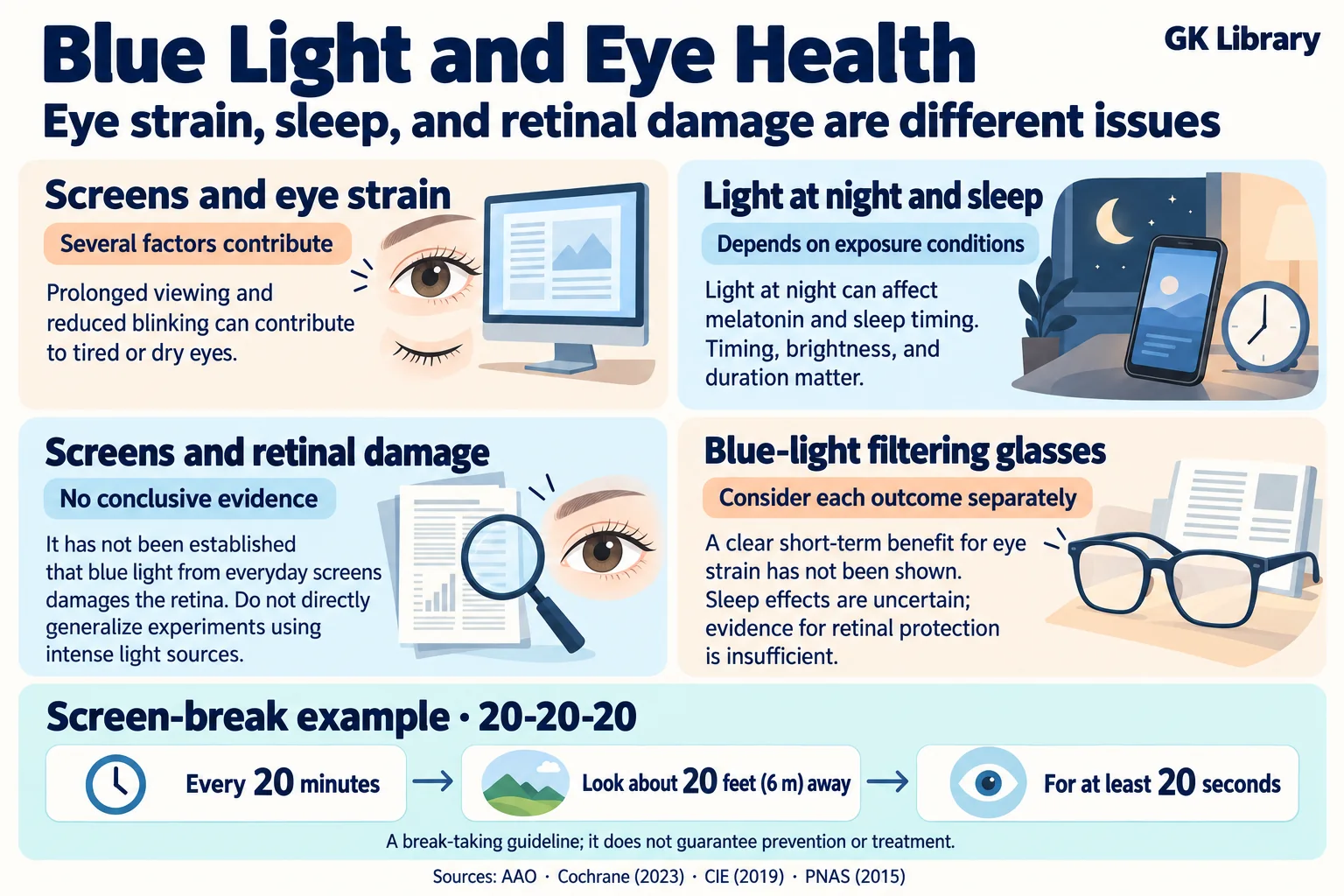
Prolonged screen viewing or close work can be accompanied by eye strain, discomfort and blurred vision. There is insufficient evidence to explain these symptoms solely by blue-light scattering or its focal position, or to conclude that blue light itself is the cause.
Screen-related discomfort involves several factors, including close work, reduced blinking, glare and lighting conditions. Concentrating on a screen can reduce blinking and contribute to dryness of the eye surface, but blinking does not necessarily fall by more than half or dry eye rapidly worsen in every person.
An important distinction:
Eye strain and dryness during prolonged screen use are different from light-induced retinal damage. Feeling eye strain does not, by itself, mean that blue light has damaged the retina.
(2) Nighttime Light, Melatonin and Sleep
The body has an approximately 24-hour circadian clock. Daytime light is one of the signals that regulates this rhythm and influences alertness; these effects cannot be explained by blue light alone.
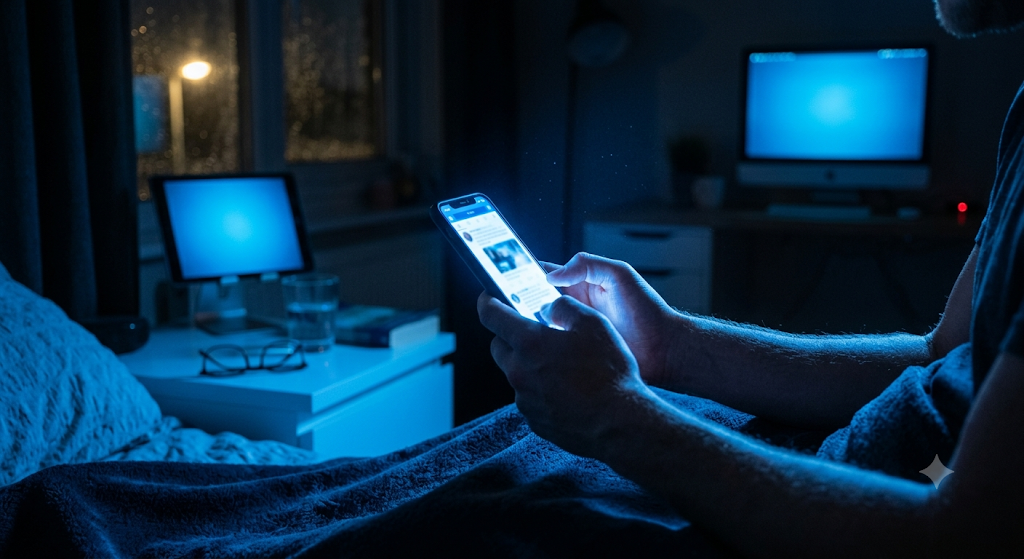
Depending on exposure conditions, light at night can suppress melatonin secretion or delay the circadian clock and sleep timing. Its effects vary with brightness, spectrum, timing and duration of exposure. Results from a controlled light-emitting e-reader experiment do not establish smartphone use for one or two hours before bed as a decisive cause of insomnia or chronic fatigue.
(3) Evidence on Ordinary Screen Use and Retinal Damage
The risk of photochemical retinal damage from intense light depends on light intensity and exposure conditions as well as wavelength. A particular wavelength range alone does not establish that ordinary display screens damage the retina.
Results from high-intensity light sources, animal studies or cultured-cell experiments should not be directly applied to normal human screen use. AAO guidance and the CIE position statement indicate that evidence has not established that blue light from ordinary screens damages the human retina or increases the risk of macular degeneration.
Screen Use and Eye Health: Evidence Behind Management Approaches
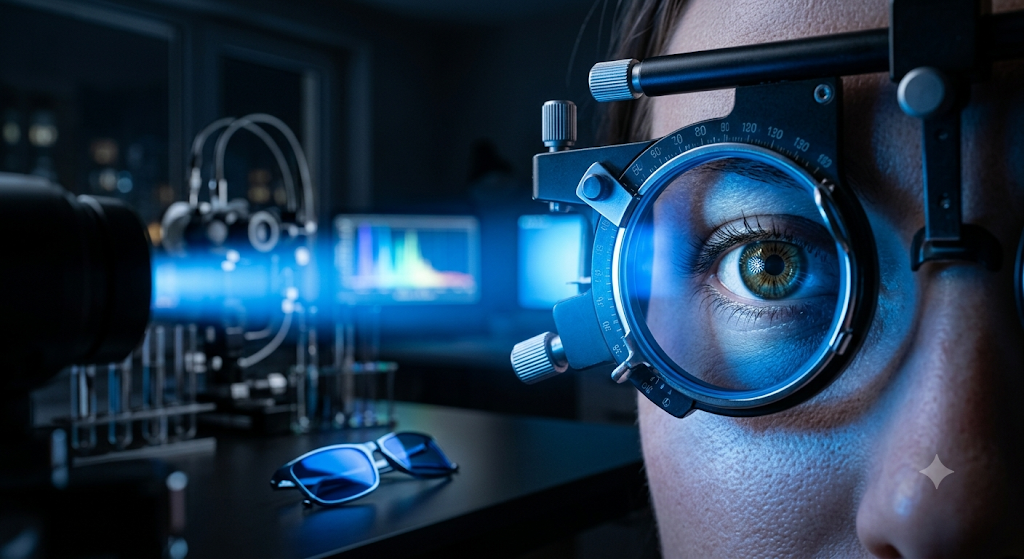
Habits that adjust the screen-use environment should be distinguished from the clinical effects of blue-light filtering products. The following sections consider general environmental adjustments and screen breaks, alongside the limits of evidence for filtering products.
(1) Using Display Software Settings
- Night mode: This setting reduces the blue component of a display and gives it a warmer color tone. Changing the screen's color alone cannot be assumed to resolve eye strain or sleep problems, or to protect the retina.
- Brightness adjustment: Reducing differences between screen and ambient brightness, and reducing glare, are general ways to adjust the screen-use environment. These adjustments should not be equated with preventing blue-light-induced retinal damage.
(2) Distinguishing the Effects of Blue-Light Filtering Glasses and Films
- Blue-light filtering glasses: A 2023 Cochrane review found no clear short-term advantage for eye strain compared with non-filtering lenses, with low-certainty evidence. Effects on sleep were uncertain, and none of the included trials assessed macular health. Glasses that correct vision or accommodate a working distance should be distinguished from blue-light filters.
- Screen films: Filtering particular wavelengths is different from demonstrating clinical benefits such as relief of eye strain or retinal protection. A claim that a film blocks blue light does not, by itself, establish a health benefit.
(3) The 20-20-20 Screen-Break Method
This is one example of a screen-break method described by the American Academy of Ophthalmology (AAO). It does not, on its own, guarantee disease prevention or long-term preservation of vision.
- Every 20 minutes: Look away from your monitor.
- At least 20 feet (about 6 meters) away: Look at a distant object rather than the nearby screen.
- For at least 20 seconds: Keep looking at that distant object during the break.
(4) Protecting the Tear Film and Providing Nutrients
- Use artificial tears: When your eyes feel dry, apply single-use artificial tears to keep the eye surface moist.
- Lutein and zeaxanthin intake: Regularly consuming nutrients that maintain pigment density in the retina's macula helps reduce oxidative damage caused by light.
Understanding Light and Screen Use Through the Evidence
Blue light does not need to be avoided altogether. Daytime light helps regulate circadian rhythms, while nighttime light can affect sleep depending on exposure conditions. These sleep effects do not mean that ordinary screen use damages the retina.
Eye strain, sleep changes and retinal damage are different outcomes, each requiring its own evidence. Night mode and 20-20-20 breaks do not guarantee what a person's vision will be like in ten years. A product's blue-light filtering performance should also be distinguished from its demonstrated health effects.