When a new technology appears, the world gets noisy, as if everything were about to be turned upside down. News reports say it will change everything within a few years, investment money pours in, and everyone rushes into related businesses. But when life has not changed as much as expected a few years later, people quickly grow disappointed and forget about the technology.
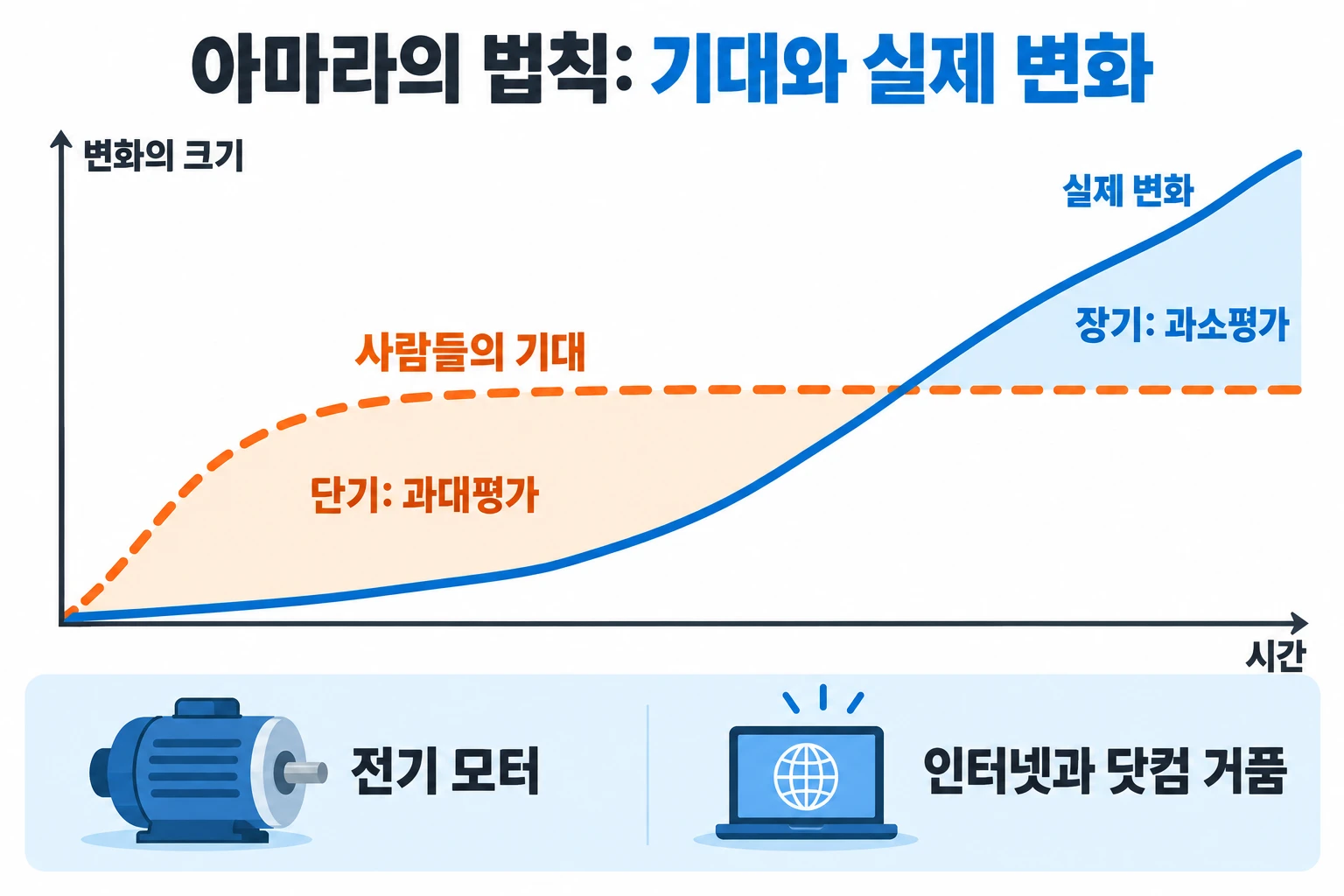
The saying that sums up this familiar scene in a single sentence is “Amara's Law.” Put simply, Amara's Law is the adage that people tend to overestimate the effect of a new technology in the short run and underestimate it in the long run. Early expectations get inflated, while the long, slow changes that actually transform the world are underestimated.
In this article, we will look in turn at where Amara's Law came from, why this illusion arises, historical cases where the law held true, and how to look at new technology calmly.
A Trap That Is Easy to Fall Into When Forecasting Technology
A Remark from Futurist Roy Amara

The law is named after the American futurist Roy Amara.
(1) A Man Who Studied the Future
Roy Amara worked at the Stanford Research Institute (SRI) and later served as president of the Institute for the Future, an organization that studies the future. For many years, he researched methods for forecasting how technology and society would change.
(2) An Adage That Became a Law
The words he left behind come down to one sentence: “We tend to overestimate the effect of a technology in the short run and underestimate the effect in the long run.” Known since the late 1970s, the remark came to carry his name and be called Amara's Law. It is not a law of nature, however, but a rule of thumb gained from long observation of how people predict the future.
(3) Similar Sayings
Bill Gates, the founder of Microsoft, made a similar remark in his 1996 book The Road Ahead, saying that people overestimate the change that will occur in the next two years and underestimate the change that will occur in the next ten.
Why Expectations and Disappointment Cross Paths

Amara's Law is less a description of technology itself than of the minds of the people looking at it.
- Novelty Excitement: A technology seen for the first time stands out and gives people plenty to talk about, so they easily believe it will change daily life right away.
- Linear Thinking: People tend to assume that change continues at a steady pace. So they are disappointed by slow progress at first and fail to foresee the change that picks up speed later.
- Complementary Changes: For a technology to reach its full power, roads, laws, education, and even ways of working must change along with it, and these changes take longer than expected.
(1) Disappointment in the Short Run, Surprise in the Long Run
In the end, results fall short of expectations for the first few years and disappointment grows; only after the surrounding environment slowly falls into place does change beyond anyone's forecast appear all at once.
(2) Voices That Inflate Expectations
Companies trying to sell a new technology, people trying to raise investment, and media trying to grab attention sometimes speak with one voice in offering rosy forecasts. That is why early predictions tend to be painted brighter than reality, and the disappointment that follows is just as large.
Amara's Law in History

This law has appeared again and again in the history of many technologies.
(1) Electric Motors in Factories
Even after electricity reached factories, productivity did not rise much for quite a while. That was because factories kept the layout from the steam-engine era and simply swapped in motors. Only after factory layouts and work methods were redesigned around electricity did productivity leap dramatically, over a span of decades.
(2) The Internet and the Dot-Com Bubble
In the late 1990s, it seemed that any internet company would succeed, and stock prices soared. When the bubble burst around 2000, many people doubted the internet's potential, but the internet went on to change shopping, banking, and even the way we communicate, entering daily life far more deeply than people had expected at the time.
(3) The Hype Cycle
Since 1995, the research firm Gartner has published the “Hype Cycle,” a graph showing how a new technology passes through a peak of expectations and a trough of disillusionment before finding real-world use. The graph is like a picture of Amara's Law.
How to Look at New Technology Calmly

Amara's Law can be read as advice not to get carried away by a new technology, nor to give up on it too easily.
(1) Be Skeptical of Short-Term Promises
When you hear that “everything will change within a few years,” it is wise to first check whether the infrastructure and institutions that change requires are already in place.
(2) Prepare for Long-Term Change
Conversely, even a technology that has gone quiet for a while is worth learning about and preparing for, imagining what it will look like in ten years, if it keeps steadily improving.
(3) See the Period of Disappointment as an Opportunity
A time when interest has cooled is also a time when you can calmly examine a technology's usefulness and learn it properly before others do.
(4) Think in Separate Time Frames
When forecasting a technology's future, thinking separately about one year, five years, and ten years from now can reduce both excessive expectations and excessive indifference.
Amara's Law shows not the speed of technology but how easily our expectations are swayed. If you know the gap between a loud first impression and a quiet, long change, you can keep your balance even amid the commotion surrounding new technology.
Telling today's commotion apart from tomorrow's change: that is the first step toward the wisdom of foreseeing the future of technology wisely.