How would people 100 years ago have seen a world where a single spoken word turns on the lights and you can talk face to face with someone on the other side of the planet? Probably not much differently from a wizard’s spell. British science fiction writer Arthur C. Clarke summed up this idea in three short sentences, which people now call “Clarke’s Three Laws.”
Simply put, Clarke’s Three Laws are “three maxims warning us not to rush to judgment about what science and technology can do.” The first and second laws came from Clarke’s 1962 essay collection on forecasting the future, Profiles of the Future, and the third law was added in the revised edition of 1973.
In this article, we will look in turn at the background of Clarke’s Three Laws, the meaning of each law, moments in history when the laws proved true, and how to read these laws today.
Three sentences about the line between possible and impossible
The background of Clarke’s Three Laws

Arthur C. Clarke (1917–2008) was a writer born in England who later spent the end of his life in Sri Lanka. He is best known for creating 2001: A Space Odyssey (1968) together with director Stanley Kubrick. Besides novels, he also wrote steadily about science and the future.
(1) An essay on why prophecies fail
In “Hazards of Prophecy: The Failure of Imagination,” published in Profiles of the Future in 1962, Clarke examined cases in which brilliant scientists declared new technologies “impossible” and turned out to be wrong. The first law came from this essay.
(2) A “second law” named by readers
Readers began calling another sentence from the same essay the second law: “the only way of discovering the limits of the possible is to venture a little way past them into the impossible.” Clarke accepted the name.
(3) Stopping at three, like Newton
In the 1973 revised edition, Clarke added the third law: “Any sufficiently advanced technology is indistinguishable from magic.” He joked that since three laws had been enough for Isaac Newton, he would modestly stop at three as well.
The meaning of the three laws at a glance

The three laws are short, but each points in a different direction. The first is about authoritative judgments, the second about an experimental attitude, and the third about the way we look at technology.
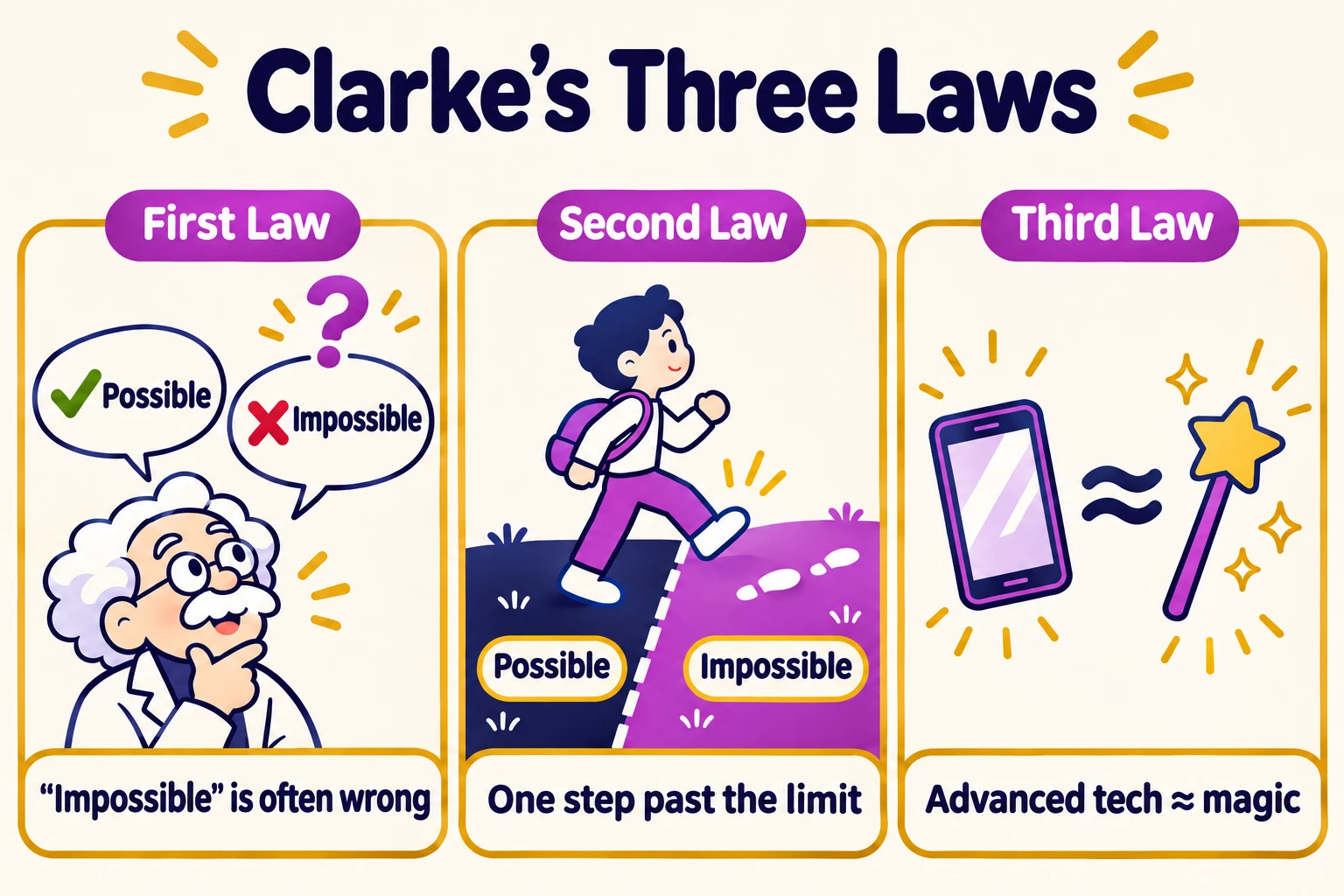
- First Law (Clarke’s First Law): When a distinguished but elderly scientist states that something is possible, he is almost certainly right; when he states that something is impossible, he is very probably wrong.
- Second Law (Clarke’s Second Law): The only way of discovering the limits of the possible is to venture a little way past them into the impossible.
- Third Law (Clarke’s Third Law): Any sufficiently advanced technology is indistinguishable from magic. It is the most widely quoted of the three.
- Gehm’s Corollary: A witty twist that flips the third law: “Any technology distinguishable from magic is insufficiently advanced.”
Here, “elderly” is not a criticism of age itself. The word points out that the more knowledge someone has built up, the easier it is to underestimate possibilities outside that framework. Clarke even joked that in physics, mathematics and astronautics, anyone over thirty already counts as “elderly.”
Moments in history when the laws proved true

Clarke’s laws are still talked about because similar scenes have appeared again and again in real history. Looking at moments when experts’ “impossible” was overturned, together with Clarke’s own imagination that went past a limit, makes the meaning of the laws clearer.
(1) The forecast that flying machines were unlikely
In several writings in the early 1900s, American astronomer Simon Newcomb expressed skepticism that heavier-than-air flying machines could become practical. Yet on December 17, 1903, the Wright brothers flew a powered airplane for about 12 seconds.
(2) Atomic energy called “moonshine”
In 1933, Ernest Rutherford, a pioneer of nuclear research, called the idea of extracting energy from atoms “moonshine.” After reading a report of the remark, physicist Leó Szilárd came up with the idea of a nuclear chain reaction that same year.
(3) A limit Clarke himself went past
In 1945, Clarke published an article in the magazine Wireless World suggesting that three satellites in an orbit about 36,000 km above the equator could link the whole Earth by communications. In 1964 the geostationary satellite Syncom 3 relayed the Tokyo Olympics to the United States, turning this idea into reality, and the geostationary orbit is still sometimes called the “Clarke orbit.”
How to read Clarke’s Three Laws today
Clarke’s Three Laws are not scientific laws proven by experiment but maxims that point out traps we easily fall into when thinking about the future. That is why they carry over directly into everyday life today.
(1) Question the word “impossible” again
When you hear an expert’s negative outlook, it helps to tell whether the reason is a law of nature or simply today’s level of technology. The former rarely changes, but the latter can change over time.
(2) Ask how it works, especially when it looks like magic
Read backward, the third law becomes a warning. Technology whose workings we do not understand looks like magic, so it is easy to be taken in by exaggerated ads or tricks. In front of a new technology, the habit of first asking “How does it work?” is helpful.
(3) Test limits with small experiments
The second law encourages us not to set limits by thought alone but to try things for ourselves. By repeating small experiments that carry little risk, we can gradually find out where the real limits lie.
The simple idea that today’s “impossible” may become tomorrow’s everyday life is the first step toward understanding Clarke’s Three Laws.