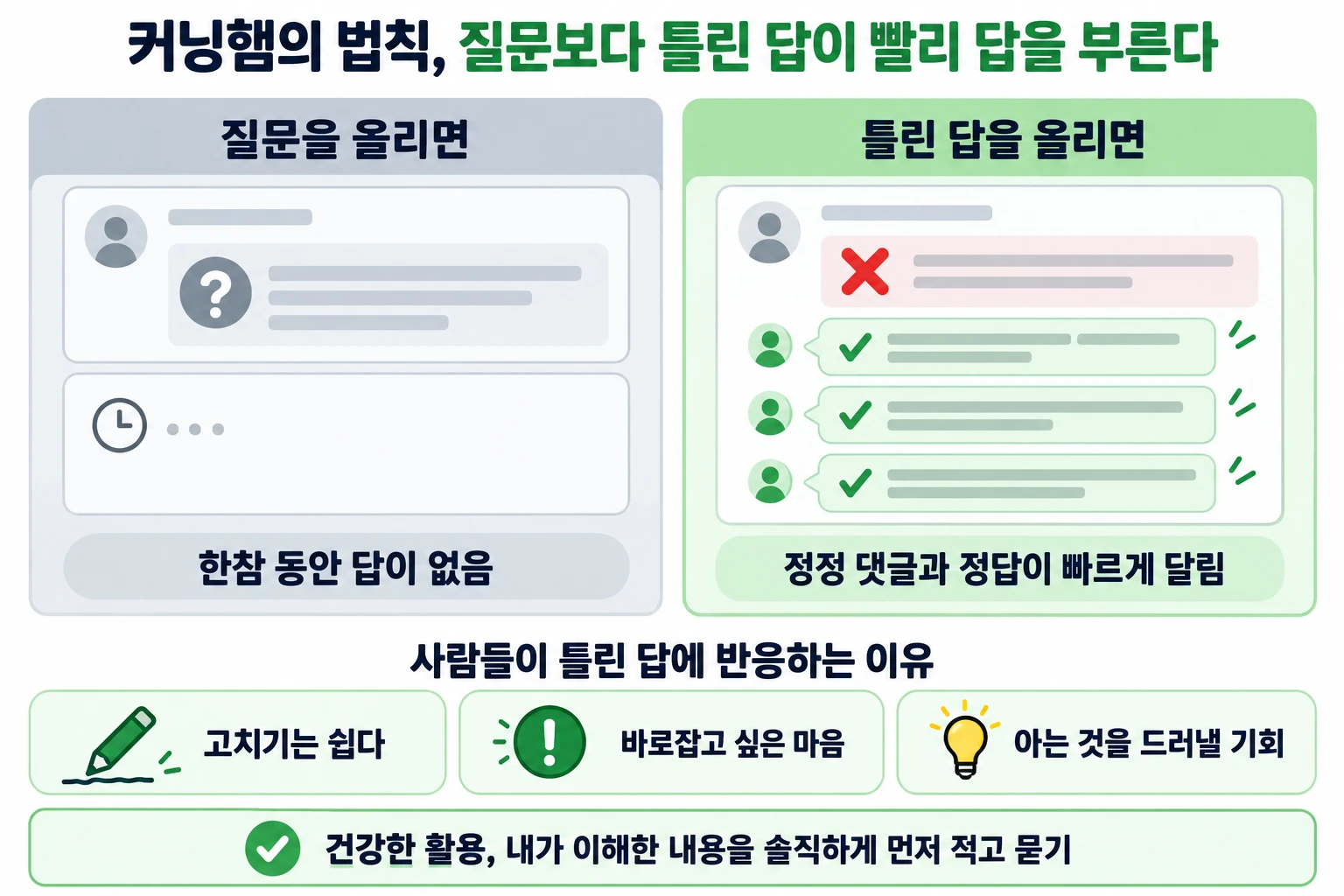
When you post a question such as “How do I do this?” in an online community, it often goes unanswered for quite a while. Yet if someone confidently writes down a bogus answer, within minutes a string of comments saying “That’s wrong” appears, along with accurate explanations. There is an internet adage that sums up this curious phenomenon in a single sentence: ‘Cunningham’s Law.’
Put simply, Cunningham’s Law is the rule of thumb that ‘the best way to get the right answer on the internet is not to ask a question, but to post the wrong answer.’ It captures the observation that people move far more quickly to correct a wrong answer in front of them than to answer a question that has no answer yet.
In this article, we will look in turn at how Cunningham’s Law came about, why people react to wrong answers, the situations in which the law shows up, and the points to be careful about when putting it to use.
Cunningham’s Law: When a Wrong Answer Calls Forth the Right One
Where Did Cunningham’s Law Come From?

This law became widely known less through the man it is named after than through a colleague who remembered his words.
(1) The Programmer Who Created the Wiki
The law takes its name from the American programmer Ward Cunningham. He is famous as the person who created the first wiki, a style of web document that anyone can edit.
(2) A Name Given by a Colleague
Steven McGeady, who worked with Cunningham at the American electronics company Tektronix, said he heard this advice from Cunningham in the early 1980s. The stage for the story at the time was Usenet, a network of topic-based discussion boards, and it was McGeady who gave it the name Cunningham’s Law.
(3) When It Was Put in Writing
In 2010, McGeady introduced the law and its origin in a comment he left on a New York Times blog about new words, and it then spread quickly as a saying that describes the internet as a whole.
Cunningham himself, however, said it was a misquote and that he had never advised people to post wrong answers in place of questions. He even described it as a misquote that disproves itself by spreading across the internet.
Here, the word ‘law’ does not mean a principle proven by experiment, like a scientific law. It is closer to a witty name for an experience shared by people who have long watched online communities.
Why Do People React to Wrong Answers?

People who stay quiet in the face of a question rush to raise their hands in front of a wrong answer. Several reasons overlap here.
(1) Fixing Is Easy, Writing from Scratch Is Hard
To answer an empty question, you have to put together an explanation from the beginning, but when there is a wrong answer, you only need to point out where it went wrong. Once a starting point is given, the threshold for taking part drops sharply.
(2) The Urge to Set Things Straight
When you see something wrong in a field you know well, it is hard to just let it pass. The comic 「xkcd」 by the American cartoonist Randall Munroe has a scene in which someone cannot leave the computer late into the night because someone on the internet is saying something wrong, and it is often used as a picture that symbolizes this urge.
(3) A Chance to Show What You Know
A comment correcting a wrong answer is a place where you can naturally show off your knowledge. Many people feel that a rebuttal stands out more and earns recognition more easily than answering a question.
When these three work together, a single wrong answer ends up drawing far more people than a single question. In the end, Cunningham’s Law can be described as an observation about how people treat information and how they take part.
Where Cunningham’s Law Shows Up

This law reveals itself in more places than you might think.
- Wiki documents (Wiki): McGeady said that Wikipedia, the online encyclopedia anyone can edit, is the most widespread evidence of Cunningham’s Law. When incomplete or wrong sentences are posted first, other people correct them, and the article gets polished.
- Question boards (Q&A Forum): On developer communities and knowledge Q&A sites, it is common for more accurate answers and corrections to follow beneath a sloppy first answer.
- Meetings and drafts (Draft): Rather than asking for opinions in front of a blank screen, putting a rough draft forward first often gets colleagues to say much more actively what should be fixed.
What the three situations have in common is that something to fix was laid down before a finished correct answer. People open up more easily when refining what is already there than when filling an empty space.
Points to Be Careful About When Using It

Cunningham’s Law is an amusing observation, but following it to the letter has big side effects.
(1) Wrong Information Can Spread
Not every wrong answer gets corrected. For people who never see the correcting comments, only the wrong answer remains, and the misinformation can spread as it is.
(2) It Uses Up Other People’s Time
Deliberately posting a wrong answer means borrowing other people’s goodwill and time. If it happens repeatedly, it is easily seen as trolling and you lose trust.
(3) Refuting Takes Far More Effort
Correcting a false claim takes much more effort than making it. That is why it is better to treat this law not as a trick to use on purpose, but as an observation that helps you understand how people react.
(4) Use an Honest Draft Instead
If you want to use this law in a healthy way, rather than inventing a wrong answer on purpose, you can first write down honestly what you have understood, as in ‘From what I’ve found, it works like this—is that right?’ This gives people something to fix without deceiving them.
Cunningham’s Law wittily shows that people react faster to errors than to questions. At the same time, it reminds us that the collective intelligence of the internet grows by people correcting one another’s mistakes.
Understanding the impulse to react to wrong answers while asking honestly and answering accurately—that is the first step toward healthy knowledge sharing online.