What if, out of nowhere, hundreds of visitors from elsewhere began coming to the alley outside your home every day to take selfies, shouting and singing loudly until late at night, while the buses were always so full that you could not even get to work? What if the neighborhood's corner shops and home-style restaurants had even closed because they could not withstand the surge in rents associated with businesses catering to visitors, and their places were filled entirely with taco shops and instant photo studios for those visitors?
This is no fictional dystopia. It is an ongoing problem that Barcelona in Spain, Venice in Italy, and Bukchon Hanok Village and parts of Jeju Island in South Korea are actually experiencing.
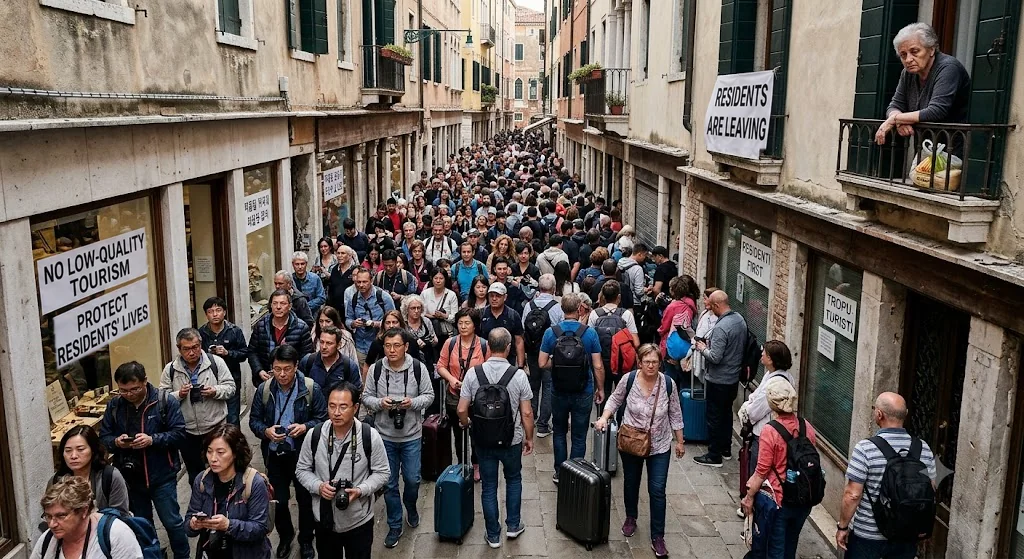
Overtourism (excessive tourism) refers to a phenomenon in which an influx of tourists exceeds a destination's carrying capacity, sharply reducing local residents' quality of life, destroying the natural environment and cultural heritage, and ultimately diminishing the value of tourists' own experiences.
In the past, the formula that "the more tourists arrive, the more the local economy thrives" held true, but people now point out that tourism can become a weapon that destroys local communities. This article takes an in-depth look at the core mechanisms of overtourism and their solutions.
The 3 Main Mechanisms and Manifestations of Overtourism
The Collapse of Tourism Carrying Capacity

In tourism studies, 'tourism carrying capacity' means the maximum number a region can accommodate without suffering environmental, physical, social, or economic damage.
- Physical carrying capacity: The limit that infrastructure such as roads, public transportation, waste disposal facilities, and parking lots can withstand.
- Social and psychological carrying capacity: The limit within which local residents can accept the presence of tourists without experiencing stress.
Overtourism occurs when the balance of this carrying capacity breaks down. The rapid proliferation of low-cost carriers (LCCs), the spread of home-sharing platforms, and the explosive popularity of particular places through social media (SNS) combine to overwhelm a particular space's carrying capacity almost instantly.
Touristification and Tourism Phobia

As overtourism intensifies, it brings a side effect known as 'touristification.' This is a variation of gentrification in which existing residents are driven out as residential neighborhoods turn into tourist destinations.
Example: The Chain Reaction Between Airbnb and a 'Housing Shortage'
- Situation: A property owner in central Venice switches a home previously rented to residents on a long-term basis with monthly rent to short-term accommodation rented by the day through Airbnb.
- Result 1: Because short-term accommodation is far more profitable, all the surrounding property owners also begin switching to the short-term accommodation business.
- Result 2: Homes available to local residents disappear, and monthly rents skyrocket.
- Final result: Residents have no choice but to move to the outskirts, leaving the city center as nothing more than a 'tourist set' without a permanent population.
In this process, residents experience 'tourism phobia,' an extreme aversion to and fear of tourists, which leads to demonstrations and protests.
Sustainable Solutions: 'Intelligent Management' Rather Than Simple Controls

To address overtourism, cities around the world are introducing various administrative and economic measures.
- Charging admission fees and tourist taxes (pricing policy): In 2024, Venice began charging day-trippers a city admission fee of 5 euros. This approach regulates tourist numbers and uses the resulting revenue to maintain infrastructure.
- Quotas and reservation systems (control of visitor numbers): Places such as Machu Picchu in Peru and Mont-Saint-Michel in France operate reservation systems that limit daily admissions.
- Dispersal strategies (dispersal across time and space): This strategy spreads out crowds by developing peripheral areas beyond the main hubs into new tourism resources.
From 'Tourism That Consumes' to 'Tourism That Coexists'
Overtourism is not merely the surface-level problem of having too many tourists; it is a structural ailment caused by a breakdown in the balance between 'local residents' lives' and 'economic interests.'
Tourist destinations are places where people live. Sustainable tourism requires local governments' careful management of infrastructure carrying capacity, tourists' considerate etiquette, and legal mechanisms that protect residents' rights to work in harmony.
The time has come for a paradigm shift from 'capture-oriented tourism,' which consumes nature and local communities before moving on, to 'coexistence-oriented tourism,' which respects and preserves a region's distinctive culture and environment.