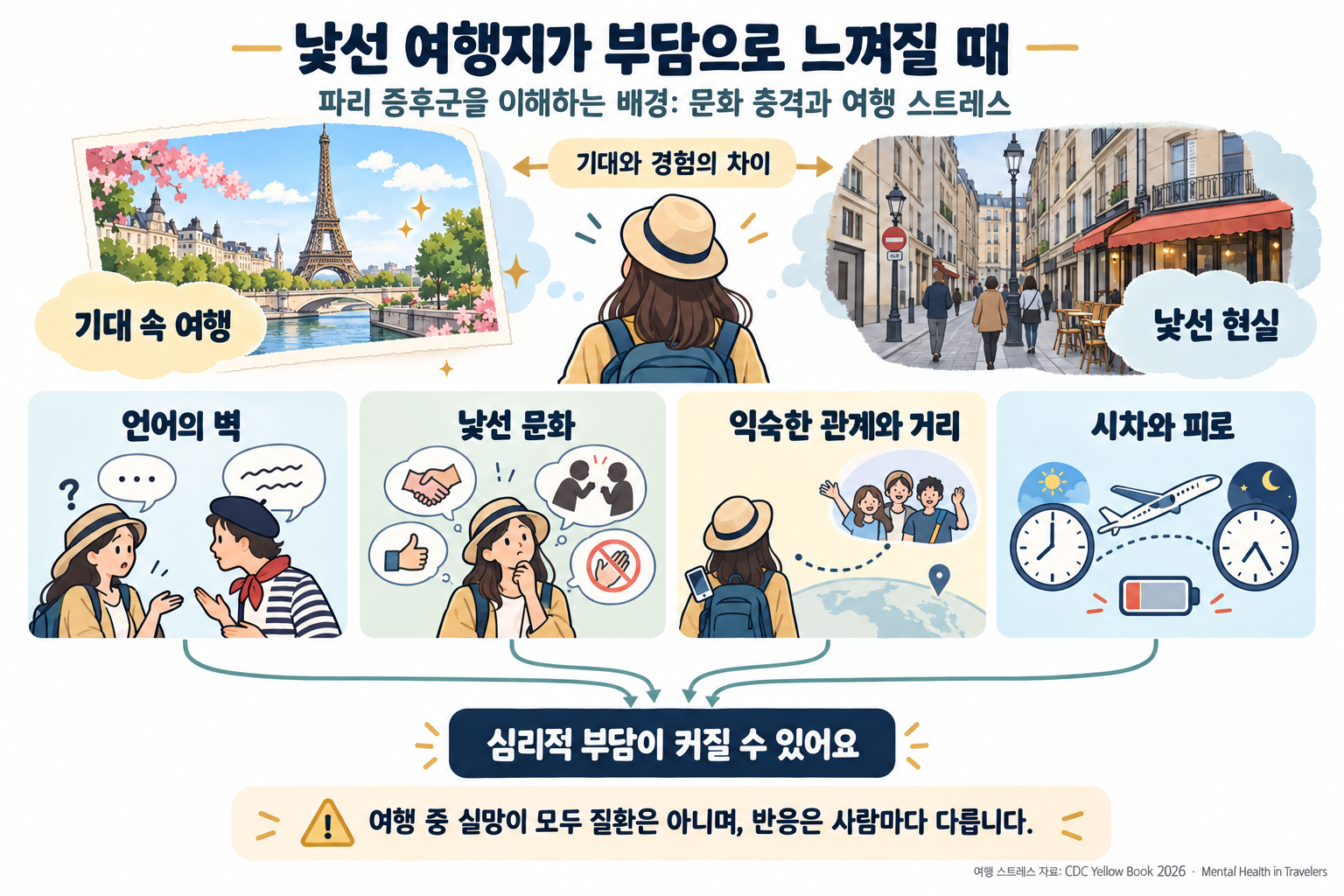
Strolling beneath the Eiffel Tower with a baguette in hand, lingering at a sidewalk café, people dressed stylishly on every street. Paris, seen countless times in films and magazines, is a dream city for many people. But once you actually arrive, the metro is crowded, litter rolls along the streets, and shop staff are curter than you expected. The bigger the expectations, the bigger the disappointment.
Most people shrug off this kind of disappointment as a travel mishap, but in rare cases some experience anxiety and dizziness, and in severe cases even hallucinations and delusions of persecution. This severe confusion that arises when a dream destination falls short of expectations is called ‘Paris Syndrome’. It is commonly understood as an extreme case of culture shock.
In this article, we will look in turn at how the name Paris syndrome came about, its main symptoms and causes, similar travel syndromes, and the lessons tourism studies takes from this phenomenon.
Between Expectation and Reality: The Causes and Lessons of Paris Syndrome
How the Name Came About

The term Paris syndrome was first used in the 1980s by Hiroaki Ota, a Japanese psychiatrist working at the Sainte-Anne Hospital Center in Paris, France. While treating a number of Japanese travelers and residents going through mental crises in Paris, he noticed a common pattern, and in 1991 he published a book of the same title that brought the phenomenon to wide attention.
The phenomenon is thought to have been reported especially often among Japanese people because Japanese popular culture has long portrayed Paris as an elegant, romantic city. Around 2006, an official at the Japanese embassy in France told the press that there were about 20 cases a year. However, considering that more than 1 million Japanese tourists visit Paris every year, only a tiny fraction actually experience the syndrome. In response to some reports that the embassy ran a dedicated hotline, the embassy also clarified that it offers no such service.
Disappointment with Paris itself is a much older story. In his Confessions, Jean-Jacques Rousseau wrote that when he first saw Paris in 1732, he felt deep disillusionment because, instead of marble palaces, it was full of dirty, narrow alleys and scenes of poverty.
What Symptoms Appear?

Paris syndrome is not a formal diagnosis but a term for a cluster of symptoms that appear while traveling. The reported symptoms affect both mind and body.
- Acute Delusional State: The person is suddenly gripped by beliefs that do not match reality.
- Feeling of Persecution: The person feels that people around them are discriminating against or attacking them.
- Derealization: The scenery before their eyes feels strange, like a dream or a stage set.
- Depersonalization: The person feels like a stranger to themselves, as if body and mind were moving separately.
- Psychosomatic Symptoms: Dizziness, a racing heart, cold sweats, vomiting and similar symptoms appear.
Most people are known to recover with rest and calm, along with brief treatment if needed, and in many cases simply going home is enough to make them better.
The Gap Between Expectation and Reality: Five Causes

A 2004 paper by Annie Viala, Hiroaki Ota and colleagues, published in a French medical journal, summarized five causes of the syndrome among Japanese travelers.
(1) The Language Barrier
Few Japanese travelers speak French, and when people cannot make themselves understood, even small misunderstandings can easily grow into anxiety and a sense of isolation.
(2) Broken Connections
People who feel secure within a group can feel even lonelier when they are separated from their familiar community.
(3) Cultural Differences
Parisians’ frank, informal way of speaking and expressing emotions is sometimes taken as rudeness or hostility.
(4) An Idealized Image
The most central cause: the huge gap between the beautiful, glamorous Paris created by advertising and the media and the real Paris comes as a shock.
(5) Fatigue and Jet Lag
Long intercontinental journeys, jet lag and packed schedules wear out body and mind, leaving travelers easily shaken by even small shocks.
This pattern does not apply only to Japanese people. In 2014, there were reports of similar disappointment among Chinese tourists, for whom Paris had also been romanticized, and in a Paris tourism office survey at the time, safety and cleanliness received low scores.
Similar Travel Syndromes

Being emotionally shaken at a travel destination is not unique to Paris. Two well-known examples follow.
Stendhal Syndrome
The French writer Stendhal recorded that in 1817, while looking at masterpieces in the Basilica of Santa Croce in Florence, Italy, his heart began to pound and he felt as if he might collapse. The Italian psychiatrist Graziella Magherini collected cases of travelers in Florence showing similar symptoms in front of works of art and gave the condition this name. In contrast to Paris syndrome, which comes from disappointment, it is a reaction to being overwhelmed with emotion.
Jerusalem Syndrome
This is a phenomenon in which some pilgrims visiting the holy city of Jerusalem come to believe they are figures from the Bible or fall into strong religious delusions. It became known as Israeli medical staff reported a number of cases.
Paris syndrome is rare, but it clearly shows that tourism consumes the expectations and images people carry as much as the places themselves. That is why destinations need to present themselves as they really are rather than through overly polished promotion, and travelers need to leave room in their schedules for unfamiliar experiences.
Lowering expectations a little and raising curiosity a little: that is the first step tourism studies offers for preparing a trip without disappointment.