In modern society, travel has established itself as an important part of life, extending beyond a simple hobby. It is now recognized as an essential experience in the process of exploring new cultures and discovering oneself. Travel has become an activity that integrates artistic sensibility with scientific thinking to offer profound insights and diverse experiences, rather than simply providing an escape from everyday life.
This article will examine how the artistic value of travel stimulates individual sensibilities and how scientific approaches drive the development of the travel industry. It will also offer an outlook on the direction that the future of sustainable travel may take.
The Art of Travel: The Aesthetics of Experience and Cultural Exploration

The Artistic Value of Travel: The Aesthetics of the Senses and the Expansion of Experience
Travel is an experience that goes beyond simply moving from place to place and offers aesthetic value to each individual. Unfamiliar landscapes, new sounds, and scents stimulate travelers' senses, and these experiences offer special moments that are difficult to encounter in everyday life. In this way, travel allows individuals to rediscover their artistic perspectives through sensory experiences in new places. These experiences do not merely pass by; they leave a deep impression even as time passes and continue to influence travelers' lives.
Elements such as landscapes, sounds, and smells come together to broaden travelers' perspectives on the world through different senses. In particular, the scenery unfolding before their eyes evokes an aesthetic response that goes beyond the natural landscape itself, serving as an important factor in improving quality of life. Through this process, travelers can develop their own artistic perspectives and further cultivate the ability to find aesthetic value in everyday life.
Cultural Exploration: Discovering New Perspectives and Broadening Understanding
Travel offers opportunities to explore the unique culture of each region firsthand. Through travel, we come to understand a region's traditions, art, and language, making possible an in-depth experience that goes beyond ordinary sightseeing. Each culture reflects the history and life of its region, and as travelers explore it, they encounter diverse perspectives and develop new understandings of their own. Ultimately, this cultivates travelers' ability to respect and understand diverse cultures.
In this process, travelers do more than observe external elements; they experience inner growth by engaging with and experiencing local cultures. Communicating with people there and experiencing local residents' everyday lives offers profound learning that cannot be gained from books or screens. In particular, the cultural exchanges experienced through travel provide diverse perspectives, positively influencing personal growth and development.
Creating Emotions and Stimulating Creativity
Travel is a source that stimulates creative emotions. Meeting new people in diverse environments and engaging in conversations with them offer opportunities for creative inspiration. Within different cultures and environments, travelers gain opportunities to see themselves from new perspectives, leading to an improvement in artistic expression. This process becomes an important opportunity for travelers to express their emotions richly.
Emotional creation also brings about inner changes in individuals. Encountering themselves in diverse cultures and environments gives greater depth to their creative thinking and emotional expression. Creative inspiration affects travelers beyond simply leaving an impression, and it can also bring changes to their attitudes toward life.
The Lasting Nature of Aesthetic Experiences and Their Influence on Life
The aesthetic experiences gained through travel remain in travelers' memories for a long time. They offer lasting emotional resonance rather than merely a momentary response, and they greatly influence how people view life. Moments of adventure and discovery during travel remain vividly remembered even as time passes, positively influencing the way travelers view life. Ultimately, these experiences serve as an important factor in improving quality of life.
Moments of adventure and discovery remain vivid even as time passes, bringing positive changes to life. Through them, travelers discover important values in their pursuit of a better life, and these experiences greatly influence their everyday lives as well as their personal growth.
Opportunities for Self-Discovery and Growth
Travel becomes an important process of self-discovery, rather than simply a break. By immersing themselves in new environments, travelers test their limits and gain opportunities to grow through various challenges. These experiences greatly help travelers redefine their values and goals. Diverse experiences in new environments become important opportunities to reflect on themselves and recognize their strengths and weaknesses.
Ultimately, travel does more than provide opportunities to explore new places; it offers important opportunities to discover oneself and grow in the process. Through new challenges, travelers discover their own potential and develop the ability to view the world from a broader perspective. In this process, travelers redefine their lives and gain the confidence they need to move toward the future.
A Scientific Approach: Changes in the Travel Industry Seen Through Data

Data-Driven Innovation: Changes in the Travel Industry
The travel industry is undergoing major changes centered on data. Accurately identifying travelers' behavior and preferences through data analysis has made tailored services possible and improved efficiency across industry operations. Big data analysis plays an important role at every stage of travel, including flight reservations, hotel stays, and visits to tourist attractions, enabling travelers to enjoy personalized experiences. The travel industry is now moving beyond simply providing services toward anticipating travelers' needs and offering tailored solutions.
Airlines develop optimal pricing strategies based on customers' booking patterns, while hotels analyze guests' accommodation experiences to offer tailored promotions; in these ways, data serves as a key factor in strengthening the competitiveness of the travel industry. This not only increases customer satisfaction but also becomes an important means of strengthening companies' profitability.
Providing Tailored Services and Improving Efficiency
Data analysis has enabled travel agencies and related businesses to provide more precisely tailored services. Airlines can analyze the routes customers frequently choose to schedule flights that match demand and offer appropriate discounts to customers who are sensitive to price fluctuations. These services maximize customer convenience and greatly improve companies' operational efficiency.
Hotels also identify guests' preferences to provide personalized accommodation experiences. For example, they offer tailored promotions based on the amenities guests frequently use or the room types they prefer, contributing to a higher rate of repeat visits. This approach based on data maximizes the operational efficiency of the travel industry and continually improves customer satisfaction.
Identifying New Market Opportunities
Data analysis creates new opportunities for the travel industry. Travel agencies can use data to predict consumers' travel trends and develop new tourism products and services that match them. This becomes a driving force for responding quickly to market changes and achieving sustainable growth. In particular, in modern society, where travel trends change rapidly, data analysis serves as an important tool for developing new markets in step with those changes.
By using data to analyze consumers' travel purposes, preferred destinations, and areas of interest, travel agencies can develop more refined strategies and offer tailored products. This allows them to provide greater value to consumers and strengthen their position in a competitive market.
Data That Helps Travelers Make Decisions
Data also serves as a useful tool for travelers. Review and rating systems offered by various platforms provide important information that helps travelers choose their destinations. Travelers can use this data to make more rational and efficient travel plans. Various booking platforms also use real-time data analysis to help travelers make better choices.
Travelers can choose the best flights and accommodations for their preferred schedules and budgets, and make more economical choices with access to pricing information that changes in real time. This increases satisfaction with travel and allows travelers to enjoy richer experiences.
The Importance of Data Security and Privacy
As the use of data-based approaches grows, protecting personal information and ensuring data security have emerged as important challenges. With large amounts of travelers' personal information being collected and analyzed, managing it securely is essential. Accordingly, the travel industry is managing data securely by introducing the latest security technologies and establishing strict regulations for data protection.
Travel agencies apply encryption technologies to thoroughly protect customer data and implement policies that minimize unnecessary data collection. They also strengthen security systems to prevent data breaches and continually manage customers' personal information to prevent its misuse. This becomes an important factor in maintaining customer trust and promoting companies' sustainable growth.
Sustainable Change Toward the Future
The use of data through scientific approaches is accelerating changes in the travel industry, positively influencing both travelers and businesses. Decisions based on data play an important role in improving the quality of travel experiences and promoting innovation in the industry. They also offer new solutions for sustainable travel and drive the development of services that consider environmental responsibility and social value.
Modern Tourism Studies: Changes Brought About by Technology and Innovation

Changes in Modern Tourism Driven by Technological Innovation
Modern tourism is changing rapidly through technological innovation. Using mobile devices such as smartphones, travelers can book flights, check in to hotels, and look up information about tourist attractions with one hand. These technological advances make travel more accessible and present a new paradigm for travelers. Tasks that once required complicated procedures can now be completed much more easily and quickly thanks to technology, which plays an important role in greatly improving the overall quality of travel.
In particular, technology provides travelers with convenience and efficiency throughout every stage, from planning a trip to the moment it ends. With technology simplifying everything from reservations and payments to searches for local information, travel is becoming a pleasure that more people can easily access.
New Travel Experiences Brought About by Virtual Reality and Augmented Reality
Virtual reality (VR) and augmented reality (AR) are leading examples of technologies that have transformed travel experiences. Travelers can now explore destinations virtually before actually visiting them. By allowing travelers to experience unforeseen situations before their trips, these technologies help them make more accurate and detailed travel plans. Through virtual reality, travelers can move beyond the physical limitations of the real world and enjoy experiences with a heightened sense of immersion.
These technologies go beyond simply offering an experience. For example, travelers can first take a virtual tour of a place they want to visit and then consider in advance how to fulfill their expectations for that place in reality. AR technology also allows travelers to check details they might otherwise have missed at their destinations in real time during their trips.
Artificial Intelligence and Personalized Travel Services
Artificial intelligence (AI) and machine learning technologies make personalized travel possible. Travel agencies' AI-based chatbots handle customer requests promptly 24 hours a day and provide optimized services, such as analyzing customers' travel patterns to suggest personalized itineraries. This allows travelers to enjoy more personalized experiences and save time and effort.
AI technology, in particular, is bringing major changes to travel planning. By automatically generating tailored itineraries based on individual preferences and past travel records, and quickly providing the necessary information, it enables travelers to reduce stress and enjoy more satisfying trips. This also offers travel agencies opportunities to better understand and meet customers' needs.
Managing and Promoting Tourist Destinations Through Drone Technology
Drone technology has opened up new possibilities for managing and promoting tourist destinations. Aerial photography using drones offers expansive views and unique angles that conventional photography methods cannot match, allowing tourist destinations to be presented more attractively. This enables destinations to maximize their appeal and attract potential tourists from around the world.
Drones also play an important role in safety management and environmental protection at tourist destinations. Using drones to monitor conditions at tourist destinations in real time makes it possible to prevent and proactively manage environmental damage and safety issues. This improves the efficiency of managing tourist destinations and lays the groundwork for sustainable development.
Technological Efforts Toward Sustainable Tourism
Sustainable tourism has become an important challenge in modern tourism, and technological innovation is becoming an important means of making it possible. Energy-efficient transportation, smart hotel technologies, and environmentally friendly tourism facilities contribute to reducing the carbon footprint of travel. Through these developments, ways are being explored to minimize environmental impacts while maintaining the convenience of travel.
For example, smart hotel technologies reduce environmental impacts by introducing automated systems for saving energy, while environmentally friendly transportation offers travelers opportunities to participate in environmental protection. These technological advances make sustainable growth in the tourism industry possible and lay the foundation for a better future.
Sustainable Development Driven by Technology and Innovation
Technology and innovation not only enrich travelers' experiences but also contribute to making the travel industry more sustainable. Technological innovation that makes travel more accessible, increases efficiency, and drives environmentally friendly development becomes an important foundation for the future travel industry.
Modern tourism continues to change through technology, providing travelers with more satisfying experiences and greatly contributing to the sustainable development of the tourism industry. Ultimately, these changes become an important driving force for improving the quality of travel and enabling long-term growth.
New Perspectives: The Future Outlook for Sustainable Travel

The Importance of Sustainable Travel
Sustainable travel has become an important topic in modern society. It goes beyond travelers simply behaving responsibly and aims to pursue both environmental protection and the development of local communities through travel. By considering environmental, social, and economic impacts when planning trips, the travel industry is moving in a healthier direction, an essential change for a sustainable future.
Sustainable travel goes beyond being a travel option, encouraging the entire global tourism industry to focus on protecting the environment and promoting economic growth in local communities. This plays an important role in preserving nature and culture for future generations to enjoy.
Travelers' New Role: From Consumers to Environmental Protectors
Modern travelers are establishing themselves as people who positively influence the natural environment and culture of their destinations, rather than as mere consumers. Beyond simply enjoying their destinations, travelers can contribute directly to local economies through activities such as purchasing fair-trade products and visiting local restaurants. This movement goes beyond simply enjoying tourism and gives travelers an important role in preserving the culture and nature of the regions they visit.
In particular, travelers who recognize their responsibility toward the environment of their destinations travel without damaging nature and with respect for cultural heritage. This also positively influences local economies, and travelers can realize greater value through exchanges with the local communities they visit during their trips.
Cooperation Among Diverse Stakeholders: An Essential Element in Achieving Sustainability
Achieving sustainable travel requires governments, businesses, nonprofit organizations, and local communities to work together. They play essential roles in establishing and implementing sustainable tourism policies, through which they can bring about long-term changes. In particular, governments and businesses build sustainable tourism infrastructure, while nonprofit organizations and local communities can contribute to improving local residents' quality of life through policies that support it.
This cooperation plays a very important role in enabling the travel industry to achieve sustainability. Plans that consider long-term sustainability rather than short-term profits are needed, making it possible to protect the natural environment and local cultures.
The Role of Technology: Innovative Tools for Sustainable Travel
Technology has established itself as an important tool for supporting sustainable travel. Travelers can use technology to choose transportation that reduces their carbon footprint and book energy-efficient accommodations. These technological tools help travelers minimize their environmental impacts.
For example, applications that can monitor environmental impacts in real time provide travelers with information to assess and manage the environmental effects of their trips. This enables travelers to make more responsible choices and participate in environmental protection throughout their journeys.
Sustainable Travel in the Future: The Need for a Comprehensive and Innovative Approach
The future of sustainable travel calls for a more comprehensive and innovative approach. This includes going beyond environmental protection to achieve sustainable economic growth through cooperation with local communities. Travel businesses must reduce their environmental impacts while revitalizing local economies and ensuring the sustainability of tourist destinations through partnerships with local residents.
This approach will play an important role not only in protecting the environment of tourist destinations but also in improving local residents' quality of life. A future that pursues sustainable travel benefits both travelers and local communities and makes more meaningful travel experiences possible.
The Future of Sustainable Travel: Challenges and Opportunities
The future of sustainable travel brings various challenges and opportunities. It is an essential direction we must take, rather than simply a trend. Sustainable travel will positively influence the environment and society while offering travelers deeper and more meaningful experiences. Through these changes, the tourism industry will be able to achieve the two goals of environmental protection and economic development simultaneously.
Ultimately, sustainable travel will move in a direction that benefits everyone and lay the foundation for the tourism industry's long-term prosperity.
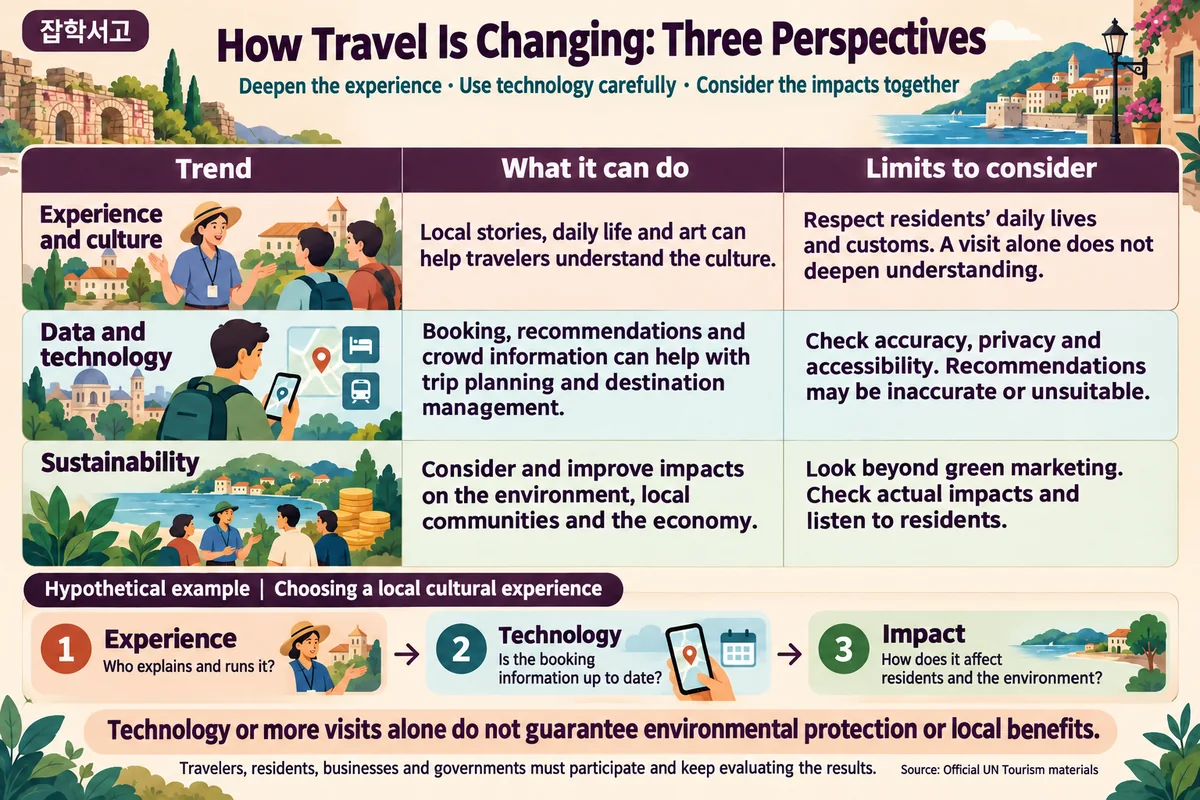
Artistic sensibility and scientific approaches in travel are the two pillars driving the development of modern tourism. The artistic aspect emphasizes the aesthetic value of travel, through which travelers gain deeper emotional resonance and creative inspiration. By contrast, scientific approaches use data to improve the efficiency of travel and offer innovative methods for sustainable development. These elements complement each other to improve the quality of travel and provide more personalized experiences.
Sustainable travel will become an increasingly important challenge in the future, and the tourism industry will develop accordingly toward fulfilling its environmental and social responsibilities. This will have positive long-term effects on local communities as well as travelers, bringing beneficial outcomes for everyone.