What is the secret that lets us buy cosmetics from overseas with a single click online and put imported bananas on our breakfast tables? It is all thanks to a vast logistics system. And there is a crucial gateway that keeps this cross-border flow of goods moving without interruption. That gateway is customs clearance.
Customs clearance (Customs Clearance), simply put, refers to all the procedures and actions required for goods to cross borders legally. It is the process by which goods arriving by plane or ship change their status from “foreign goods” to “domestic goods” that can circulate freely within Korea. During this process, the Korea Customs Service checks what the goods are and how much they cost, imposes taxes, and screens out illegal goods such as drugs and firearms.

Why is customs clearance important? Without customs clearance procedures, a country would be unable to properly impose tariffs to protect its domestic industries and would have no way to prevent the entry of harmful goods that threaten public health. The same applies from a business perspective. Fast, accurate customs clearance is a key factor in reducing logistics costs and securing competitiveness. When customs clearance is delayed, goods are held in warehouses, missed delivery deadlines damage business credibility, and costs continue to mount. In other words, customs clearance is the first and most powerful control point in global business.
The 3 Core Elements of Customs Clearance
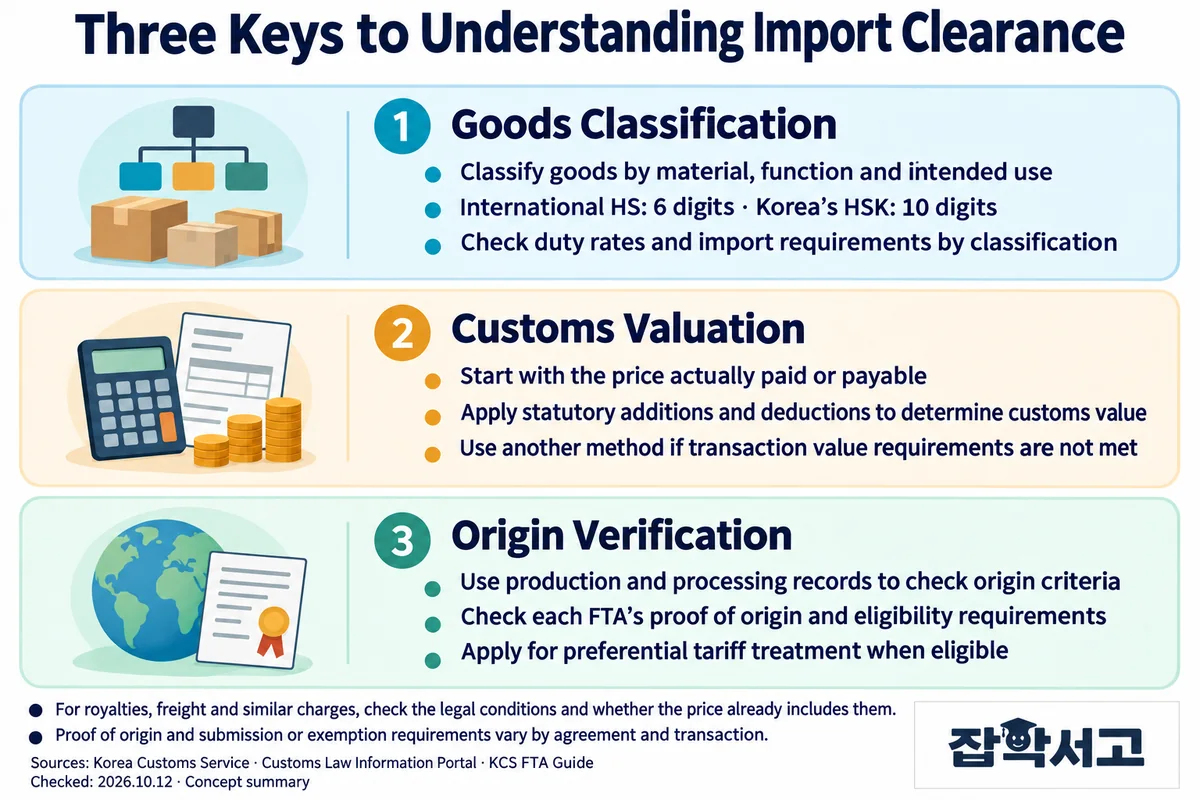
Customs clearance procedures may look complicated, but they largely revolve around three core elements. Understanding these elements helps you grasp the overall flow of customs clearance.
① Commodity Classification: Internationally Harmonized 6-Digit HS Codes and Korea’s 10-Digit HSK Codes
Every item in the world has a unique number. This is called an “HS Code (Harmonized System Code).” The Korea Customs Service uses this number to determine what percentage of customs duty to impose on the goods and which import restrictions to apply. For example, even shoes have different HS Codes and customs duties depending on whether they are leather shoes or sneakers. Entering this number incorrectly can lead to suspicions that you attempted to evade taxes or result in an administrative fine, making it the most important first step.
② Customs Valuation: “How Much Are the Goods Worth?” The Basis for Taxation
Once the HS Code has determined the tax rate, the next step is to decide the value on which to impose the tax. This is called customs valuation. In principle, it is based on the price the importer actually paid the seller—the transaction value. However, to prevent declarations of unreasonably low prices, the Korea Customs Service verifies whether the price is appropriate. If the declared price appears suspicious, it may recalculate the value using another method.
③ Rules of Origin: The Key to FTA Tariff Benefits and Determining Whether Goods Are Domestic or Imported
This involves identifying which country the goods were made in. Tariff benefits vary significantly depending on the country of origin. In particular, Korea has FTAs (free trade agreements) with many countries, but goods from an FTA partner must meet the agreement’s rules of origin and applicable requirements to receive preferential tariffs. The appropriate origin documentation must be available, while submission methods and any exemptions should be checked according to the transaction conditions. Conversely, origin labeling may also be strictly regulated to prevent the entry of substandard products from particular countries.
Import Customs Clearance Procedures at a Glance
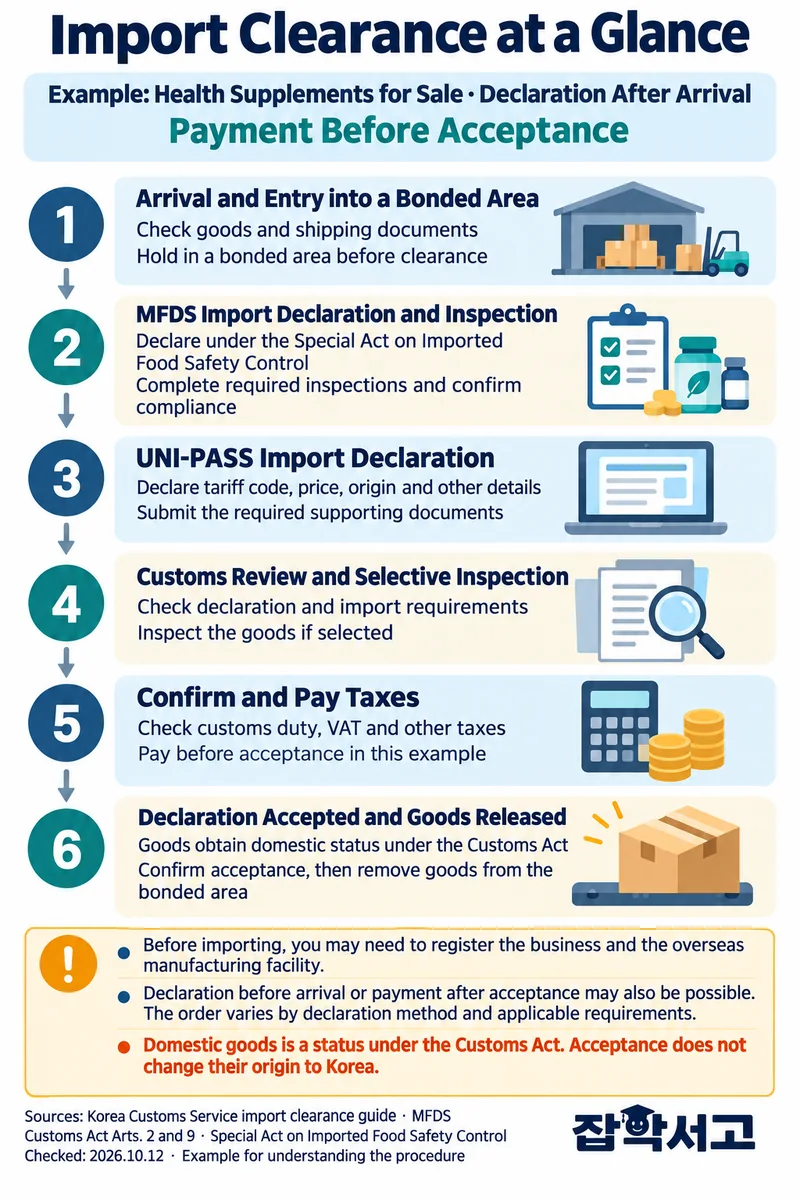
Now, let us follow the actual process of import customs clearance. To make it easier to understand, we will use a hypothetical example of importing health functional foods from the United States.
Step 1: Arrival of Goods and Placement in a Bonded Warehouse
Health functional foods shipped from the United States arrive at Incheon Airport. These goods do not go directly to the importer; they are first placed in a “bonded warehouse,” a secure location designated by the Commissioner of the Korea Customs Service. This is because, in the usual situation described here, they are still managed as foreign goods whose import declaration has not yet been accepted.
Step 2: Verification of Import Requirements and Advance Preparation for Inspection
Health functional foods imported for sale must be declared to the Ministry of Food and Drug Safety (MFDS) under the Special Act on Imported Food Safety Control and undergo the required inspections before customs clearance is completed. Customs clearance can proceed only if they pass this process. This is called “verification of requirements.”
Step 3: Import Declaration Through the Korea Customs Service’s UNI-PASS
Once the requirements have been verified, the importer (or customs broker) files an “import declaration” through the Korea Customs Service’s UNI-PASS system. At this point, they declare, “These goods are health functional foods from the United States under HS Code 2106.90, and their price is 1 times ten million won,” and submit documents verifying compliance with the requirements, an invoice, a Packing List, and other documents.
Step 4: Customs Review and Inspection of Documents and Physical Goods
The Korea Customs Service reviews the submitted documents. It checks whether the declaration is accurate, whether the correct HS Code has been applied, and whether the goods qualify for FTA benefits. Sometimes, goods are selected for a “goods inspection,” in which a customs officer visits the warehouse, opens the boxes, and checks whether the actual goods match the declaration. Drugs and counterfeit goods are also detected at this stage.
Step 5: Payment of Customs Duties and Value-Added Tax
Under the usual self-assessment procedure, the importer declares the tax amount based on the customs value and applicable tax rates, and pays according to the applicable procedure and payment deadline. When the importer pays these taxes at a bank, the biggest hurdle in customs clearance has been overcome.
Step 6: Acceptance of the Import Declaration and Release from the Bonded Warehouse
Once customs checks the declaration and import requirements and accepts the import declaration, the goods generally become domestic goods under the Customs Act. This does not change their country of origin to Korea, and the order of payment and acceptance may vary according to the applicable procedure. The importer can now use the “import declaration certificate” to collect the goods from the bonded warehouse (release them) and take them to their own warehouse or store. This completes customs clearance.
The Future of Customs Clearance: Faster and More Transparent in the Digital Age
So far, we have explored the concept and importance of customs clearance, its 3 core elements, and the actual procedures. Beyond simply collecting taxes and inspecting goods, customs clearance serves as a safety valve for the national economy and an essential lubricant that helps the global logistics system run smoothly.
In the past, customs clearance was notorious for complicated paperwork and long waiting times, but recently it has become faster and more transparent than could once have been imagined. Korea operates the world-class electronic customs clearance system “UNI-PASS” and has digitized almost all procedures.
It is also maximizing efficiency by using big data and AI (artificial intelligence) to identify illegal goods more accurately and offering expedited customs clearance benefits to Authorized Economic Operators (AEO). Efforts are underway to introduce blockchain technology to improve the transparency of logistics data and prevent forgery and tampering, and the day when customs clearance training and advance simulations take place in the metaverse is not far off.
Ultimately, customs clearance is an essential subject of study for businesses aspiring to operate globally. If they accurately understand the logic and core elements hidden within these seemingly complex procedures, customs clearance will become a powerful tool for creating new opportunities and competitiveness, rather than a daunting barrier. We hope this GK Library article has served as a small compass for your successful journey in global trade.