When you step into a logistics warehouse, the first thing that catches your eye is not the countless stacks of boxes. It is the rectangular platform firmly supporting those boxes, perhaps even looking rather rough and utilitarian: the “pallet (Pallet).” Yet few people know that this seemingly simple platform is the largest and most important “hidden giant” supporting modern logistics systems.
From the everyday necessities we use daily to enormous machine parts, almost every item rests on a pallet at least once during its lifetime. Pallets are more than simple supports; they are essential tools that maximize logistics efficiency and connect global supply chains. In this article, we will take an in-depth look at pallets, a fundamental and essential part of logistics, exploring their definition, types, and future development.
Pallets Become the “Standard Language” of Logistics

A pallet is a flat platform used to assemble goods into unit loads (Unit Load) for loading and unloading, transportation, and storage. It has openings (fork entry openings) that accommodate the forks of a forklift or hand pallet truck, and is designed to allow large quantities of cargo to be moved quickly and safely.
In the past, people moved every item individually by hand. With the introduction of pallets, however, dozens or hundreds of boxes could be lifted and moved together by forklift, bringing a revolution to logistics operations.
The Importance of Standardizing Pallet Sizes
The defining feature of pallets is “standardization.” Without standard sizes accepted worldwide, a pallet used in country A might not fit the forklifts or warehouse racks (Rack) in country B, creating the inconvenience of having to transfer and reload the cargo.
The International Organization for Standardization (ISO) has established 6 standard pallet sizes to prevent this. Among them, South Korea has adopted and uses the T11 type (1,100 mm x 1,100 mm), which is commonly used in Asia, as its standard.
- T11 Type (1,100 mm x 1,100 mm): The standard in Asian countries such as South Korea and Japan. It offers high efficiency in container loading.
- Euro Pallet (1,200 mm x 800 mm): The standard in Europe. It bears an “EUR” logo and is optimized for rail transportation.
Other sizes include the 1,219 mm x 1,016 mm size primarily used in North America. Logistics companies need to identify the standard pallet sizes of the countries they import from or export to and select appropriate pallets.
From Wood to Paper: Choosing the Right Material for the Job
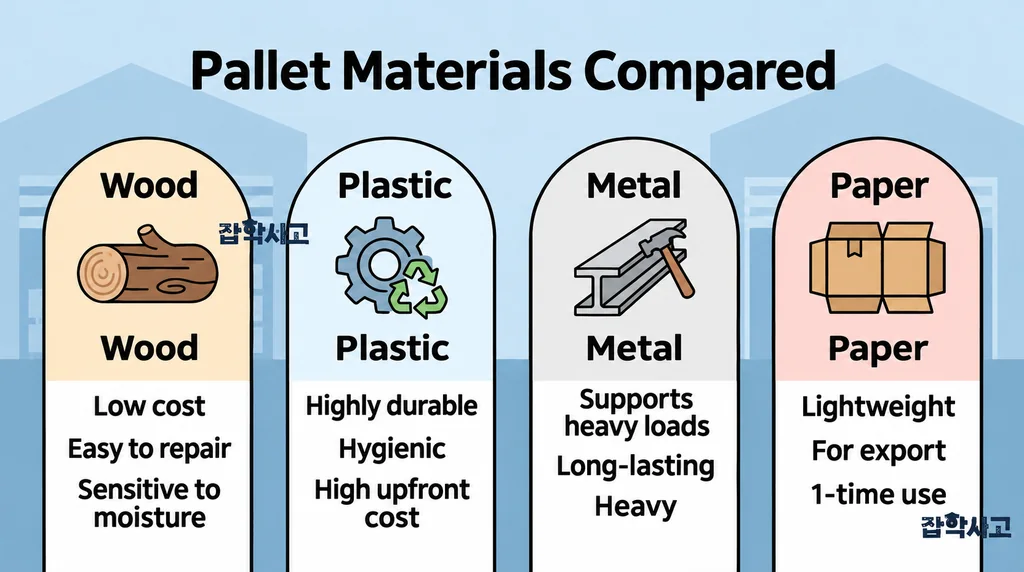
Pallets are classified by material into wood, plastic, metal, paper, and other types, with different uses depending on their respective advantages and disadvantages.
- Wooden Pallets (Wooden Pallet)
These are the most commonly seen pallets. Their advantages include low cost and ease of manufacturing and repair. Their good friction prevents cargo from slipping, and they are environmentally friendly because they can be recycled or used as firewood when discarded. However, they are vulnerable to moisture and may rot or develop mold, and there is a risk of insect infestation, so they must undergo heat treatment or fumigation (ISPM 15) when exported.
- Plastic Pallets (Plastic Pallet)
These were introduced to address the drawbacks of wooden pallets. They are highly durable, resistant to moisture, and hygienic because there is no concern about insects. They are easy to clean and are mainly used in food or pharmaceutical logistics. Their consistent dimensions and smooth surfaces make them suitable for automated warehouse systems. However, their initial purchase cost is higher than that of wooden pallets, and they are difficult to repair when damaged.
- Metal Pallets (Metal Pallet)
Made from iron or aluminum, these offer the greatest durability and load-bearing capacity. They are mainly used to transport heavy loads or in extreme environments involving high or low temperatures. They have a long service life and pose no fire risk, but they are very expensive and heavy, resulting in high transportation costs.
- Paper Pallets (Paper Pallet)
Made from corrugated cardboard or reinforced paper, these are very lightweight. They are mainly used in weight-sensitive logistics, such as air transportation, and can be easily discarded at the destination after export, eliminating retrieval costs. However, they are highly vulnerable to moisture and have low durability, so they are mainly used as disposable pallets.
The Transformation of Pallets in the Era of Smart Logistics

Pallets in the past were simple supports for cargo, but in the era of the 4th Industrial Revolution, they are evolving into “smart devices” that collect information and communicate.
- Integration of RFID and IoT Technologies
By attaching RFID tags or IoT sensors to pallets, the location, condition (temperature, humidity, impact), and travel routes of cargo can be tracked and managed in real time. This can improve transparency in logistics processes, prevent cargo loss or damage, and identify optimal transportation routes.
- Growing Adoption of Pooling Systems (Pooling System)
Pallets are not disposable items but assets used repeatedly. However, purchasing and managing pallets independently places a burden on companies in terms of cost and efficiency. To address this, “pooling systems” that provide pallet rental and retrieval services are gaining wider adoption. Companies can reduce management costs by renting as many pallets as they need and returning them, while pallet resources can be used efficiently across the country as a whole.
- Integration with Automation and Robotics
With the emergence of self-driving forklifts (AGV) or unmanned transport robots (AMR), pallets must work in close coordination with this automated equipment. Demand is growing for plastic pallets with dimensions and durability suited to automated warehouses, and pallets themselves can even guide robots along their travel routes or convey cargo information.
The Foundation of Logistics: Pallets Will Always Be Important
Although pallets are not glamorous, they are the most basic and important foundation supporting modern logistics systems. Standardized pallets are a language that connects global supply chains into a unified whole, while pallets made from different materials ensure safe transportation according to the characteristics of different types of cargo.
Furthermore, in the era of smart logistics, pallets are evolving beyond simple supports into essential tools that keep information flowing and maximize logistics efficiency. Understanding pallets is the first step toward grasping the overall flow of logistics and is an essential element in building efficient logistics systems. This is why the transformation and contributions of pallets, the hidden giants of logistics, deserve greater attention and anticipation in the future.