Ordering products from online stores and receiving them as early as the same day or the following morning has now become an entirely ordinary part of daily life. Behind this everyday experience, a vast and complex yet remarkably sophisticated logistics system is at work.
While logistics in the past was an industry centered on manual labor that simply moved goods from point A to point B, today's logistics is integrating advanced technology and evolving into a new dimension called “Smart Logistics.” Smart logistics is an innovative paradigm that goes beyond simply increasing speed, using core technologies of the 4th Industrial Revolution, such as artificial intelligence, the Internet of Things, and robots, to optimize the entire logistics process and make it intelligent.
This article will explore in depth the definition and background of smart logistics, its core technologies and specific examples, and the future changes it will bring.
What Is Smart Logistics? Definition and Background
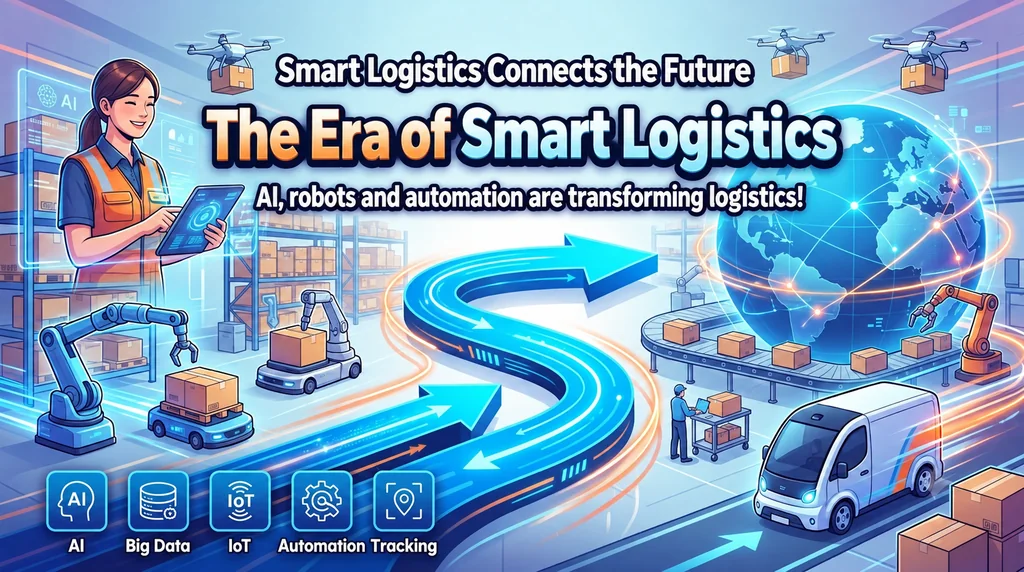
Smart logistics refers to a system that integrates information and communications technology (ICT) into the traditional logistics industry to automate and make intelligent every stage, including the transportation, storage, loading and unloading, and packaging of goods. It goes beyond automation that merely introduces machines, aiming for “intelligent logistics” that analyzes collected data, makes its own judgments, and reaches optimal decisions. The goal of smart logistics is to improve customer satisfaction and secure the competitiveness of the industry as a whole by reducing costs, increasing delivery speed, maximizing accuracy, and using resources efficiently.
Several decisive factors explain the rapid rise of smart logistics.
First is the explosive growth of the e-commerce market. As online shopping has become widespread, logistics volumes have increased exponentially, and consumers have come to demand “faster and more accurate” delivery. Ultrafast delivery services, such as early-morning and same-day delivery, have reached a level that traditional labor-centered logistics systems struggle to handle, making technology-based innovation essential to addressing the challenge.
Second is the decline in the working population and the rise in labor costs. Logistics is a prime example of a labor-intensive industry, but population aging and low birth rates are making it increasingly difficult to find on-site workers. Rising labor costs are also placing a heavy financial burden on companies, making the replacement of human labor with robots and automation an urgent necessity to overcome this problem.
Third is technological advancement and falling costs. Core technologies that enable smart logistics, such as artificial intelligence (AI), the Internet of Things (IoT), big data, and cloud computing, have advanced dramatically, and the prices of related equipment and solutions have fallen to practical levels, creating conditions that allow companies to adopt them.
Core Technologies and Examples of Innovation Driving Smart Logistics

Smart logistics is achieved through the integration of various advanced technologies rather than a single technology. We will examine how each technology works in logistics operations and what innovations it produces, using specific examples.
- The Internet of Things (IoT) and Big Data: The “Eyes” and “Brain” of Logistics
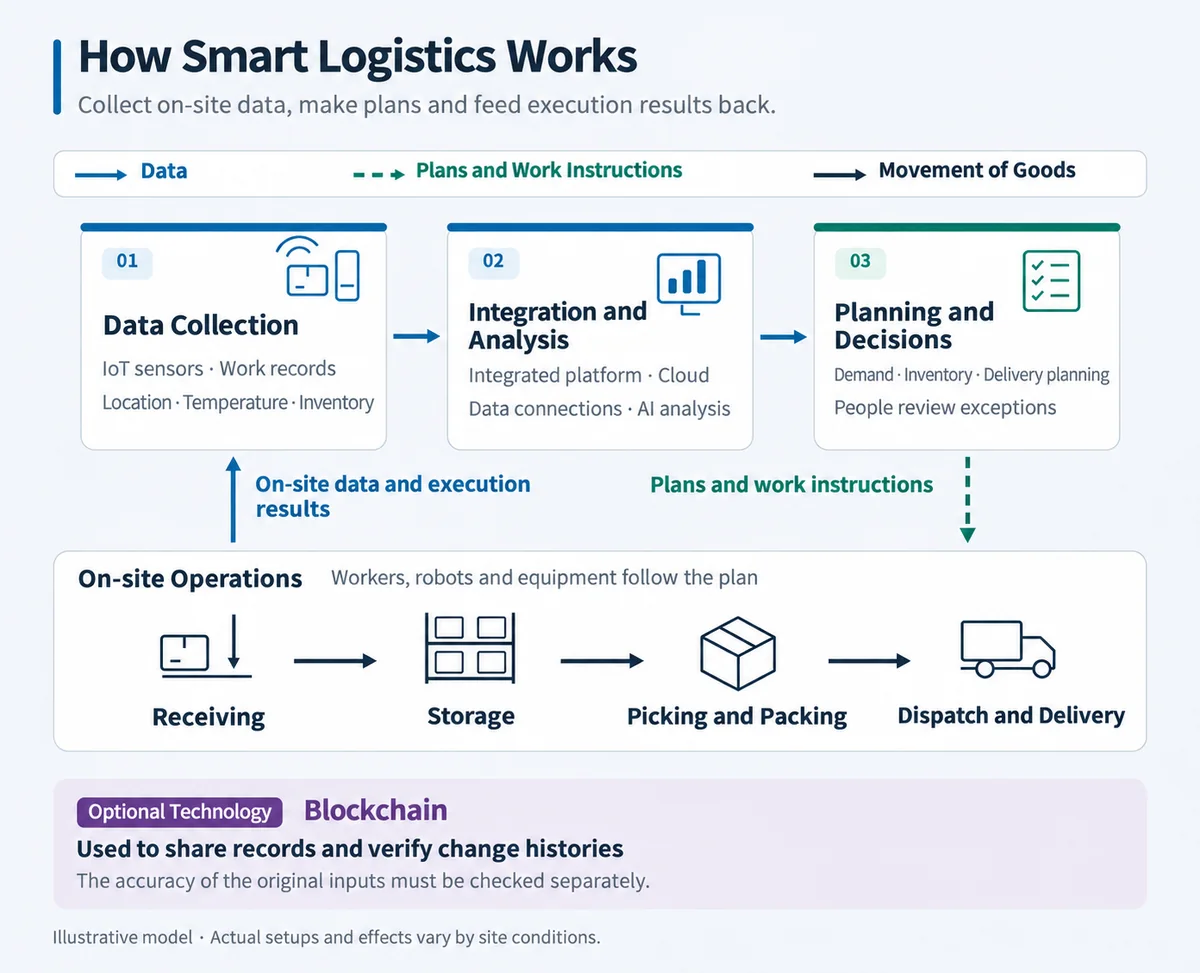
Internet of Things (IoT) sensors act as the “eyes” that collect data generated throughout the logistics process in real time. Sensors attached everywhere, including to goods, vehicles, warehouses, and equipment, continuously transmit information such as location, temperature, humidity, and impacts. The vast amounts of data collected in this way—big data—are analyzed by artificial intelligence (AI) and cloud systems, serving as the “brain” for logistics optimization.
[Example: A Cold Chain System for Fresh Food]
IoT is essential when transporting temperature-sensitive fresh food or pharmaceuticals. IoT sensors attached to shipping containers or trucks monitor the internal temperature in real time. If the temperature goes outside the specified range, they immediately send an alert to the manager so that appropriate action can be taken to prevent the goods from deteriorating. The collected temperature data serves as the basis for quality control along the entire transportation route.
- Artificial Intelligence (AI) and Algorithms: Wizards of Optimization and Prediction
Artificial intelligence uses collected big data to find optimal routes, predict demand, and propose efficient approaches to warehouse management.
[Example: AI-Based Delivery Route Optimization]
Traditionally, routes were determined based on the delivery driver's experience. AI algorithms, however, calculate the fastest and most efficient delivery routes in real time by considering numerous variables, including real-time traffic conditions, weather, delivery locations, shipment volumes, and vehicle characteristics. This shortens delivery times and reduces fuel costs.
- Robots and Automation Systems: Smart Workers in Logistics Operations
Warehouses where people once moved goods individually are now becoming spaces led by robots and automated equipment. Autonomous mobile robots (AMR), automated guided vehicles (AGV), and automated sorting systems perform tasks quickly and accurately for 24 hours a day without stopping.
[Example: A Smart Warehouse Operated by Autonomous Mobile Robots (AMR)]
Logistics robots, exemplified by Kiva robots, move through warehouses, lift entire shelves loaded with products, and bring them to workers. (Person-to-Goods approach) Workers only need to pick up and pack the items brought by the robots, staying in place without having to move around. This increases work efficiency severalfold or more and greatly reduces worker fatigue. In addition, drone-based inventory management and pilot last-mile delivery services are actively underway.
The Future Smart Logistics Will Shape and the Challenges Ahead
Smart logistics is going beyond the simple adoption of technology to fundamentally change the structure of the logistics industry itself. The future it will bring will be even more remarkable.
First, faster and more personalized delivery services will become possible. “Predictive delivery,” which uses AI predictions to move products to nearby logistics centers before consumers even place their orders, will become widespread, and innovations in “last-mile delivery” using drones and autonomous vehicles will make ultrafast delivery within a few hours of ordering an everyday experience.
Second, the logistics industry will become more environmentally friendly. Optimized routing will reduce fuel consumption, and the adoption of environmentally friendly transportation, such as drones and electric vehicles, will expand. Smart packaging technology will also help reduce carbon emissions by reducing excessive packaging and efficiently managing recyclable materials.
Third, the transparency and resilience of the entire logistics supply chain will improve. Integration with blockchain technology will enable more complete tracking of goods' transportation routes and prevent forgery and tampering. AI-based prediction systems will also provide the ability to respond flexibly to unexpected factors such as natural disasters or geopolitical crises.
However, there are also challenges that must be addressed for smart logistics to become widespread. These include initial implementation costs that remain high, disparities arising from differences in technological capabilities (the digital divide), and the need for social consensus on the reduction of on-site jobs caused by automation.
In conclusion, smart logistics is a necessity, not a choice. If logistics, which functions like the blood vessels of the modern economy, stops or operates inefficiently, the entire economy will suffer. Technology should serve as a tool for transitioning human labor into more valuable and safer jobs rather than replacing it.
When we actively embrace smart logistics technologies while pursuing institutional and social efforts to ensure that the added value they create is shared equitably across society, smart logistics will establish itself as a true cornerstone of future industries. We look forward to a more convenient, efficient, and sustainable world brought about by logistics innovation.