In modern society, logistics is like the vast bloodstream that keeps cities and nations moving. Millions of parcel boxes move every day, container ships come and go around the world, and enormous manufacturing plants churn out products without pause. The key piece of equipment that keeps this vast, complex logistics system running smoothly without stopping for even 1 minute or 1 second is the forklift.
Many people think of a forklift simply as a machine that lifts heavy loads. Yet in logistics operations, the presence or absence of a forklift is a decisive factor that can make work proceed tens or hundreds of times faster. By readily lifting loads ranging from hundreds of kilograms to several tons that people could never lift themselves, forklifts make it possible to use the vertical space in cramped warehouses. They are more than simple work tools: they are the most powerful means of maximizing efficiency in the modern logistics industry.
This article takes an in-depth look at the definition and history of forklifts, the various types and features found in the field, essential maintenance practices for safe operation, and the smart forklifts of the future that are evolving through integration with technologies of the 4th Industrial Revolution.
The Diverse World of Forklifts and Their Technological Evolution
Forklift Types by Power Source and Structure, and Optimization for Different Industries
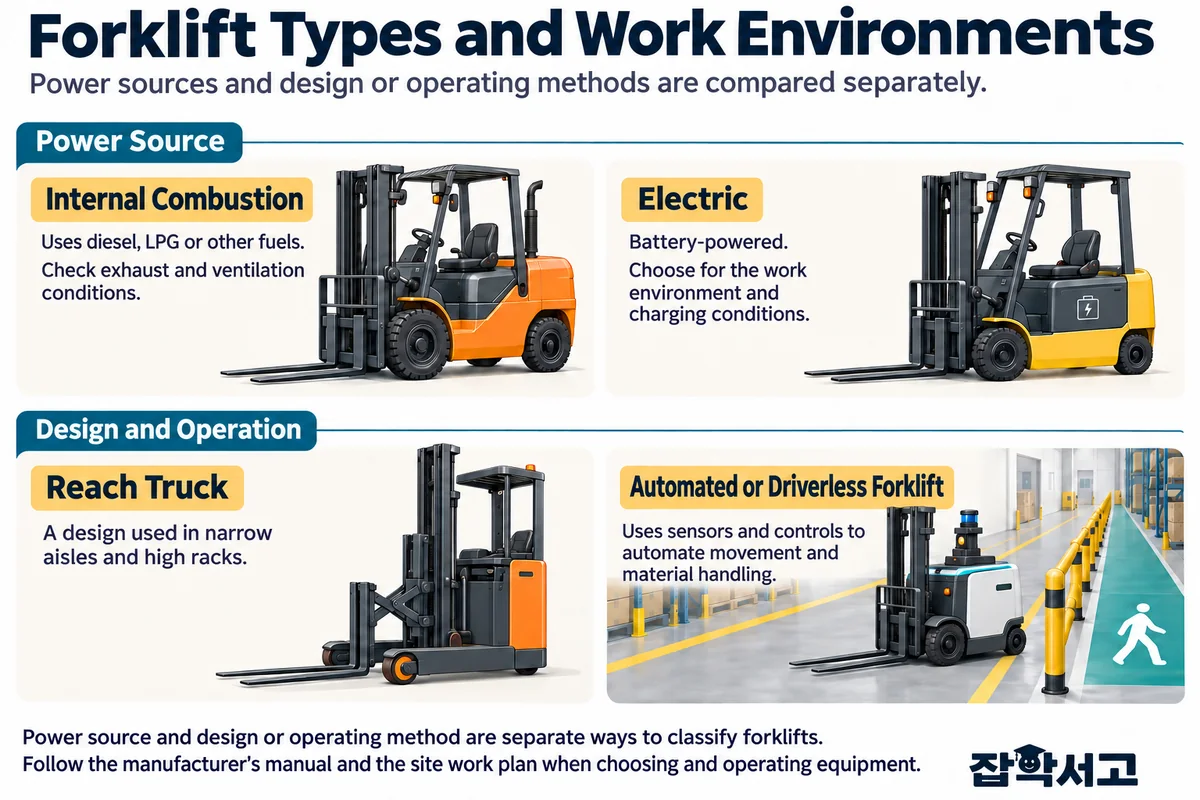
Forklifts have developed into very different forms depending on the operating environment—indoors or outdoors—the weight of the loads they handle, and the layout of the warehouse. By power source, the most common basis for classification, forklifts are divided as follows.
Diesel Forklifts (Internal Combustion Engine Models)
Boasting powerful torque and lifting strength, diesel forklifts are mainly used to handle extremely heavy loads at outdoor logistics sites, ports, construction sites, and steel plants. They operate without interruption even in harsh conditions such as rain or snow, and their overwhelming advantage is that they can run continuously for 24 hours simply by refueling. However, they have a clear limitation: their loud noise and exhaust emissions mean they must never be used in enclosed indoor warehouses.
Electric Forklifts (Battery-Powered Models)
These are the forklifts most commonly seen in indoor spaces such as distribution warehouses for large supermarkets, food factories, and pharmaceutical companies. Equipped with large, high-performance batteries, they produce almost no noise and emit no exhaust gases, making them environmentally friendly and protecting workers' respiratory health. In the past, they were often considered less powerful than diesel models, but recent advances in lithium-ion battery technology have dramatically improved their power output and operating time. Charging with electricity also costs less than fuel, making them highly advantageous for reducing long-term operating and maintenance costs.
LPG/Gasoline Forklifts
These combine, in equal measure, the advantages of diesel's powerful output and the relatively low exhaust emissions of electric forklifts. They are mainly adopted by small and medium-sized manufacturing plants that are sensitive to exhaust emissions but need to move frequently between outdoor and indoor spaces.
Classifications are also subdivided according to structure and operating method. The most common type is the counterbalance forklift, which the operator controls while seated and looking around in all directions. Its conventional structure uses a heavy counterweight at the rear of the vehicle to maintain balance and prevent it from tipping forward when lifting heavy loads at the front. Reach forklifts, on the other hand, excel in warehouses with extremely narrow aisles. Operators often ride standing up, and because the mast—the upright column along which the forks move up and down—slides forward and backward, loads can be precisely placed into and retrieved from storage even between tightly spaced racks where there is insufficient room for the vehicle itself to turn.
Safe Forklift Operation and Maintenance: Controlling Hidden Risks
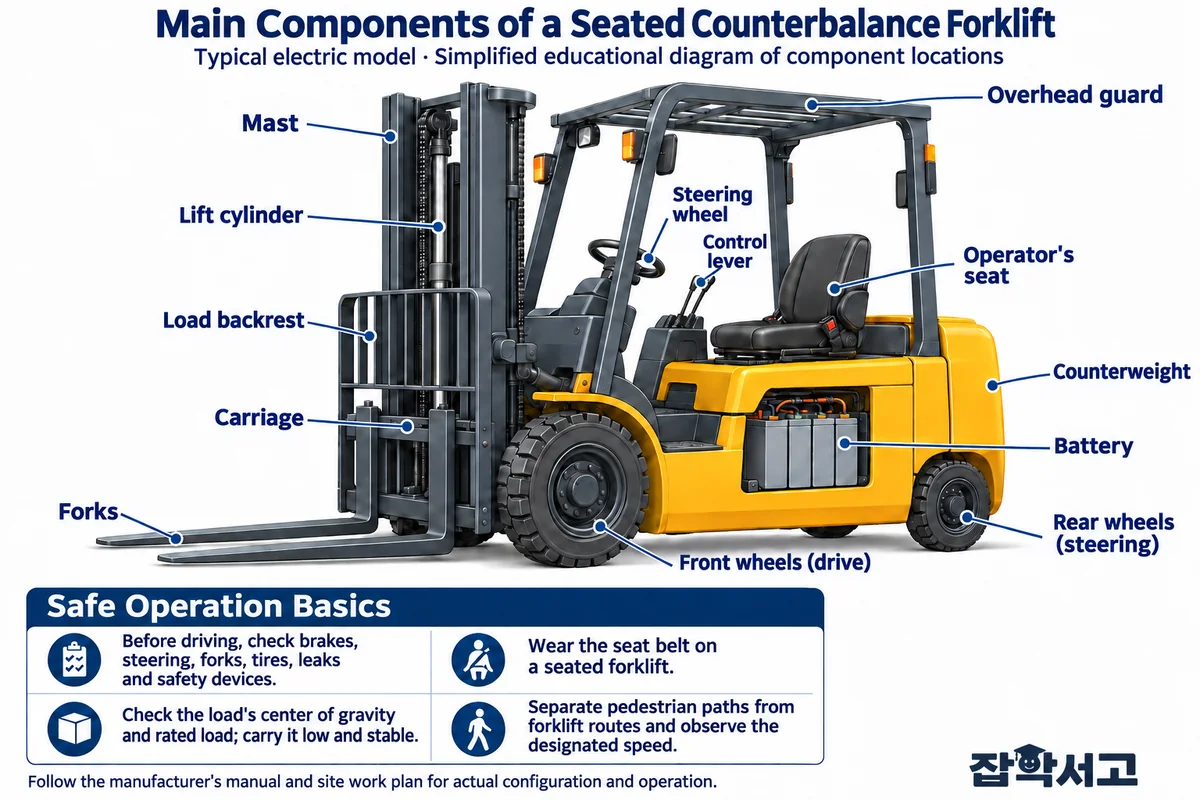
Forklifts are heroes of logistics operations, but they are also dangerous machines that cause the most industrial accidents. This is because the vehicle alone weighs several tons, and loads stacked high at the front can completely block the operator's view. In fact, a substantial proportion of warehouse accidents are collisions that occur when a moving forklift fails to spot a worker walking nearby in time.
Safe forklift operation therefore requires both strict rules and systematic management.
Maintaining Visibility and Assigning a Signaler: When a tall load blocks the forward view, the operator must not force the forklift to move forward. It must be driven in reverse, or a signaler must be positioned alongside it to guide its movement.
Prohibiting Overloading and Securing Loads: Each forklift has a specified maximum permissible load. Loading beyond this limit can lead to serious accidents, such as broken forks or the vehicle overturning forward. Loads must be placed evenly and securely on pallets and firmly secured with wrapping or similar methods.
Daily Preventive Inspection (Routine Check): The habit of checking before work begins that the brakes hold properly, hydraulic oil is not leaking, chain tension is appropriate, and the tires have no cracks extends equipment life and saves workers' lives.
The 4th Industrial Revolution and Smart Logistics: The Emergence of Unmanned Autonomous Forklifts (AGF)

Today's warehouses are no longer spaces where people perform work manually. They are rapidly transitioning into an era of smart logistics that combines artificial intelligence (AI), the Internet of Things (IoT), and robotics, and forklifts are also at the center of this transformation. A prime example of its results is the autonomous unmanned forklift (AGF, Automated Guided Forklift).
In the past, people sat in the operator's seat and drove by pulling levers, but unmanned forklifts in smart warehouses independently recognize a 3D map of the entire warehouse through LiDAR sensors and cameras mounted on top. When they receive a digital command from the central logistics management system (WMS), such as "Move the pallet on rack 3 in Zone A to the shipping area," the forklift calculates the optimal route and moves on its own. If a person appears while it is moving, its sensors detect them and it immediately stops or takes a detour, allowing the rate of accidents caused by human operators' carelessness to be reduced to nearly zero.
Modern forklifts incorporating IoT technology also transmit data about their condition to a server in real time. This enables predictive maintenance, such as "The hydraulic motor temperature of forklift 3 is currently abnormally high, so replace the part within 3 days," preventing devastating losses caused by sudden equipment failure that brings an entire logistics line to a standstill.
An Evolving Giant That Will Keep the Arteries of Future Logistics Flowing
Forklifts began as mechanical equipment that moved heavy loads with the rough roar of diesel engines, progressed through today's environmentally friendly electric forklifts without noise or exhaust emissions, and have now evolved into unmanned autonomous robots that think and move on their own. However much times change and technology advances, the value of forklifts will never change as long as the essence of logistics—safely lifting and moving physical goods—remains the same.
Indeed, the explosive growth of e-commerce and the increasing size of fulfillment centers are driving demand for high-performance forklifts that move faster and more precisely ever higher. Only by properly understanding this remarkable equipment, which is responsible for logistics efficiency from beginning to end, selecting the best equipment for each site, and practicing rigorous safety management can we achieve a complete logistics system that flows without interruption.