
Machine learning is central to modern technological progress, driving changes across various industries at the heart of the data revolution. Having established itself as an essential tool for analyzing vast amounts of data and making predictions, machine learning is steadily expanding its range of applications.
This material will comprehensively cover everything from the basic concepts of machine learning to major algorithms, data preparation, and methods for evaluating and optimizing models.
Understanding the Basic Concepts and Working Principles of Machine Learning
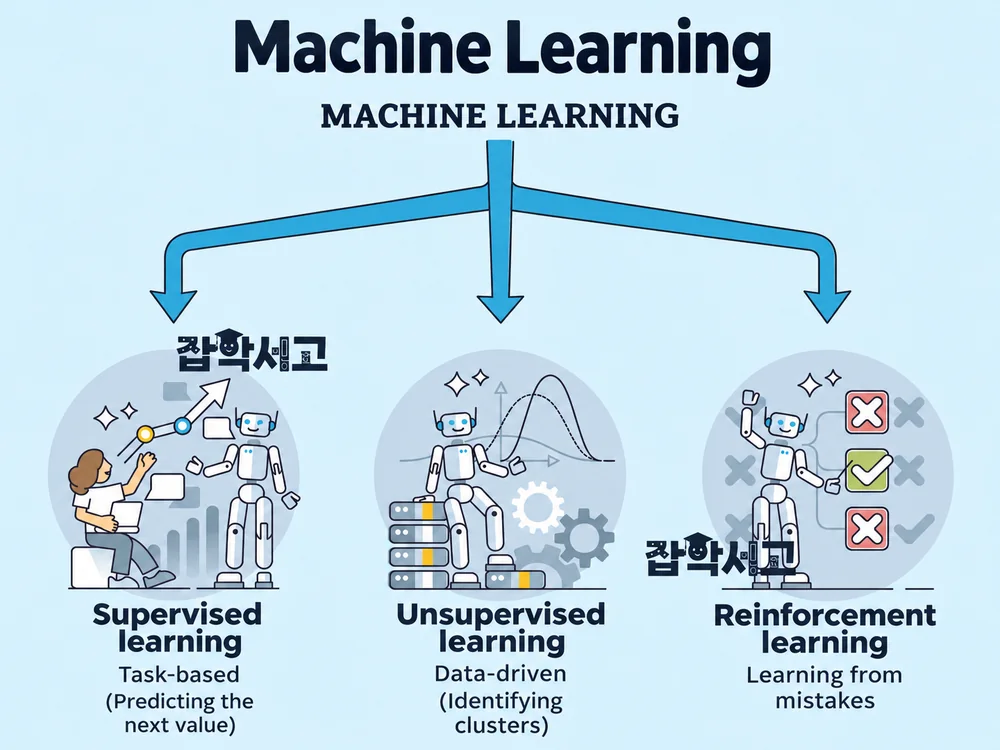
Basic Concepts of Machine Learning
Machine learning is a technology that enables computers to learn from data without explicit programming and use that learning to make predictions or decisions. It is a branch of artificial intelligence that involves analyzing various types of data and learning rules independently. Machine learning is broadly divided into three categories: supervised learning, unsupervised learning, and reinforcement learning. Each learning approach is applied differently depending on the form of the data or the objective, making it possible to solve a variety of problems.
Supervised Learning: Learning from Data and Correct Answers
Supervised learning is a method of training a model using given data and the corresponding correct answers, or labels. This approach creates a model that predicts output values for input data, with regression analysis and classification being representative algorithms. Regression analysis is used to predict continuous numerical values, while classification is used to divide data into discrete categories. For example, models that predict house prices and algorithms used to filter spam emails are examples of supervised learning. Supervised learning becomes more accurate as more data is used and plays an important role in many industries.
Unsupervised Learning: Finding Patterns in Unlabeled Data
Unsupervised learning is a method of analyzing data without correct answers to uncover hidden patterns or structures within it. Because there are no labels, it is mainly used to discover characteristics or clusters in the data itself. Representative algorithms include clustering and association rule learning: clustering divides data into similar groups, while association rule learning identifies correlations between data. This approach is widely used in customer segmentation, recommendation systems, and other applications, and more data allows it to uncover more complex and sophisticated patterns.
Reinforcement Learning: Learning Optimal Actions Through Rewards
Reinforcement learning is an approach in which an agent learns optimal actions to maximize rewards while interacting with an environment. The agent tries various actions and receives rewards based on their outcomes, using this experience to learn how to make better decisions. Reinforcement learning is mainly used in game AI, robot control, autonomous driving, and other applications that require the ability to learn independently in highly dynamic environments. Because the agent learns through trial and error, this approach can involve a lengthy learning process, but the resulting performance is excellent.
The Importance of Data Preparation and Preprocessing
Data preparation and preprocessing are essential for building successful machine learning models. Data preprocessing includes handling missing values, removing outliers, and normalizing data, and without these processes, model performance can decline significantly. Selecting and engineering appropriate features (Feature) for the model is also important. Having more data does not automatically guarantee good performance; properly organized data is necessary. Because the performance of a machine learning model depends heavily on the quantity and quality of its data, the data must be prepared carefully.
Model Evaluation and Optimization
After training a model, its performance must be evaluated and optimized. To do this, the data must be divided into training and test data to evaluate the model's predictive performance. Cross-validation (Cross Validation) is generally used to measure model performance objectively, and hyperparameter tuning is also performed to prevent overfitting (Overfitting) or underfitting (Underfitting). To achieve optimal performance, the model's performance must be carefully analyzed using various evaluation metrics, such as accuracy, precision, and recall.
The Future and Applications of Machine Learning
Machine learning is applied across various industries, and its potential applications are limitless. It maximizes efficiency through data analysis and prediction in finance, healthcare, manufacturing, services, and other fields. In particular, continued advances in machine learning will bring more innovation to areas such as autonomous vehicles, medical diagnosis, personalized advertising, and financial investment. The future of machine learning remains bright, and it will help us move toward a smarter and more efficient world.
Major Machine Learning Algorithms and Their Applications
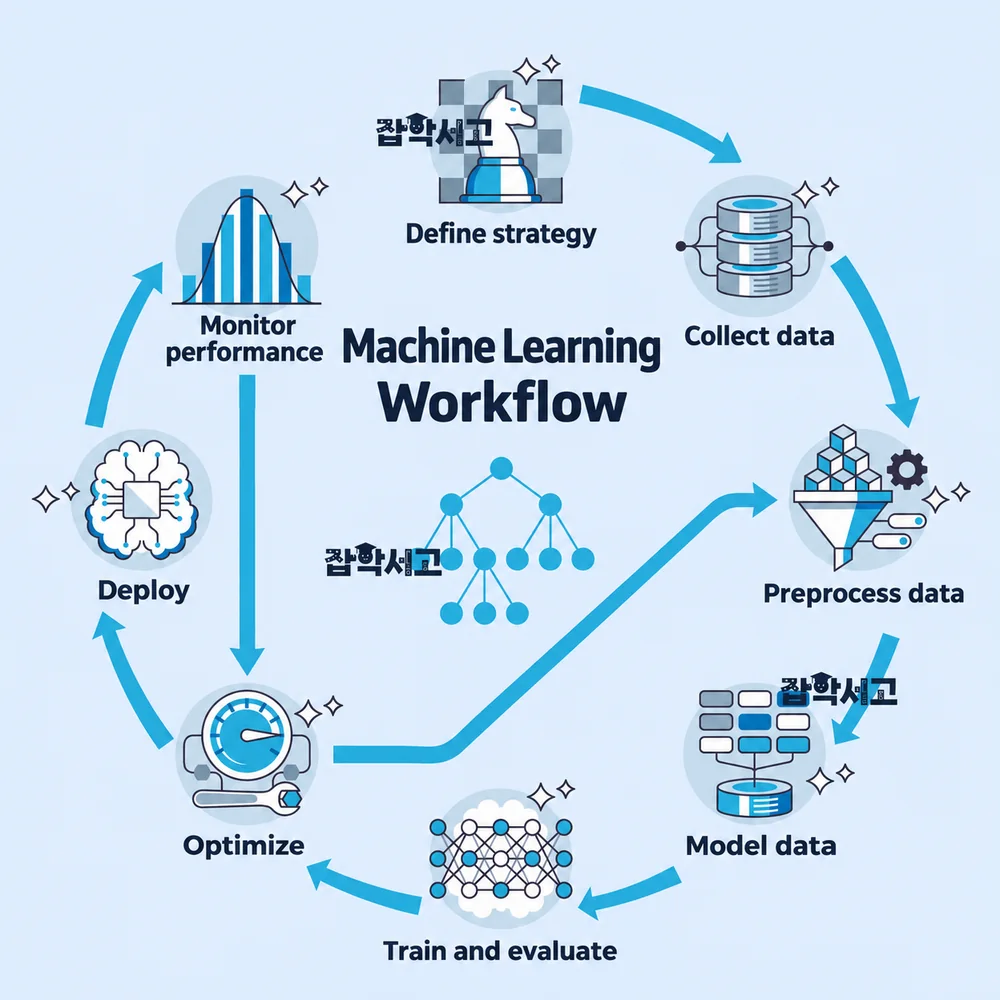
Overview of Major Machine Learning Algorithms
Machine learning includes many algorithms, each offering an appropriate method depending on the characteristics of the problem. These algorithms are used in various application areas and contribute significantly to data analysis and prediction. Representative machine learning algorithms include linear regression, logistic regression, decision trees, random forests, support vector machines (SVM), k-nearest neighbors (k-NN), naive Bayes, and neural networks. Each algorithm has its own approach to solving problems and its own purpose, so it is important to understand its characteristics accurately and apply it accordingly.
Linear Regression: Predicting Continuous Data
Linear regression is one of the most basic algorithms used to predict continuous data. It models the linear relationship between one or more independent variables and a dependent variable, focusing on making predictions based on data. For example, linear regression is widely used to predict housing prices or sales volumes. Linear regression is useful for identifying trends in data and predicting future values, but its accuracy may decline when the data is not linear.
Logistic Regression: Solving Binary Classification Problems
Logistic regression is an algorithm suited to binary classification problems and is used to solve problems with two possible outcomes. For example, it is widely used to classify spam emails or predict whether a disease is present. Logistic regression calculates probabilities based on data and uses the results to perform classification. In particular, it provides high reliability in classification problems and performs well even when the data is moderately complex.
Decision Trees: Intuitive and Easy-to-Interpret Models
A decision tree is a method of visualizing decision-making in a tree structure, making it an intuitive and easy-to-interpret model. It checks conditions at each node and makes decisions accordingly, and it is used for both classification and regression problems. For example, it is useful for predicting customer churn or recommending specific products. However, decision trees are prone to overfitting (overfitting), which has the drawback of potentially making the model too complex.
Random Forests: A Leading Approach to Ensemble Learning
A random forest is an ensemble learning method that combines multiple decision trees to improve predictive performance. It provides more stable and accurate predictions than a single decision tree and is highly effective at reducing overfitting. Random forests are especially widely used in finance for fraud detection, credit score prediction, and other tasks. They also have the advantage of maintaining high reliability regardless of the complexity of the data.
Support Vector Machines (SVM): Classification in High Dimensions
A support vector machine (SVM) is an algorithm that transforms data into a high-dimensional space to find the optimal classification boundary. It mainly performs well on problems such as facial recognition and text classification. SVM performs well even with limited data and is particularly powerful in classification problems with clear boundaries. However, training can take longer when the data is large or complex.
Neural Networks and Deep Learning: Recognizing Complex Patterns
Neural networks are algorithms that imitate the structure of the human brain and excel at recognizing complex patterns. In particular, deep learning is a branch of neural networks that uses multilayer neural networks to achieve excellent performance in large-scale data analysis. It has achieved outstanding results in various fields, including image recognition, speech recognition, and natural language processing, and its range of applications is gradually expanding. Deep learning requires vast amounts of data and substantial computing power, but it can produce correspondingly innovative results.
k-Nearest Neighbors (k-NN): A Simple but Powerful Algorithm
k-nearest neighbors (k-NN) is an algorithm that compares new data with existing data, finds the k nearest neighbors, and uses them to classify it. This algorithm involves simple calculations, but speed and memory usage can become issues with large datasets. It is mainly used in pattern recognition, recommendation systems, and other applications, making decisions based on data similarity in an intuitive way.
Naive Bayes: Probability-Based Classification
Naive Bayes is a classification algorithm based on probability theory that classifies data by calculating conditional probabilities. It is mainly used in text classification, sentiment analysis, and other applications, offering high performance despite its simplicity. Naive Bayes assumes that all features are independent, but it has the advantage of producing good results even when this assumption does not hold in real data.
The Importance of Algorithm Selection
Different machine learning algorithms must be selected and applied according to the specific problem. Choosing an appropriate algorithm based on the characteristics of the problem and the form of the data is important for achieving optimal results. To apply machine learning successfully, it is essential to understand the characteristics and limitations of each algorithm and choose the method best suited to solving the problem.
Data Preparation and Preprocessing: The Foundation of Successful Machine Learning

The Importance of Data Preparation and Preprocessing
The success or failure of a machine learning project depends on how thoroughly data preparation and preprocessing are carried out. Because data directly affects the performance of a machine learning model, it must be handled carefully at every stage. Steps such as data collection, cleaning, transformation, feature extraction, and feature selection form the foundation for optimizing model performance, and if they are not performed properly, the machine learning model may fail to provide reliable results.
Data Collection: Securing Quantity and Quality
Data collection is the first step in gathering the data needed to train a model. During this process, data is collected through various methods, including web scraping, database queries, and API calls. Both the quantity and the quality of the data are very important. A sufficient amount of data is needed for the model to learn various patterns, and poor data quality also reduces the model's predictive accuracy. It is therefore important to obtain data that is as reliable and high-quality as possible at this stage.
Data Cleaning: Removing Noise and Defects
Data cleaning is the process of removing errors or unnecessary elements from collected data. It consists of handling missing values, removing duplicates, and detecting and correcting outliers. Because machine learning models depend heavily on data quality, including uncleaned data may cause the model to learn incorrect patterns or suffer a significant decline in predictive accuracy. Handling missing values is particularly important at this stage, requiring their removal or replacement using appropriate methods. Because leaving incorrect data in place can significantly affect model performance, data cleaning must be carried out meticulously.
Data Transformation: Processing Data to Suit the Model
Data transformation is the process of converting collected data into a form that the model can understand. It includes tasks such as scaling, standardization, and normalization. For example, standardization may be needed to align the units of all variables, or one-hot encoding (One-Hot Encoding) may be needed to convert categorical variables into numerical ones. These transformations enable the model to process and learn from the data efficiently. If this process is not carried out correctly, the model may fail to properly reflect the characteristics of the data, reducing its performance.
Feature Extraction: Highlighting Important Information
Feature extraction is the process of extracting important information from the original data to create new features. This task is central to maximizing model performance. For example, identifying meaningful features by analyzing periodicity or trends in time-series data, or extracting important keywords from text data, are representative examples of feature extraction. Feature extraction helps reveal the essential characteristics of the data more clearly and enables the model to learn important patterns.
Feature Selection: A Task for Optimizing Model Performance
Feature selection is the process of choosing only the features important for model training from among many variables. Removing unnecessary variables can reduce model complexity and improve training speed and predictive accuracy. In this process, important features are selected using various statistical methods, such as correlation analysis and principal component analysis (PCA), to prevent the model from overfitting. Removing unnecessary data also improves model interpretability, making feature selection a very important stage in machine learning.
The Need for Thorough Data Preparation and Preprocessing
Data preparation and preprocessing are time-consuming tasks, but they are essential to a successful machine learning project. Accurate and reliable predictive models can be built only when the quality and structure of the data are properly prepared at this stage. Data scientists must go beyond simply analyzing data and have the ability to understand its characteristics and process it appropriately. Without thorough data preprocessing, even the most complex model will inevitably produce unreliable results.
Analyzing Methods for Evaluating and Optimizing Machine Learning Models

The Importance of Evaluating Machine Learning Models
After building a machine learning model, objectively evaluating its performance is essential. Model evaluation (Evaluation) is the stage of measuring how effectively a model solves a given problem, using various evaluation metrics. Each metric analyzes model performance from a different perspective, and appropriate metrics must be selected according to the situation.
Evaluation Metrics for Classification Models
Metrics commonly used to evaluate classification models include accuracy (Accuracy), precision (Precision), recall (Recall), and the F1 score (F1 Score). Accuracy indicates the proportion of all data that the model predicts correctly, but it has limitations when used alone if the data is severely imbalanced. Precision is the proportion of predicted positives that are actually positive, while recall is the proportion of actual positives that the model predicts as positive. The F1 score is a metric that harmonizes precision and recall and is useful when emphasizing a balance between the two metrics. For example, recall is important in medical diagnostic systems because the aim is to miss as few patients who are actually positive as possible.
Evaluation Metrics for Regression Models
Mean absolute error (MAE), mean squared error (MSE), and the coefficient of determination (R²) are used to evaluate the performance of regression models. MAE is a metric that evaluates a model's prediction errors by averaging the absolute differences between predicted and actual values. MSE is the average of the squared differences between predicted and actual values, giving greater weight to large errors. R² indicates how well the model explains the data, with values closer to 1 indicating a better model. For example, MSE plays an important role in evaluating prediction accuracy in a housing price prediction model.
Preventing Overfitting and Underfitting
Overfitting (Overfitting) occurs when a model focuses too heavily on the training data, while underfitting (Underfitting) occurs when it does not learn enough from the data. An overfitted model performs very well on the training data but performs worse on new data. Underfitting is a state in which the model fails to properly identify patterns in the training data, resulting in low performance overall. Overfitting can be prevented by increasing the amount of data or applying regularization (Regularization) techniques, while preventing underfitting may require using a more complex model.
Model Evaluation Through Cross-Validation
Cross-validation (Cross-Validation) is a very useful method for evaluating a model's generalization performance. It involves dividing the data into several folds and then training and evaluating the model for each fold. This approach reduces variability in evaluation results caused by data splitting and enables more accurate performance evaluation. Cross-validation is widely used, particularly when data is limited or when a more precise evaluation of model performance is desired.
Hyperparameter Optimization
Hyperparameter optimization (Hyperparameter Optimization) is necessary to maximize model performance. Hyperparameters are settings that directly affect model training, and model performance can vary significantly depending on how they are adjusted. Grid search (Grid Search) explores all possible hyperparameter combinations, while random search (Random Search) randomly selects and explores some combinations. More efficient Bayesian optimization (Bayesian Optimization) has recently been introduced, offering an advantage in finding optimal hyperparameters with less computation.
Balancing Model Complexity and Performance
An important part of optimization is maintaining a balance between model complexity and performance. An overly complex model is more likely to overfit, while an overly simple model may underfit. To address this, regularization (Regularization) techniques can be used to control model complexity, or dropout (Dropout) can be used to prevent overfitting in neural network models. Ultimately, the goal of optimization is to adjust complexity and performance appropriately to build a model that generalizes.
The Importance of Evaluation and Optimization
Evaluating and optimizing machine learning models is not merely optional; it is essential to a successful machine learning project. Model performance must be carefully analyzed using evaluation metrics and maximized through hyperparameter optimization. These processes make it possible to address overfitting and underfitting and build the optimal model for the data.
Machine learning holds an important place in modern data analysis and is driving innovative changes across various fields. Using it successfully requires a thorough understanding of its basic concepts, appropriate algorithm selection, and rigorous data preparation and preprocessing.
Evaluating and optimizing model performance is also a very important part of successful machine learning. These processes enable more accurate predictions and effective decision-making and make it possible to offer innovative solutions suited to the era of the data revolution.