Advances in AI technology are bringing new changes to our lives. We can now interact with artificial intelligence (AI) that thinks and learns like humans.
Among these technologies, OpenAI's ChatGPT has attracted considerable attention, and this article explores the concept and applications of AI, as well as how to use ChatGPT.
The Concept of AI
 What Is AI?
AI is a computer system designed to imitate or assist human intelligence. This technology is making people's lives more convenient in various fields and is playing an increasingly important role in our everyday lives.
AI helps us by enabling computer programs to analyze data and make judgments, and AI with these capabilities will affect all areas of our society.
What Can AI Do, and Where Can It Be Used?
 How Is AI Used?
AI (Artificial Intelligence) refers to technology that can learn, make judgments, and perform tasks based on data. In recent years, AI has advanced rapidly across various fields, creating many areas of application, which will continue to expand.
First, a broad overview of what we can do with AI is as follows.
Data Analysis: AI is used to quickly analyze large amounts of data and identify patterns.
Natural Language Processing: It can understand human language and engage in conversation (e.g., chatbots and translation tools).
Image and Speech Recognition: It can recognize objects in images or videos, or analyze and recognize human voices.
Autonomous Driving: AI is used in vehicles' autonomous driving functions to recognize and respond to the surrounding environment.
Games: AI can act as an opponent in various games, from board games to video games.
Prediction: It is used for predictive modeling in various fields, such as the stock market, weather, and consumer behavior.
Recommendation Systems: It analyzes users' preferences or behavior to provide personalized recommendations (e.g., online shopping and streaming services).
The methods mentioned above can be applied to bring AI technology into various industries, and the following are examples of its use in several industries.
Major Applications of AI
Healthcare: It is used for disease diagnosis, treatment recommendations, medical image analysis, medical data analysis, and more.
Finance: It is used for fraud detection, algorithmic trading, credit assessment, and more.
Manufacturing: It is used for production process optimization, defect detection, robotics, and more.
Retail: It is used for inventory management, customer behavior analysis, developing personalized marketing strategies, and more.
Education: It is used for recommending personalized learning paths, learning tools, analyzing practice exams, and more.
Entertainment: It is used for speech recognition, video generation, game design, and more.
Real Estate: It is used for price prediction, investment analysis, creating virtual tours, and more.
Agriculture: It is used for crop diagnosis, optimized farming techniques, and automated agricultural equipment.
AI is rapidly advancing and being applied in many other fields beyond these areas. However, its use must also involve moral and ethical considerations, and AI should be used to complement human roles rather than replace them.
ChatGPT, Which Ushered in the AI Era
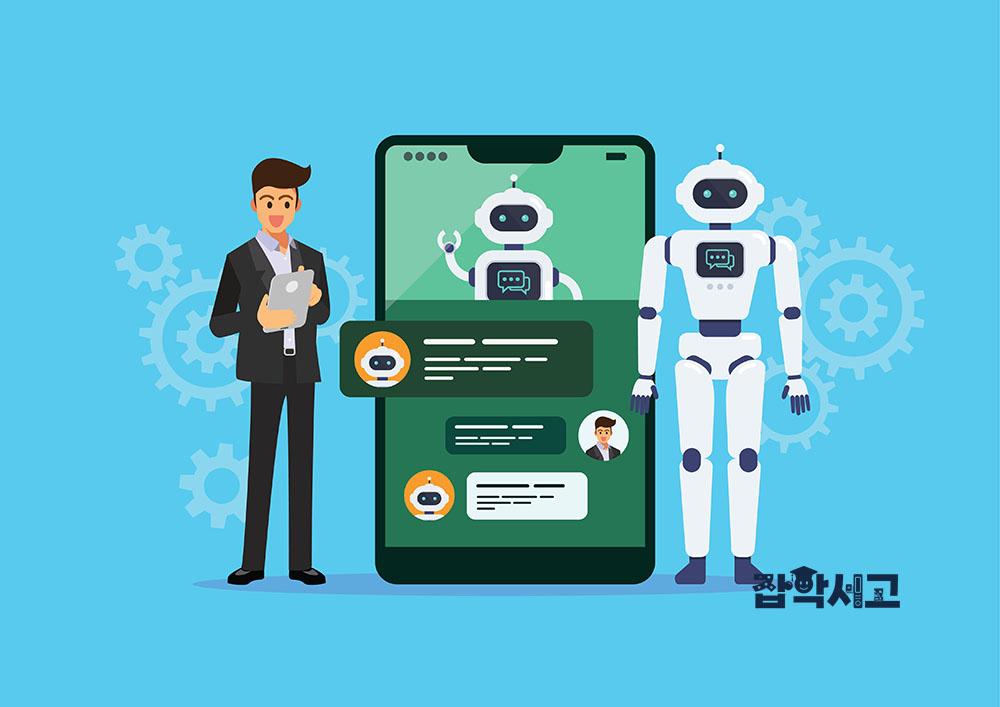 ChatGPT marked the beginning of the full-fledged era of conversational AI.
ChatGPT is an artificial intelligence model developed by OpenAI that can engage in natural conversations with people. By learning from an enormous amount of data, this model can understand context and provide more accurate responses.
Unlike earlier AI models, ChatGPT is characterized by engaging in conversation rather than following commands. GPT in particular is a model based on deep learning that has brought major innovations to natural language processing.
Looking at ChatGPT's features, it is pretrained on large amounts of text data, allowing it to respond naturally to users' questions or commands, and it demonstrates contextual understanding by being able to generate responses based on information spanning multiple sentences or paragraphs.
It can also be used not only for chatbots but for various natural language processing tasks, such as text generation, sentence completion, translation, and summarization. Now, let's take a brief look at how to use this ChatGPT model.
How to Use ChatGPT
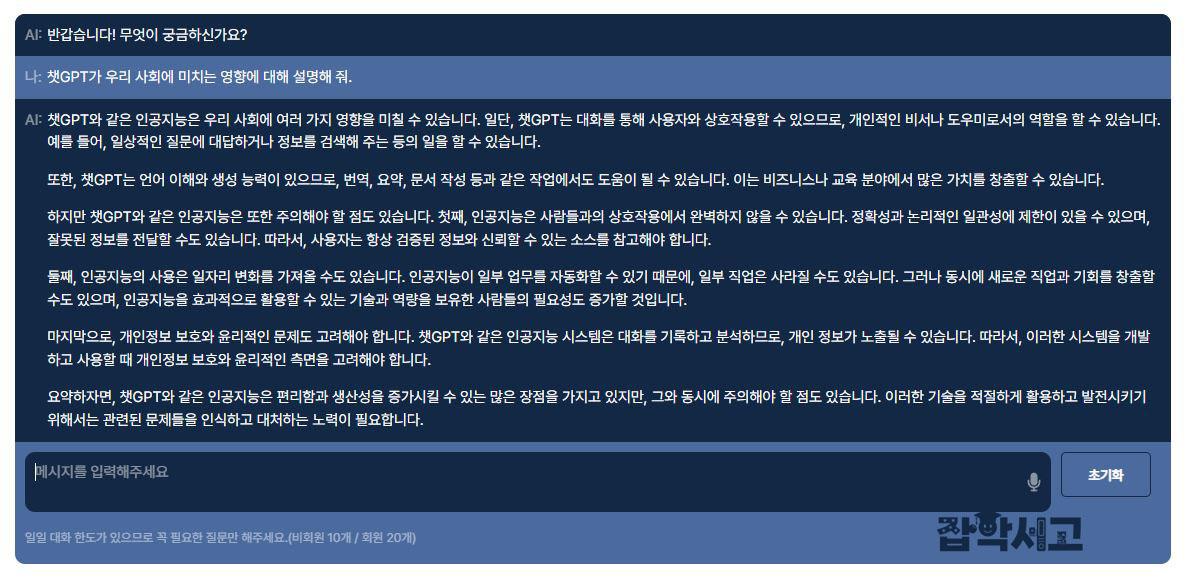 GK Library Chat Window
Using ChatGPT is very simple. For example, you can start a conversation by selecting the AI Chat Room (Discussion) on the GK Library website or the character icon in the lower-left corner.
A conversation consists of user input and AI responses. When a user enters a question, the AI generates a response to that input. In doing so, the AI generates its response by understanding the context of the input sentence, allowing it to accurately understand and respond to what the sentence means.
Users can steer the conversation however they wish, and the AI provides appropriate responses to match their input.
There are several tips for using ChatGPT effectively.
First, it is best to write clear, concise input sentences. Ambiguous questions or sentences can make it difficult for the AI to generate accurate responses. For example, entering only keywords in the chat window may make it difficult for the AI to determine the intended direction, causing it to talk about something else.
Second, verifying the AI's responses is important. Because the AI generates responses based on its training data, it may sometimes produce inappropriate responses. Users should therefore review the AI's responses and check the results.
Third, it is also important to understand and make use of the AI's training data. Because the AI conducts conversations based on its training data, reviewing that data and understanding the context can help users learn.
The following are examples of questions and responses exchanged with ChatGPT based on these tips. Keep in mind that it does not always give the same answer, so its response to the same question can change each time.
Basic Conversation
User: "What's the weather like today?"
ChatGPT: "I'm sorry. I can't provide real-time weather information. Please check a weather website or app."
Answering Questions Rather Than Searching for Information
User: "What drinks go well with pizza?"
ChatGPT: "Drinks that go well with pizza include cola, Sprite, beer, and wine. You can choose according to your personal preferences."
Storytelling and Creative Writing
User: "Create a story about a cat and a dog traveling together."
ChatGPT: "Once, there was a cat named 'Mia' and a dog named 'Luca' in a village. The two of them ... [The story continues]"
Questions About Code or Technology
User: "How do I add up all the elements in a list in Python?"
ChatGPT: "To add up all the elements in a list in Python, you can use the sum() function. For example, you can use it as total = sum(your_list)."
Language Translation
User: Translate "Hello, how are you?" into Korean.
ChatGPT: "Hello, how are you?"
Opinions or Advice
User: "Recommend a good book to read."
ChatGPT: "It depends on your interests or preferred genres, but 'Wide and Shallow Knowledge for Intellectual Conversations' is a good book that encourages you to think about various topics."
One thing to keep in mind when using ChatGPT is that, because it generates responses based on training data, it does not always provide 100% accurate information. Therefore, when making important decisions or when fact-checking is needed, it is a good idea to consult additional sources or expert opinions.
This concludes our overview of the concept of AI, as well as the applications and usage of ChatGPT, which ushered in this era in earnest.
The beginning of the AI era presents us with new possibilities and challenges. ChatGPT is a new type of AI system that communicates with us through conversation. This technology is playing an increasingly important role in our everyday lives, and the possibilities for its use in various fields are endless.
By using ChatGPT, we can enjoy more convenient and efficient lives and gain a glimpse of exciting prospects for the future of AI technology. The AI era is beginning right now, and by understanding and using new technologies, we can build a better future.