When a major accident breaks out at a factory, people often say it happened “suddenly.” Yet when you trace the accident back, you often find that there had already been many warning moments: a floor someone nearly slipped on, a valve that was not fully closed, close calls that were narrowly avoided. The idea that major accidents do not arrive out of the blue one day but surface only after small signals have piled up is precisely what is known as “Heinrich’s Law.”
Put simply, Heinrich’s Law is a rule of thumb stating that “behind every major accident lie 29 minor accidents and 300 near misses.” Because of this ratio it is also called the “1:29:300 rule,” and today it is widely cited not only in industrial safety but also in healthcare, aviation, and service management as a lesson never to dismiss small warning signs lightly.
This article offers an easy-to-follow overview of how Heinrich’s Law came about, what the 1:29:300 ratio means, the domino theory that explains accidents, the later extensions and criticisms of the law, and how to read small signals in everyday life and in organizations.
Heinrich’s Law: Small Signals That Foreshadow Major Accidents
What Is Heinrich’s Law?
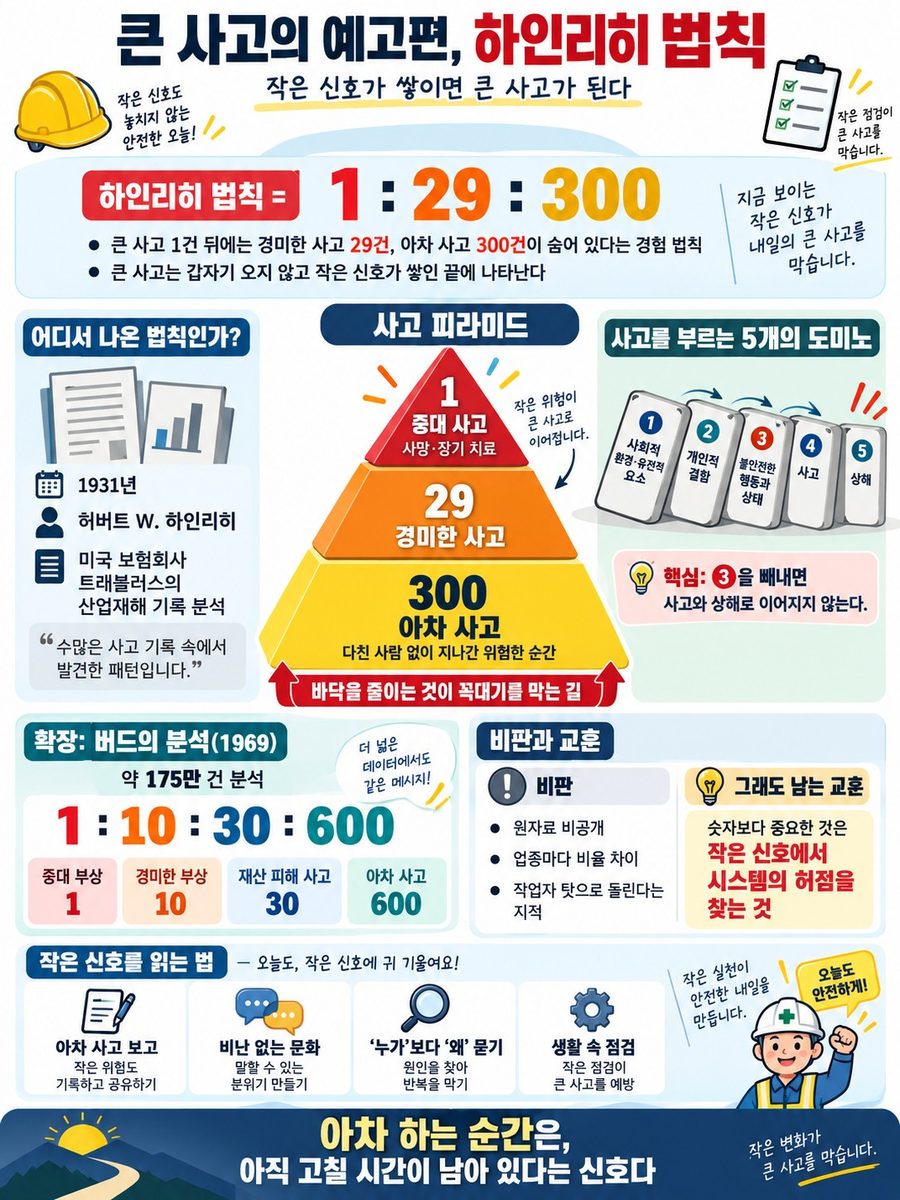

Heinrich’s Law was introduced in “Industrial Accident Prevention: A Scientific Approach,” a book published in 1931 by Herbert William Heinrich (Herbert W. Heinrich), who investigated industrial accidents at the American insurance company Travelers. Analyzing the vast number of accident records he had gathered while handling insurance claims, he argued that when accidents of the same type recur, the severity of their outcomes breaks down according to a consistent ratio.
If you draw this ratio as a triangle, you get a pyramid with a single major accident at the top and a broad base of minor accidents and near misses spread out beneath it. The key point is that the wider the base, the greater the chance of reaching the top, so reducing the small accidents at the base is itself the way to prevent major ones.
- Major Injury: A serious injury resulting in death or requiring long-term treatment, corresponding to the 1 at the top of the pyramid.
- Minor Injury: An injury that needs only minor treatment, corresponding to the 29 in the middle.
- Near Miss: A dangerous moment that passes without anyone getting hurt, corresponding to the 300 at the base.
Five Dominoes That Lead to an Accident

Heinrich also sought to explain why accidents happen. He likened an accident to five dominoes standing in a row, holding that when a piece in front falls, the pieces behind it topple one after another.
(1) Social Environment and Hereditary Factors
The first piece: the environment a person grew up in and their innate temperament shape how they approach risk.
(2) Fault of Person
This refers to weaknesses that stem from the person, such as carelessness, ignorance, and haste.
(3) Unsafe Act and Condition
This covers actions such as not wearing protective equipment or disabling safety guards, as well as conditions such as slippery floors and broken equipment.
(4) Accident
The event that actually takes place, such as a fall, a collision, or getting caught in machinery.
(5) Injury
The injury or loss that results from the accident.
What Heinrich emphasized most was the third piece. His principle of prevention was that if you remove the unsafe acts and conditions, the chain will not carry through to an accident and injury even if the pieces in front fall.
Bird’s Extension and Criticisms of the Law

Heinrich’s ideas went on to inspire many later studies. In 1969, the American Frank E. Bird Jr. analyzed about 1.75 million accident reports from 297 companies and proposed a new ratio: “1:10:30:600.” It holds that behind 1 serious injury there are 10 minor injuries, 30 property-damage accidents, and 600 near misses with no damage, and it is significant in that it brought even accidents in which no one was hurt into the pyramid.
On the other hand, criticism has been raised steadily. The original data Heinrich used were never made public, making them difficult to verify, and the ratios vary greatly by industry and type of work. Critics have also pointed out that reducing small accidents does not reduce large-scale accidents such as explosions or collapses to the same degree, and the law has been criticized for placing too much of the blame for accidents on workers’ behavior. For this reason, today it is often taken not as a ratio to be believed literally, but as a lesson to uncover weaknesses in the system from small signals.
How to Read Small Signals in Everyday Life and in Organizations

The reason Heinrich’s Law has endured for so long lies less in its numbers than in the attitude it encourages. Safety is built by a culture that notices the small signals sent before a major accident and shares those signals instead of hiding them.
- Near Miss Reporting: Record moments that were dangerous, even if no one was hurt, so that the same thing does not happen again.
- Blame-Free Culture (Just Culture): Foster an atmosphere in which, rather than blaming the person who owns up to a mistake, everyone works together to find the cause.
- Root Cause Analysis: Ask “why” something happened rather than “who” made the mistake, and fix the equipment and procedures.
- Daily Checks: Don’t ignore the small signals at home either, such as a threshold you keep nearly tripping over or a gas valve you keep forgetting to turn off.
Heinrich’s Law is less a formula for memorizing exact numbers than a warning to look at the countless small signals lying beneath a major accident. A close call may not be a stroke of good luck, but a signal that there is still time to fix things.
If you had a close call today, take a moment to write down why it happened. The habit of never letting small signals slip by and fixing them right away is the first step toward the kind of safety that prevents major accidents.