On a windy winter night, have you ever heard power lines or flagpole ropes humming with a steady “whoo”? The wind seems simply to brush past, so why does a thin line give off a sound of a fixed pitch? The secret lies in small vortices that form alternately on each side behind the line. This staggered double row of vortices trailing behind an object is called the ‘Kármán Vortex Street’.
Put simply, a Kármán vortex street means ‘the phenomenon in which, when water or air flows past a blunt object such as a cylinder, vortices spinning in opposite directions break away alternately from the top and bottom of its rear side and line up in a zigzag’. It is named after the Hungarian-born engineer Theodore von Kármán, who in 1911 and 1912 explained in theory how this arrangement of vortices is maintained.
In this article, we will look in turn at how the phenomenon was discovered, the conditions and formula for vortex formation, examples ranging from singing wires to clouds in the sky, and finally the technologies that suppress vibration and measure flow.
The Science of Vortices Lining Up Behind an Object
1. Two Rows of Vortices Found Behind a Cylinder

If you look down behind a bridge pier standing in a river, you can see vortices breaking away one by one and drifting downstream where the water has wrapped around the pier. People had watched such ripples for a long time, but why the vortices line up so regularly was explained only in the early 20th century.
(1) The first observers
In 1907 Arnulph Mallock of Britain and in 1908 Henri Bénard of France observed in experiments how vortices form alternately behind an object.
(2) Kármán’s calculation
Kármán, then at the University of Göttingen in Germany, became interested in experimental results showing that the flow behind a cylinder would not settle down but kept wobbling, and he calculated which arrangement of vortices could last. He concluded that the arrangement is stable only when the upper and lower rows are staggered rather than facing each other, and when the ratio of the spacing between the two rows to the spacing between vortices is about 0.28.
(3) Vortices painted before they were explained
Kármán liked to talk about a 14th-century Italian painting. In it, vortices were painted alternately behind the legs of Saint Christopher as he carried the infant Jesus across a river. The painting is thought to be the one in the museum of the Basilica of San Domenico in Bologna. The painter did not know the principle, but had already seen the phenomenon with his own eyes.
2. Conditions for Vortices: the Reynolds Number and the Strouhal Number
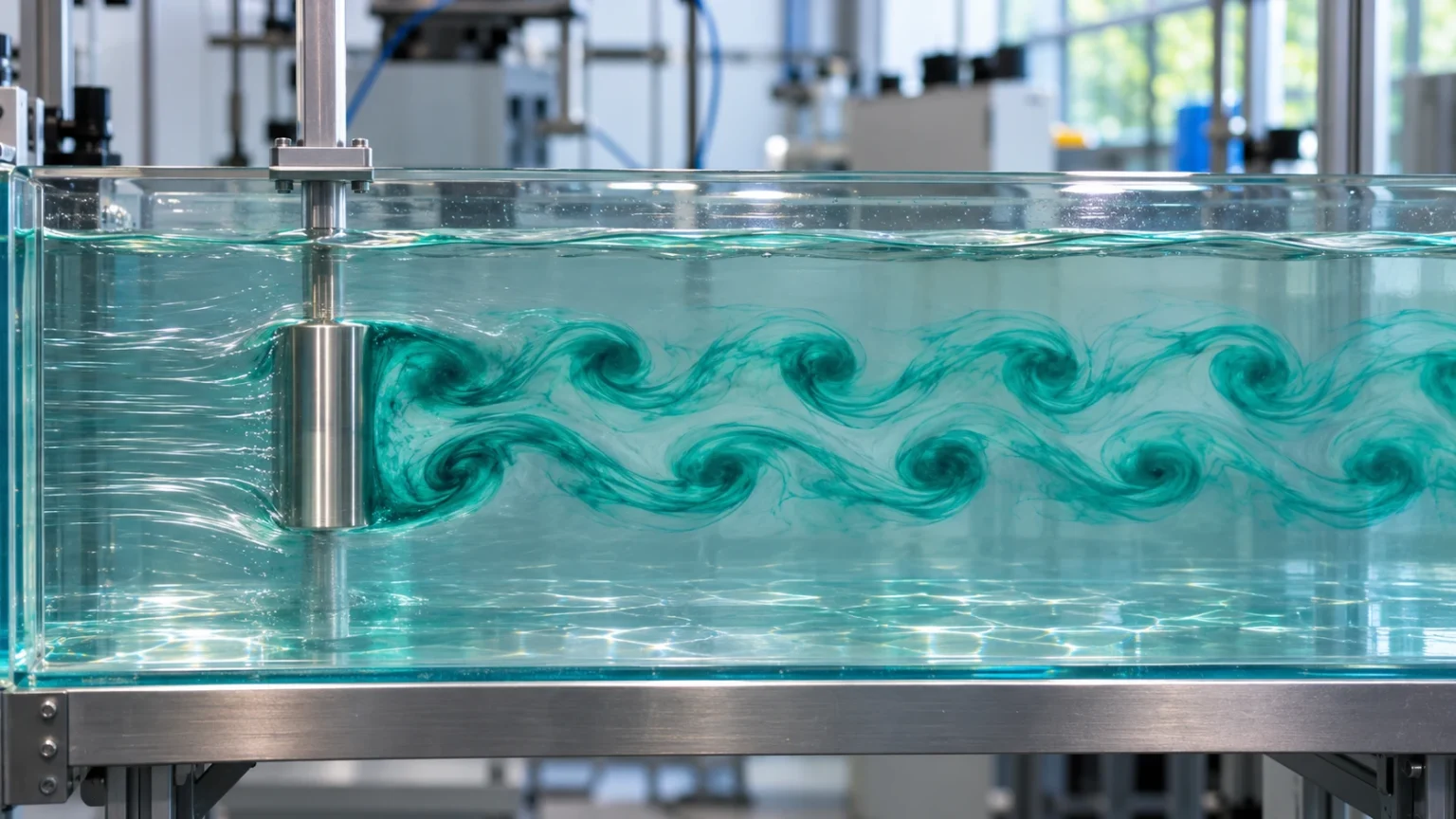
Vortices form because fluid flowing along the surface of an object separates from it at the rear. The flow separating from the top and the flow separating from the bottom curl in opposite directions, and as soon as a vortex on one side grows and breaks away, the other side takes over, a cycle that repeats like a pendulum.
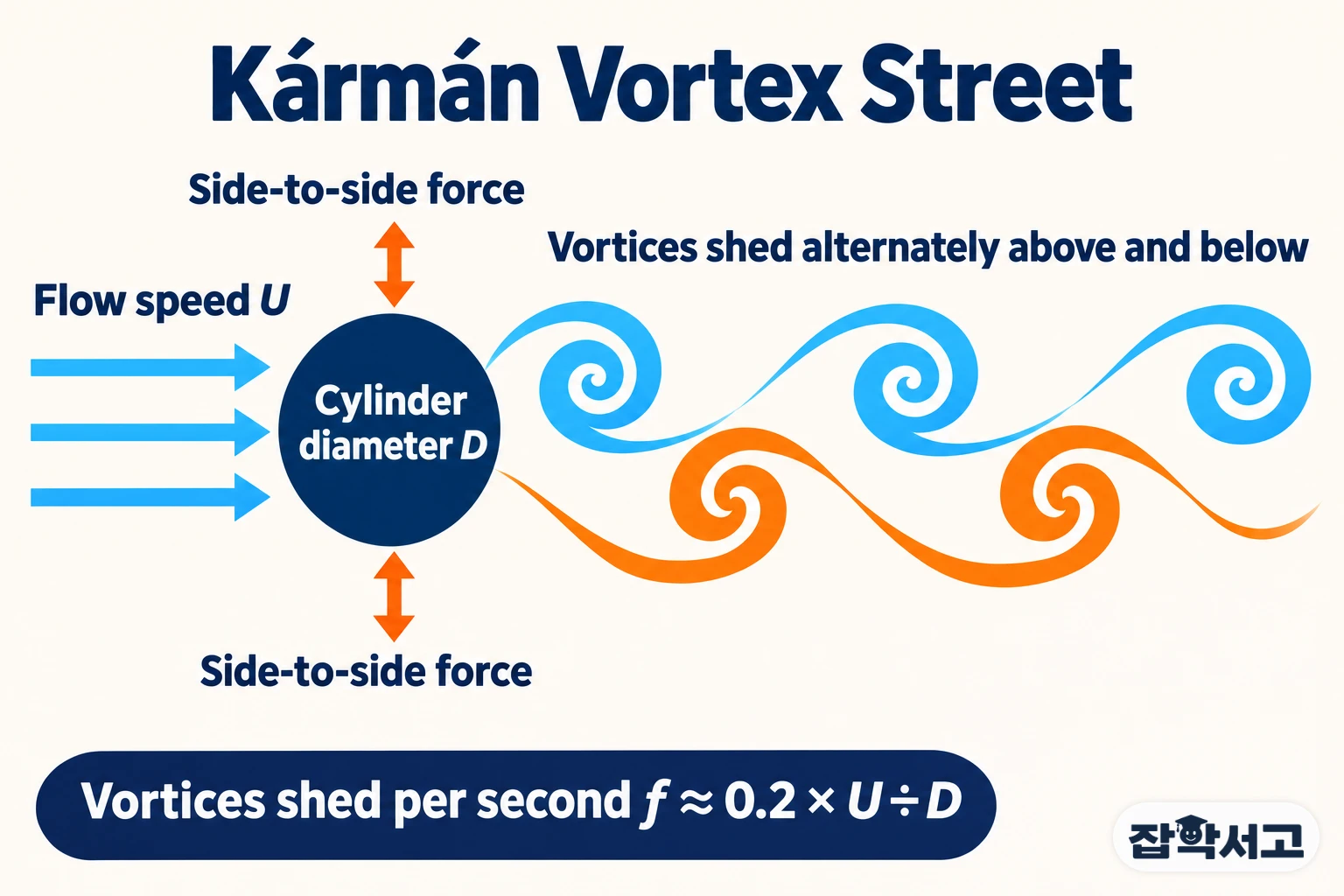
- Reynolds Number: a number that combines the flow speed, the size of the object and the stickiness (viscosity) of the fluid; for a cylinder, vortices begin to break away alternately once it exceeds about 47.
- Vortex Shedding: the process in which vortices detach one by one behind an object; each time a vortex detaches, the object receives a small sideways force.
- Strouhal Number: the shedding frequency f multiplied by the object’s diameter D and divided by the flow speed U; for a cylinder it stays almost constant at about 0.2 over a wide range.
- Wake: the region of disturbed flow behind an object; a Kármán vortex street is this wake arranged into a regular procession.
A Strouhal number of about 0.2 makes a simple calculation possible: f ≈ 0.2 × U ÷ D. For example, if a 10 m/s wind blows across a wire 1 cm thick, about 200 vortices break away every second, and this beat becomes the pitch of the sound we hear. However, once the Reynolds number exceeds about 190 the flow becomes complicated in three dimensions, and beyond roughly 100,000 the vortices also scatter irregularly.
3. From Singing Wires to Clouds in the Sky
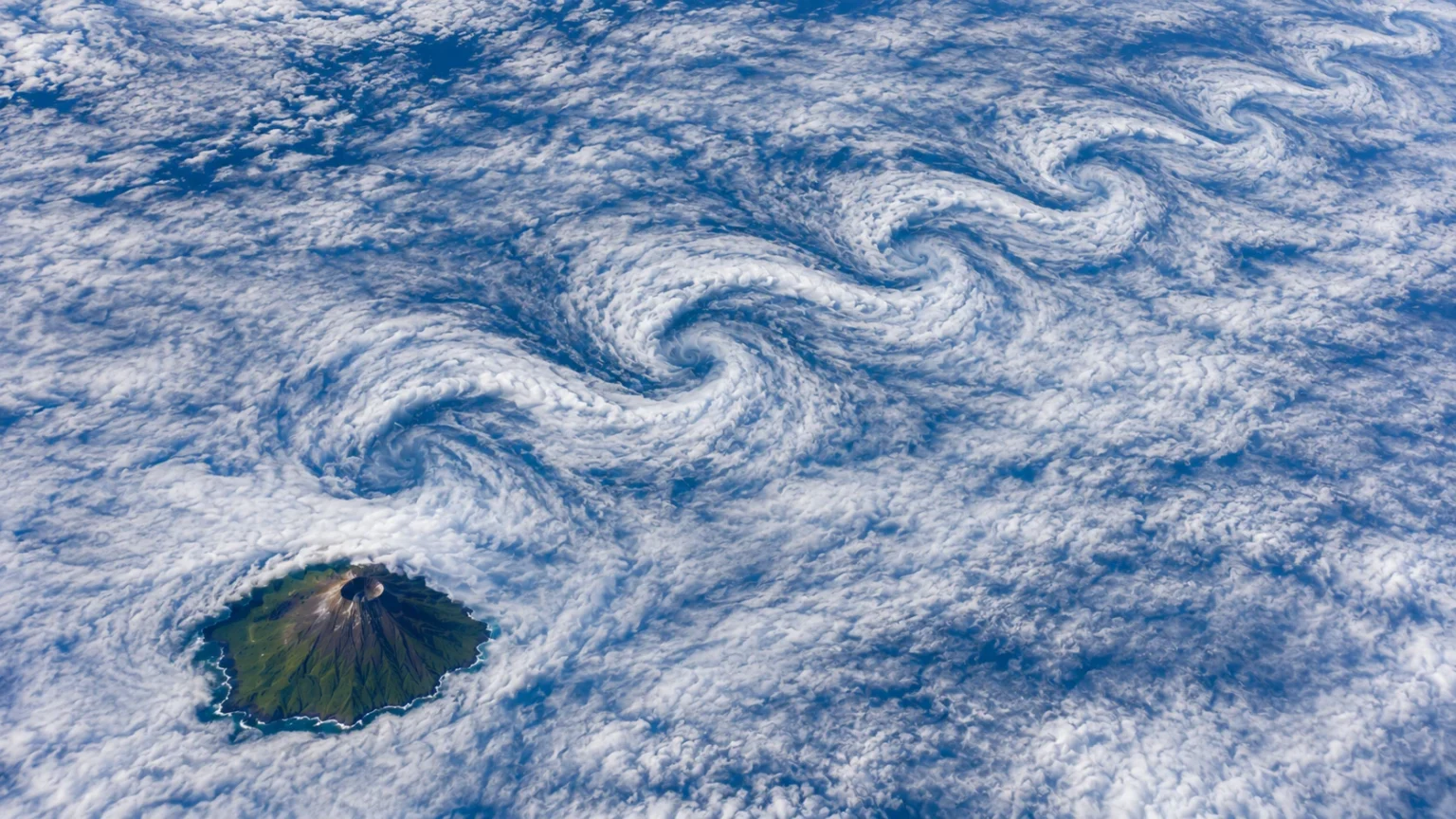
The Kármán vortex street is not just a laboratory phenomenon. The same pattern of vortices forms behind a wire a few millimeters thick and behind an island several kilometers across.
(1) Wires that sing in the wind
In 1878 the Czech physicist Vincenc Strouhal studied the humming of telegraph wires in the wind and showed that the pitch of the sound is set by the thickness of the wire and the speed of the wind. The rod antenna of a moving car vibrating at certain speeds is the same phenomenon.
(2) Cloud patterns drawn behind islands
When wind blowing over the sea meets a tall island, the island acts like a giant cylinder. Satellite images have captured vortex streets forming in the cloud layer downwind of the Juan Fernández Islands off Chile and Socorro Island in Mexico. Such streets can stretch for more than 400 km, with individual vortices 20–40 km across.
(3) Buildings and underwater structures
A tall building of uniform height can create a Kármán vortex street behind it when the wind is calm, and these vortices become a force that sways the building sideways. At sea, long pipes connected to offshore platforms sway in the same way because of ocean currents, so this is a problem that must be checked during design.
4. Technologies That Stop the Shaking and Measure the Flow

Each time a vortex breaks away, the object is pushed slightly sideways. If this beat matches the rhythm at which a structure naturally sways, its natural frequency, small forces add up to large vibrations. Engineers have therefore found ways to scatter the vortices or even put them to use.
(1) Spiral strakes and vibration absorbers
Wrapping spiral strips (helical strakes) around the top of a tall chimney or tower makes the point where vortices break away differ at each height, so they do not fall into a single rhythm. Tuned mass dampers, which use a heavy weight swinging like a pendulum in time with the vortices to absorb the vibration, are also used, and tapering a structure toward the top has the same effect.
(2) A misconception about the Tacoma bridge
The 1940 collapse of the Tacoma Narrows Bridge in the United States, which twisted violently in the wind before falling, was once explained as the work of a Kármán vortex street. Today, however, the real cause is considered to be aeroelastic flutter, in which the bridge’s own motion amplifies the force of the wind.
(3) Flowmeters that measure flow with vortices
The vortex flowmeter turns the fact that the shedding frequency is proportional to the flow speed to its advantage. By placing a blunt bar inside a pipe and counting the vortices that break away with a sensor, it can calculate how much is flowing. Since Yokogawa of Japan launched the first commercial product in 1969, it has been widely used in gas, steam and water piping.
The Kármán vortex street shows that the small sound of a wire and cloud patterns hundreds of kilometers long arise from the same principle. The simple idea that flow passing an object leaves a trace by twisting alternately up and down is the first step toward understanding the Kármán vortex street.