Look up on a clear day and the sky almost always looks blue. But sunlight is white light made of many colors mixed together, and air is transparent, so why is the sky in particular blue? It also makes you wonder why the same sky turns red at sunset. The physical phenomenon that explains both scenes at once is Rayleigh Scattering.
Put simply, Rayleigh scattering means “light bouncing off particles much smaller than its wavelength, especially the nitrogen and oxygen molecules in the air, and spreading out in all directions.” The key point is that the shorter the wavelength, the far more strongly the light is scattered. It is named after the British physicist Lord Rayleigh (born John William Strutt), who worked out this relationship mathematically in 1871.
In this piece we will look in turn at what Rayleigh scattering means and how it was discovered, why scattering changes with wavelength, easy examples from sunsets and clouds, and its uses in everyday life and technology.
How Light Scatters When It Hits Air Molecules
What Is Rayleigh Scattering?

When light passes through matter, some of it leaves its original path and spreads out in many directions. This is called scattering. How scattering looks depends greatly on the relationship between the wavelength of light and the size of the particles, and the case that occurs when particles are smaller than about one-tenth of the wavelength is called Rayleigh scattering.
- Scattering: the phenomenon in which light meets a particle, changes direction, and spreads out in all directions. Unlike absorption, the light’s energy does not disappear; only its direction changes.
- Scattering Particle: in Rayleigh scattering, this role is played mainly by the nitrogen and oxygen molecules that make up air. These molecules are far smaller than the wavelengths of visible light (about 380–750 nm).
The first clue came from the laboratory. In 1869, John Tyndall observed that when strong light was shone through air containing very tiny suspended particles, the scattered light had a bluish tint. Two years later, Rayleigh worked out the phenomenon in equations, and in 1899 he laid out the framework explaining that it is the air molecules themselves, not dust, that make the sky blue.
Why the Fourth Power of Wavelength Sorts the Colors
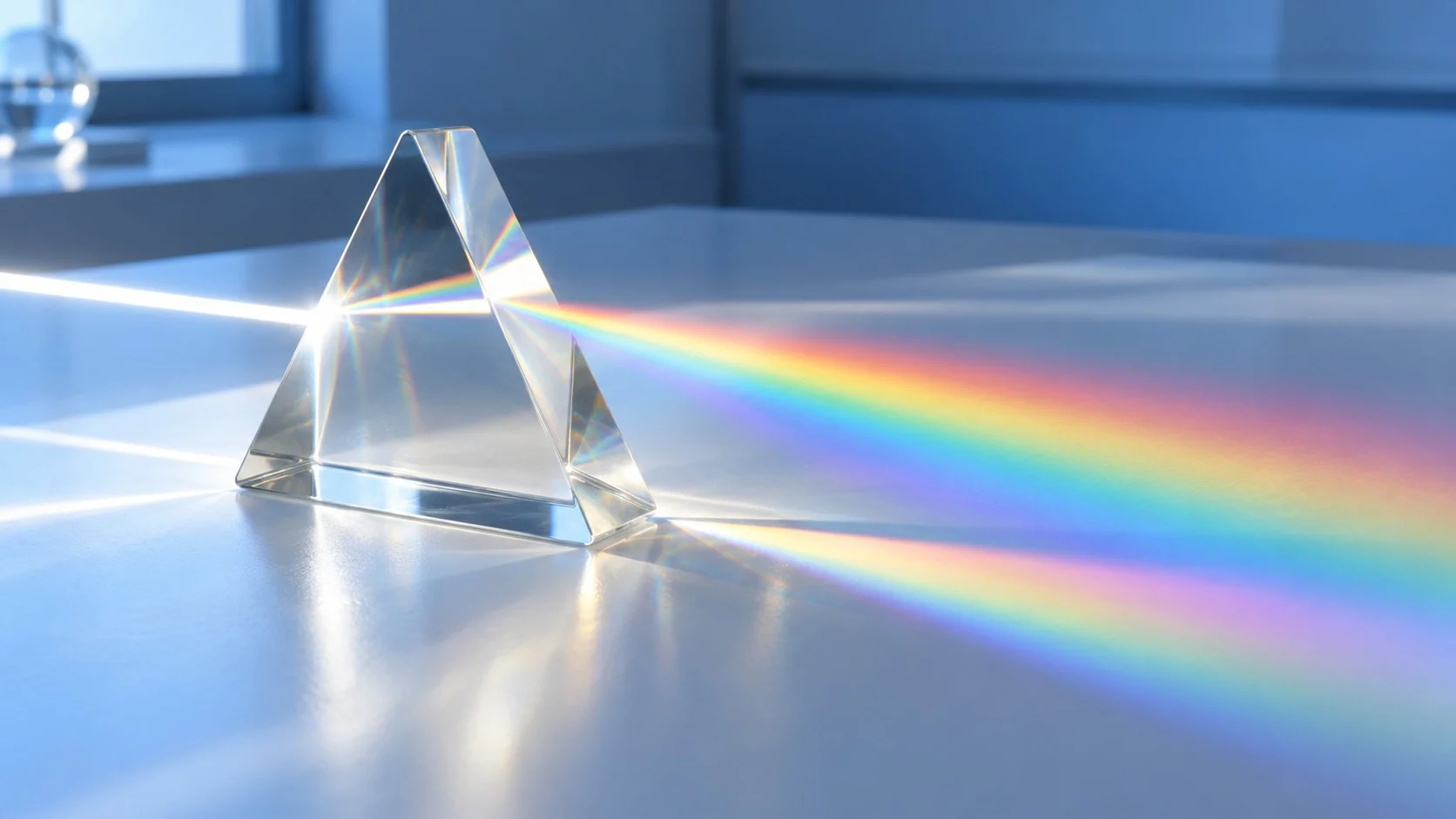
The most important property of Rayleigh scattering is that the intensity of scattered light is inversely proportional to the fourth power of the wavelength. Halve the wavelength and scattering increases by 2 to the fourth power, or 16 times. That is why, even within the same sunlight, each color scatters to a very different degree.
(1) The shorter the wavelength, the more it scatters
Blue light (about 450 nm) has a shorter wavelength than red light (about 700 nm), so it is scattered about 6 times more. Violet light (about 400 nm) scatters about 9 times more than red light.
(2) Scattered blue light fills the whole sky
As sunlight passes through the atmosphere, blue light keeps bumping into air molecules and spreading in all directions. Whichever part of the sky we look at, other than the sun itself, blue light scattered from that direction reaches our eyes, so the whole sky looks blue.
(3) There is also a reason the sky isn’t violet
Even though violet light is scattered more, there are reasons the sky doesn’t look violet. Sunlight contains less violet light than blue light to begin with, and the human eye is also more sensitive to blue than to violet.
- Wavelength Dependence: the property that scattering intensity is inversely proportional to the fourth power of the wavelength, the clearest feature that sets Rayleigh scattering apart from other kinds of scattering.
- Mie Scattering: scattering that occurs when particles are similar to or larger than the wavelength of light. It hardly differs by color, so light scatters as something close to white.
The Colors of the Sky Through Easy Examples

Once you know about Rayleigh scattering, you can read the sky’s changing colors over the course of a day with a single principle. The key is how thick a layer of air sunlight must pass through before it reaches our eyes.
[Example 1] A sunset glowing red
When the sun sinks near the horizon, its light must travel at a slant through a much thicker layer of air than at midday. Along that long path, nearly all the blue light is scattered off to the side, and only the orange and red light, which scatter less easily, remain to reach our eyes. In other words, sunsets are red because the blue light has been removed.
[Example 2] Clouds that look white
The water droplets that make up clouds are much larger than air molecules, similar to or larger than the wavelength of light. In this case, Mie scattering rather than Rayleigh scattering takes place, and all colors scatter about equally, so clouds look white. When droplets pile up so thickly that light can barely pass through, they become gray rain clouds.
(1) Without an atmosphere, the sky isn’t blue
On the Moon, which has almost no air, there are no molecules to scatter light, so the sky looks black even at midday. The blue of the sky is, in the end, a color made by the atmosphere around us.
Traces Rayleigh Scattering Has Left in Daily Life and Technology
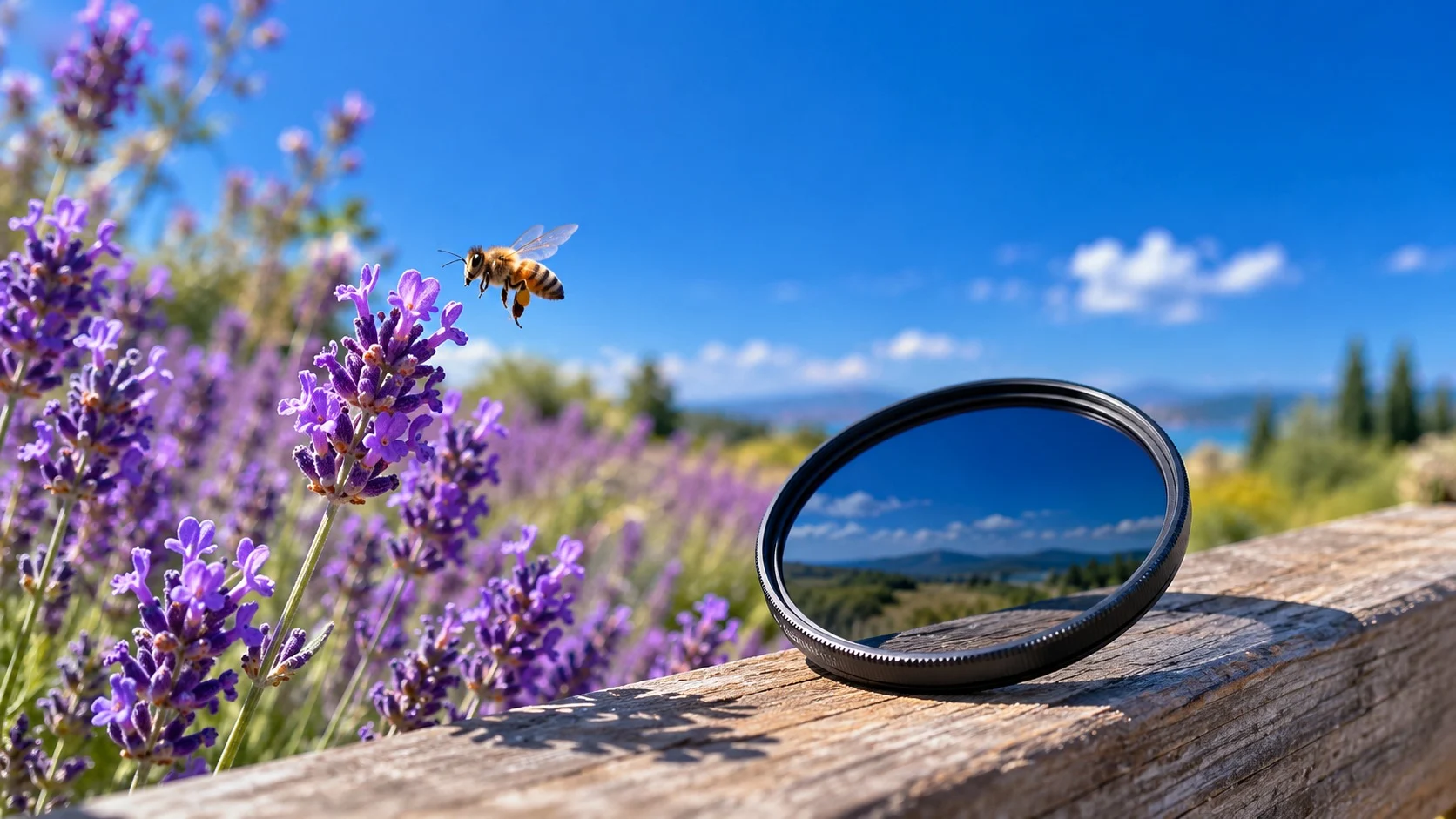
Rayleigh scattering does more than explain the color of the sky. The distinctive properties of scattered light are also used in photography, nature observation, and scientific research.
(1) Polarizing filters make the sky look deeper
Skylight scattered by Rayleigh scattering becomes polarized, vibrating in a particular direction. Polarization is strongest in the part of the sky at a right angle to the sun. When photographers turn a polarizing filter to capture a deeper blue sky, they are using this property.
(2) Honeybees find their way by skylight
Honeybees are known to sense patterns of polarized skylight that are invisible to the human eye, which lets them judge direction even when the sun is hidden behind clouds. In effect, the whole sky serves as a natural compass.
(3) Light scattering becomes a research tool
Measuring the intensity of scattered light reveals the properties of small particles and molecules in gases and liquids. Methods that precisely measure light scattering are also widely used in atmospheric observation and chemical analysis.
Rayleigh scattering shows us that tiny, invisible particles such as air molecules scatter sunlight and paint the color of the sky.
The next time you see a blue sky or a red sunset, remember that the color is the result of light meeting air: that is the first step in learning the physics of everyday life.