You have probably seen a free kick sail over the defensive wall, bend sharply, and get pulled into the corner of the goal. In table tennis and tennis, too, a sliced ball suddenly swerves or drops on the opponent's side. It is the same ball, so how can its flight path change so much?
Put simply, the Magnus effect means “the phenomenon in which an object spinning as it moves through air or water receives a force perpendicular to its direction of travel and curves.” Its formal name, the Magnus Effect, comes from the German physicist Heinrich Gustav Magnus, who demonstrated it experimentally in 1852.
In this article, we will look in turn at how the Magnus effect was discovered, why spin creates a sideways force, and how it is used in sports, ships, and aircraft, as well as what its limits are.
Understanding and Applying the Magnus Effect
An Observation That Began with a Tennis Ball

The first person to put in writing that a spinning ball curves was Isaac Newton. In a 1672 letter on light, he recalled seeing tennis balls at Cambridge struck with an oblique racket fly in a curve, and explained that this was because the spin pressed harder against the air on one side.
In 1742, the English ballistics researcher Benjamin Robins showed that bullets veer sideways away from the target because of their spin. He hung a wooden ball from a twisted string and set it swinging, showing that as the string untwisted and the ball spun, the direction of its swing turned sideways.
Later, in 1852, Magnus at the University of Berlin conducted an experiment in which he directed air from a blower at a rapidly spinning brass cylinder. Once the cylinder began to spin, it was clearly pushed in a direction perpendicular to the wind, and the phenomenon was named after him.
How Spin Creates a Sideways Force

The key to the Magnus effect is that air flows at different speeds over the two sides of a spinning object. Following it step by step makes it easy to understand.
(1) The surface drags the air around with it
The surface of the ball drags the thin layer of air in contact with it around as it spins. As a result, the air around the ball also moves slightly along with the ball's rotation.
(2) The flow speeds on the two sides differ
On the side where the ball's surface moves in the same direction as the airflow, the air flows faster; on the opposite side, where the surface moves against the flow, the air slows down.
(3) A pressure difference arises
Pressure drops on the side where the flow is fast and rises on the side where it is slow. The air flowing behind the ball is also deflected to one side.
(4) The ball is pushed toward the low-pressure side
When the air is deflected to one side, the ball, in reaction, receives a force toward the opposite side, that is, the low-pressure side. Because this force is perpendicular to the direction of travel, the ball curves.
This force grows the faster the ball moves, the more it spins, and the larger it is. It appears not only in air but in anything that flows, such as water.
Uses on the Field and at Sea

The Magnus effect is seen more often on the playing field than in science textbooks. Even without knowing its name, athletes handle this force with their bodies.
- Curve Kick (Soccer): Striking the side of the ball to give it spin around a vertical axis makes it bend widely around the defensive wall.
- Breaking Ball (Baseball): A curveball drops thanks to forward-rolling topspin, while the backspin on a fastball slows its fall, making it look as if it is rising.
- Topspin and Backspin (Table Tennis and Tennis): Brushing up over the ball makes it dip quickly, while slicing under it makes it float and travel long.
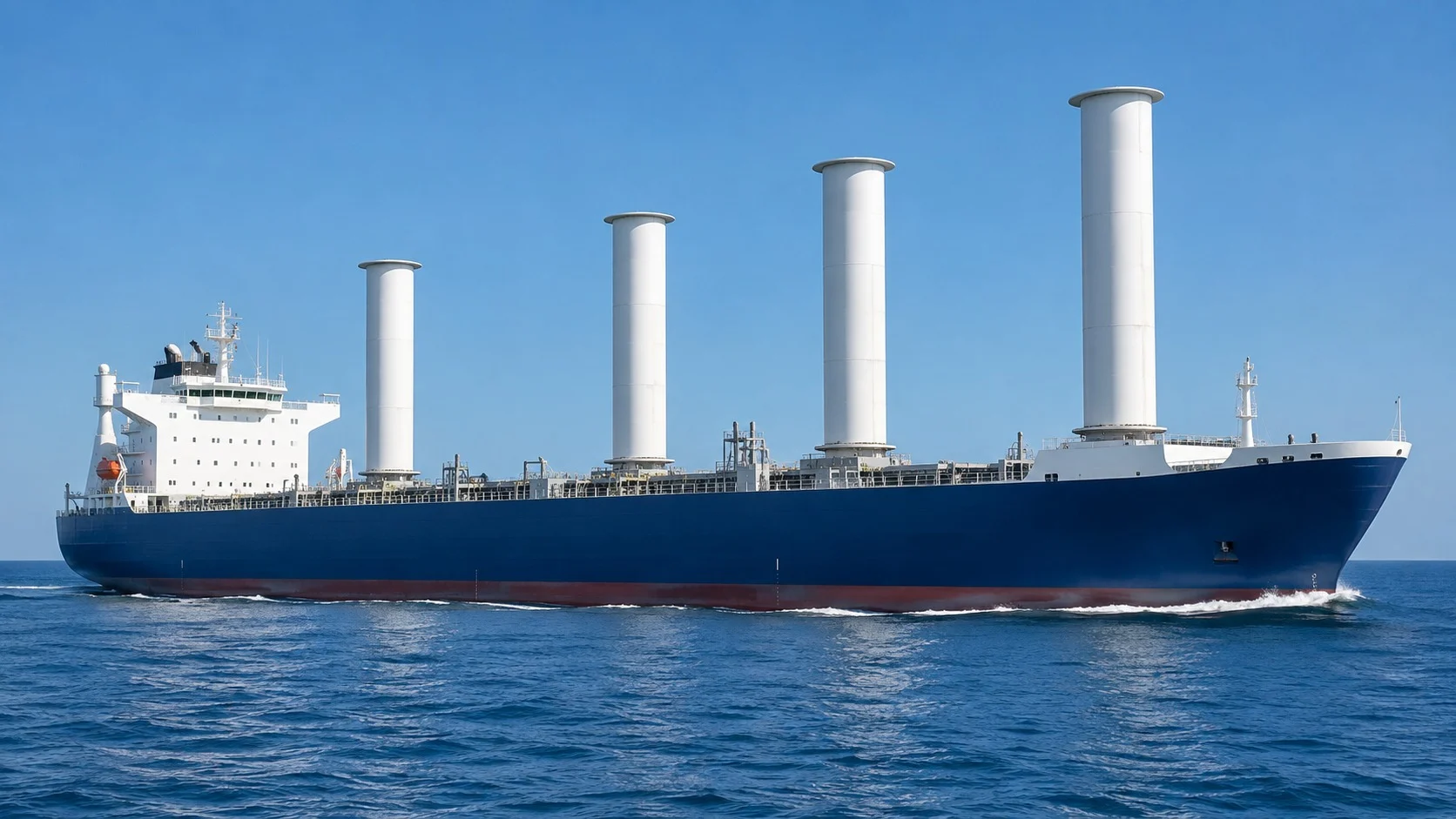
- Rotor Ship: In 1926, Germany's Anton Flettner crossed the Atlantic in the Baden-Baden, a ship with two huge cylinders standing in place of sails, and today rotating cylinder sails are once again being fitted to cargo ships to save fuel.
Golf balls, too, fly farther because their backspin gives them an upward lifting force. The small dimples on the ball's surface delay the point where the air separates from the surface, reducing air resistance.
Points to Keep in Mind About the Magnus Effect
The Magnus effect is easy to see, but it is not as simple as it seems. To understand it properly, it helps to know a few misconceptions and limits.
Common Misconceptions and Limits
- Bernoulli-only Explanation: The relationship between speed and pressure alone is not enough; for an accurate picture, you must also consider the air layer at the surface and the flow deflected behind the object.
- Inverse Magnus Effect: At certain speeds, a smooth-surfaced ball can change the way its air layer separates and actually curve in the opposite direction.
- Spin-to-Speed Ratio: With too little spin, a ball barely curves, and depending on conditions, the curve can become more pronounced as the ball slows down, making it appear to break sharply late in its flight.
- Practical Limits: Rotating-cylinder aircraft have been attempted since the 1910s, but the power and weight needed to spin the cylinders kept them from replacing wings.
Ultimately, the Magnus effect results not from spin alone but from an object's shape, surface, speed, and surrounding flow working together. That is why the same kick curves differently depending on the type of ball and the weather.
The Magnus effect is a long-known physical phenomenon that began with the tennis ball Newton saw, passed through Magnus's cylinder experiment, and extends today to breaking balls on the field and rotor sails at sea. Even in a single flying ball, invisible air flows are constantly at work.
Reading the invisible differences in flow is the first step in physics toward understanding motion.