Solar panels generate electricity, automatic doors respond to a wave of the hand, and old digital cameras convert light into electrical signals. What these scenes have in common is the phenomenon that ‘when light strikes matter, electrons pop out.’ This is the ‘Photoelectric Effect.’
Simply put, the photoelectric effect refers to ‘the phenomenon in which, when light hits a material such as a metal or semiconductor, electrons at the surface receive energy and escape outward.’ Classical physics viewed light only as a wave, but this phenomenon revealed that light carries energy in discrete bundles, like particles. In 1905, Einstein explained it with the concept of light quanta (photons), and for this achievement he received the Nobel Prize in Physics in 1921.
This article lays out the photoelectric effect in an easy-to-understand way, from its definition and historical significance, to how threshold frequency and work function operate, easy examples from daily life and technology, and the limitations and extensions its interpretation left behind.
The Concept and Quantum Significance of the Photoelectric Effect
What Is the Photoelectric Effect?
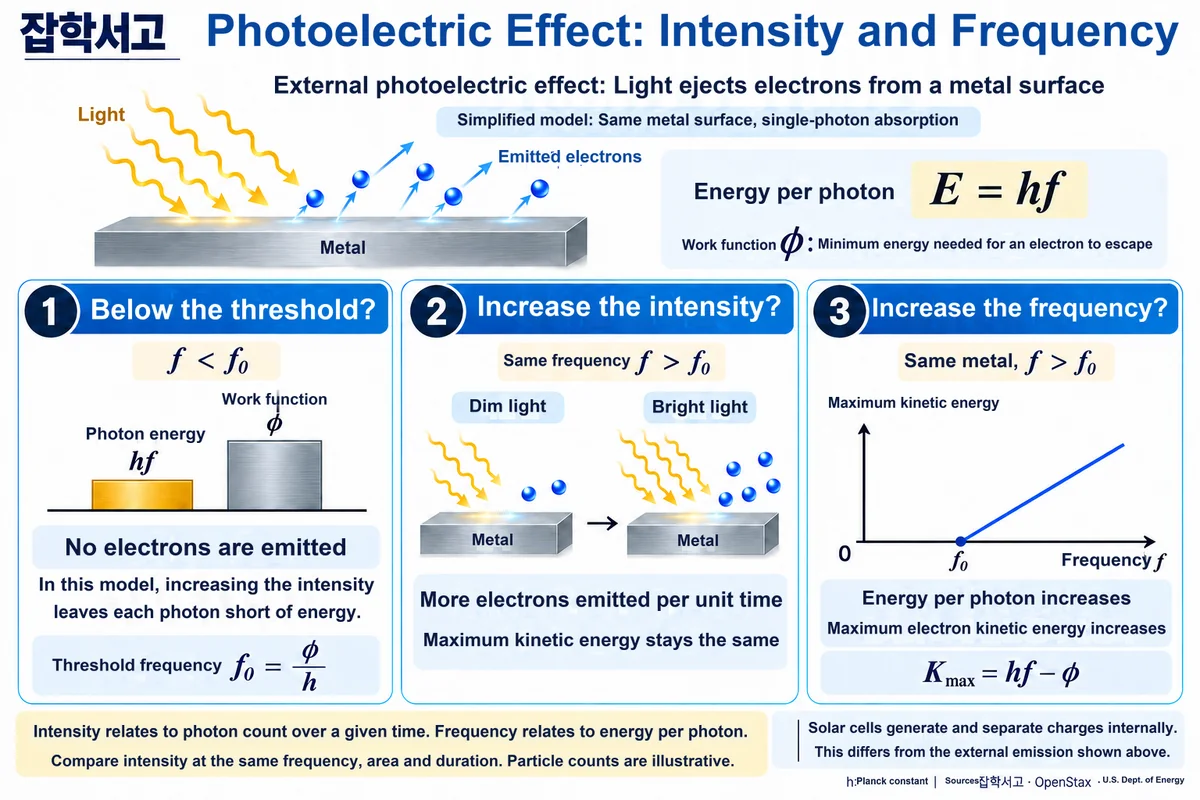

The photoelectric effect is one of the most direct scenes in which light and matter exchange energy. When suitable light is shone on a metal plate, free electrons at the surface overcome the force binding them and come out. Electrons ejected in this way are called photoelectrons.
In the late 19th century, Hertz and Hallwachs observed related phenomena, but the classical wave theory became tangled in trying to explain them. If light were a wave, even weak light should accumulate energy over time and eventually release electrons, but in experiments, below a certain frequency no electrons came out no matter how much the intensity was raised. Einstein resolved this contradiction with the light quantum hypothesis, which sets the energy of light as E = hf.
In other words, light is not only a continuous ripple but also a stream of energy packets (photons) whose energy is proportional to frequency. The picture of one electron meeting one photon and receiving its energy is the core of the photoelectric effect. This discovery later became a decisive experimental foundation for quantum mechanics to take root.
- Photoelectric Effect: The phenomenon in which electrons are emitted from a material by light.
- Photon: A quantum of light energy, a single bundle of energy.
- Photoelectron: An electron emitted through the photoelectric effect.
Threshold Frequency and Work Function: The Conditions for Electrons to Escape

The photoelectric effect is not triggered by ‘just any light.’ A photon must bring more energy than the minimum energy binding an electron to the metal, that is, the work function (φ). Even at the same brightness, red light and violet light can produce different results.
(1) Threshold Frequency
If the photon energy hf is smaller than the work function φ, no electrons come out. The minimum frequency at this point is called the threshold frequency, f₀ = φ/h. Even if you increase the intensity, the door will not open if the energy of each individual photon is insufficient.
(2) Intensity Means Number, Frequency Means Energy
Raising the intensity of light increases the number of photons, which increases the number of emitted electrons (the photocurrent). However, the maximum kinetic energy of each electron is determined mainly by the frequency (wavelength). The relationship is Kmax = hf − φ.
(3) Immediacy
When the conditions are met, electron emission occurs with almost no delay. Rather than energy ‘gradually accumulating,’ it is closer to individual photon-electron collisions. This immediacy was also an experimental fact that did not fit well with the classical wave picture.
- Work Function: The minimum energy needed to pull an electron out of a material.
- Planck Constant (h): The fundamental constant linking energy and frequency.
- Stopping Potential: The voltage that stops photoelectrons, a tool for measuring the maximum kinetic energy.
The Photoelectric Effect Through Simple Examples

The concept becomes clearer when carried over to the technologies around us. The chain of ‘light → charge → signal’ has already permeated daily life.
[Case 1] The First Step of Solar Power Generation
In a solar cell, photons are absorbed by a semiconductor, creating electron-hole pairs, and the internal electric field separates the charges to produce a current. Strictly speaking, this is closer to the internal photoelectric effect, but the principle that ‘light awakens charge carriers’ is the same. Useful current flows only when the photon energy exceeds the band gap (that is, when the wavelength is short enough).
[Case 2] Phototube and Photodiode Sensors
Automatic doors, light sensors, barcode scanners, and similar devices read changes in light intensity as changes in current. When the light weakens, fewer charges are emitted or generated, and the circuit detects that signal. It is an everyday scene of ‘light being translated into electricity.’
[Case 3] Night Imaging and Photoelectron Multiplication
Devices that convert even extremely faint light into electrons and then amplify them (such as photomultiplier tubes) are used in astronomical observation and medical imaging. The photoelectric effect becomes the ‘seed of the signal,’ and later stages amplify it.
- Internal Photoelectric Effect: The case in which electrons do not leave the material but rise into the conduction band.
- External Photoelectric Effect: The case in which electrons are fully emitted out of the surface.
- Band Gap: The energy gap that an electron in a semiconductor must jump across.
Questions and Extensions Left by the Photoelectric Effect

The photoelectric effect is an experimental pillar that opened the door to quantum mechanics. At the same time, it went beyond the dichotomy of ‘is light a wave or a particle?’ and broadened thinking toward complementarity, in which wave and particle properties appear depending on the situation. It also became a bridge carrying classroom formulas into the sensors of laboratories and factories.
Its limitations are also clear. The simple model assumes an ideal metal surface and a single photon-electron interaction. In real materials, surface states, temperature, many-electron effects, adsorbed molecules, and other factors change the threshold and efficiency. Solar cell efficiency, too, depends heavily on engineering variables such as the wavelength distribution, recombination, and reflection losses.
Nevertheless, the message of the photoelectric effect is simple and powerful. Energy does not only flow continuously; sometimes it is delivered one grain at a time. And the size of that single grain decides whether a phenomenon is possible or impossible. Seeing light again in units of energy rather than intensity: that is the first step toward understanding the photoelectric effect.