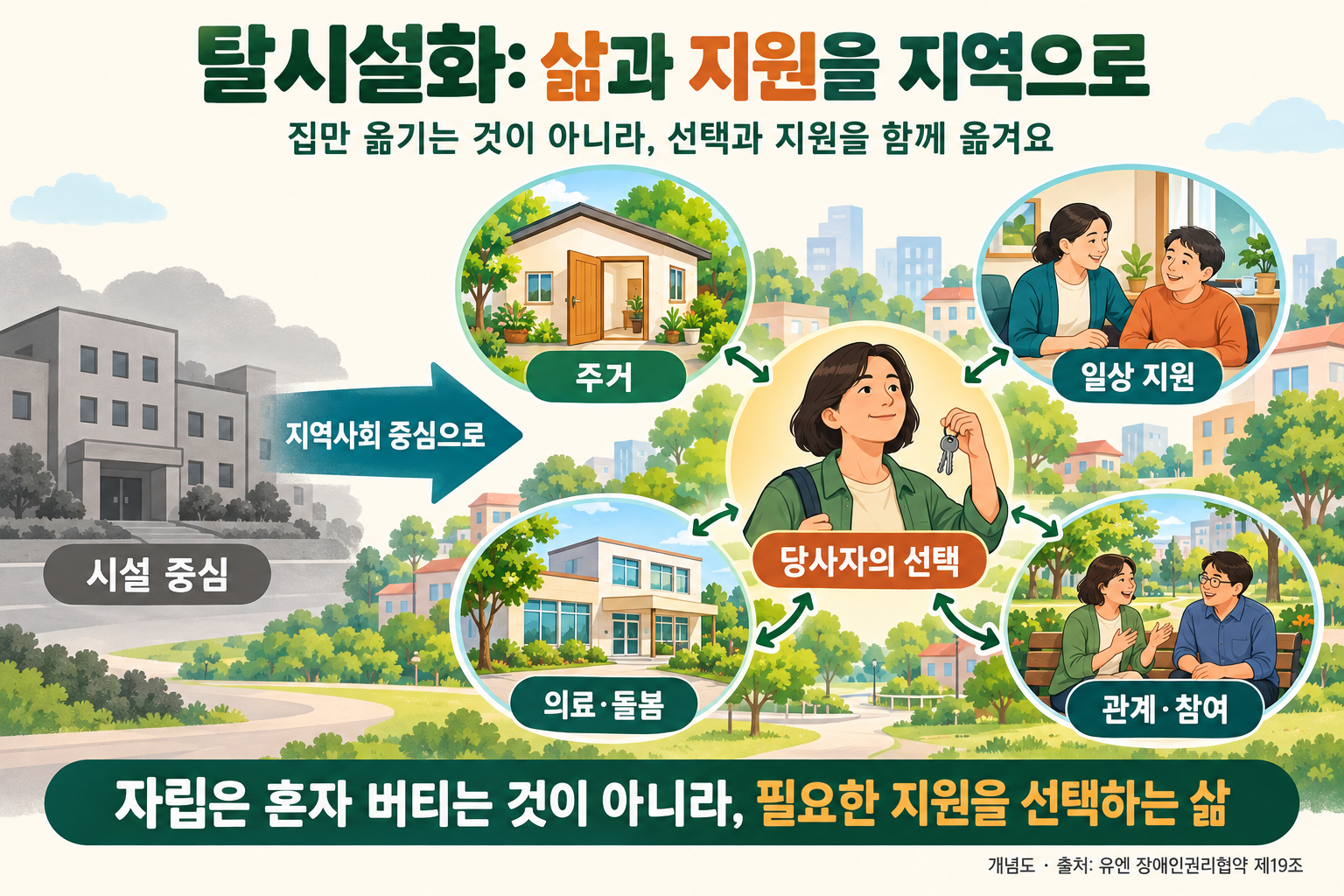
For a long time, gathering many people inside one large building and caring for them all at once was treated as the default form of welfare. The rules are consistent and management is easy, but the people who live there can hardly decide even when to sleep or whom to see. In social welfare, the movement to shrink or close institutions and shift support so that people can live in the community is called Deinstitutionalization.
Put simply, deinstitutionalization means “the process of reducing care centered on large institutions and reorganizing housing, care, and relationships so that people can carry on ordinary daily lives in their communities.” It is not just about moving people out of buildings; the heart of it is replacing the roles institutions used to play with neighborhood services and networks of neighbors. Driven by criticism of psychiatric hospitals and residential facilities for disabled people, human rights movements, and community care policies, it spread around the world from the mid-20th century.
In this piece we will look in turn at what deinstitutionalization means and where it came from, the forces and core principles behind it, the different experiences and side effects in different countries, and the conditions community support needs to meet.
Welfare Beyond Institutions: The Logic and Practice of Deinstitutionalization
What Is Deinstitutionalization?

Deinstitutionalization is not the name of a single program but a long process of changing an institution-centered system. Places where all of daily life is managed behind walls, such as psychiatric hospitals, nursing homes, and residential facilities for disabled people, are often seen as environments close to a “total institution.” When mealtimes, outings, and relationships are bound by an institution’s rules, autonomy and dignity are easily worn down, even if treatment is the goal.
- Total Institution: a concept described by Erving Goffman, referring to a living environment where sleep, work, and leisure are all bound under the rules of a single place.
- Community Care: a care system organized so that medical, welfare, and daily-living support continue in the neighborhood outside institutions.
- Transinstitutionalization: the phenomenon in which people leave large hospitals only to move into other closed settings, such as nursing homes, prisons, or the street.
Goffman’s Asylums (1961) revealed how psychiatric hospitals lock people into the “patient role,” and afterward the view of institutions as a human rights issue spread more widely. Deinstitutionalization is, in a sense, the name for turning that criticism into policy.
What Pushed Deinstitutionalization Forward

Several forces overlapped to shake the institution-centered system. The arrival of new medications, changes in human rights and law, and questions about cost and effectiveness all came into play at once.
(1) Changes in treatment and awareness of rights
With the introduction of antipsychotic drugs in the 1950s, some patients became able to manage their symptoms outside the hospital. At the same time, the civil rights movement and the disability rights movement challenged practices that took away people’s freedom in the name of “protection.”
(2) The U.S. Community Mental Health Centers Act
In 1963, under the Kennedy administration, the Community Mental Health Centers Act was passed with the aim of building up community centers in place of large state hospitals. The intent was clear, but when federal support later faltered, gaps opened up where community services could not take in enough people.
(3) Italy’s Basaglia Law
In 1978, Italy’s Law 180, known as the Basaglia Law, barred new admissions to public psychiatric hospitals and forced a shift to community services. The public psychiatric hospital population, about 78,000 in 1978, declined step by step, and the dismantling is generally described as having been completed around 2000.
(4) The language of international human rights
Article 19 of the 2006 UN Convention on the Rights of Persons with Disabilities (CRPD) states that disabled people have the right to choose where they live on an equal basis with others and to be included in the community. It became the basis for reading the move out of institutions not as a “favor” but as a “right.”
Achievements and Shadows Through Easy Examples

Even under the same name, deinstitutionalization has led to very different results depending on the country and the people involved. If the pace of closing institutions does not match the pace of building up community support, freedom and neglect can appear side by side.
[Example 1] Italy, where hospitals shrank and communities took over
After the Basaglia Law, Italy reorganized acute care around small psychiatric units inside general hospitals and community mental health centers. Involuntary admission was restricted under strict requirements, and the country tried to weaken the logic of confining people under the stigma of being “dangerous.” The model also influenced mental health reforms in Latin America.
[Example 2] The gap left when people leave without support
In the United States, state hospital beds were cut sharply, but in many areas community centers, housing, and case management failed to keep up. Some people moved to nursing homes, some to correctional facilities, and some to the street. It is a painful lesson that closing institutions alone does not automatically make lives better.
- Independent Living: the view that disabled people live in the community receiving support they choose for themselves, rather than relying only on professionals’ decisions.
- Supported Housing: an approach that provides ordinary housing and the needed support services separately, so that a home and treatment are not tied together as a single condition.
- Personal Assistance: support for daily living that the person hires and manages, so that it follows the individual’s own schedule instead of an institution’s rules.
In Korea, too, the disability deinstitutionalization movement grew from the mid-2000s, leading to local government plans and the central government’s independent-living roadmap and pilot projects. If the principle of normalization speaks of “the conditions of an ordinary life,” deinstitutionalization is closer to the policy process of actually dismantling and rearranging the institutional structures that block those conditions.
What Must Be in Place When Moving to the Community

For deinstitutionalization to succeed, the supports that sustain life after the door opens matter as much as opening the door. Social work practice treats the following as a set.
(1) Safe housing
Temporary shelters or large group living alone are not enough. A home the person can stay in, along with rental support, must come first so that other support can build on it.
(2) Continuous support
Rather than leaving one person to run around looking for medical care, mental health services, personal assistance, employment, and transportation, case management ties them together. A system with a center by day and nothing at night makes crises worse.
(3) Choice and relationships
People must be able to choose where they live and whose help they receive. Without relationships connecting them to neighbors, peers, and family, isolation remains even when they live in the community.
(4) Moving the resources
If institutional budgets do not move along with people into community services, “closing institutions” simply becomes “cutting services.” It amounts to emptying the building while leaving the people as they were.
Deinstitutionalization is not proven by fast discharge numbers. A more accurate report card is whether people still keep their homes and take part in the daily lives they want one year and three years after leaving.
Deinstitutionalization is a major shift in social welfare that refuses to confine life to the single space of an institution and instead seeks to rearrange the right and the support to live in the community. It spread worldwide as medication, law, human rights conventions, and grassroots movements came together, but if community care is lacking, it can leave behind only another form of segregation.
Designing what to plant after the walls come down, together with tearing them down: that is the first step toward person-centered deinstitutionalization.