Family welfare is regarded as an important element that forms the foundation of every society. It plays an important role in improving individuals' quality of life, ensuring social stability, and promoting sustainable development.
This article will examine the current state and future of family welfare by exploring its importance, its role in a sustainable society, major policies and programs, and future challenges and prospects.
The Importance of Family Welfare: The Foundation of Social Stability
 Why is family welfare important?
The Role of Family Welfare
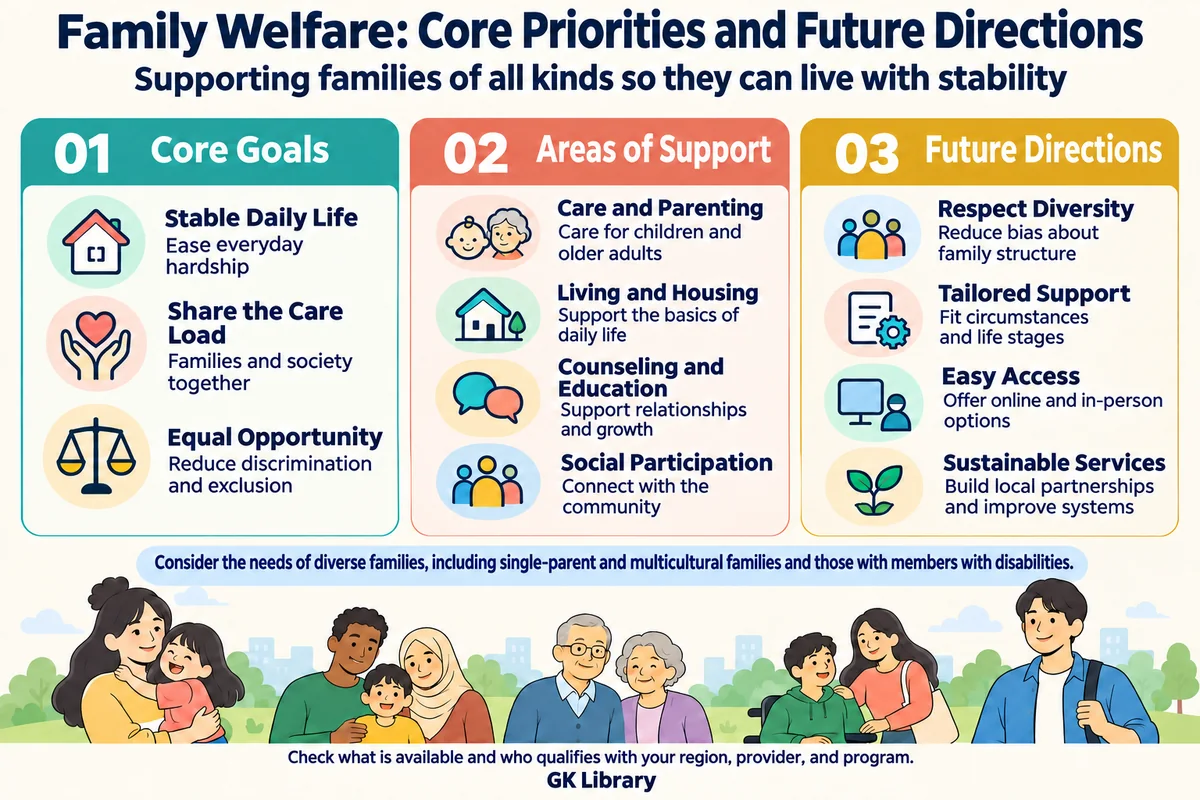
Family welfare lays the foundation for social stability by protecting and supporting families, the basic units of society. When families are healthy and stable, society as a whole can also be stable. Family welfare strengthens bonds among family members and helps individuals effectively address the various problems they experience. This is directly linked to stability across society and contributes to reducing financial burdens and social costs.
Support for Vulnerable Groups
Family welfare plays a particularly important role for families in vulnerable groups. Families facing difficulties such as financial hardship or health problems can improve their quality of life through support from the welfare system. This reduces social inequality and helps everyone have equal opportunities. Family welfare therefore serves as an important factor in promoting social integration and equality.
Support for the Development of Children and Adolescents
Family welfare has a positive impact on the growth and development of children and adolescents. A stable home environment is essential for children to grow up healthily and become adults who can contribute positively to society. Family welfare supports children's holistic development through education, health care, psychological support, and other forms of assistance.
Connections with Welfare for Older Adults
Family welfare is also closely related to welfare for older adults. As society enters an era of population aging and the number of older adults increases, the family welfare system plays an important role in helping older adults lead stable and healthy lives. This contributes to improving their quality of life and preventing social isolation.
Expanding Women's Roles in Society and Promoting Gender Equality
Family welfare promotes the expansion of women's roles in society and gender equality. As the increase in dual-income households makes it difficult for women to manage both housework and childcare, family welfare can ease these burdens. This enables more women to participate in economic activities and contributes to creating a society with gender equality.
In conclusion, family welfare is an essential element in enhancing the happiness of individuals and families and promoting social stability and development. Through this, society can raise its overall level of welfare and achieve sustainable development.
The Role of Family Welfare in a Sustainable Society
 What functions and roles does family welfare serve?
Family Welfare and the Social Safety Net
Family welfare plays an important role in building a sustainable society. It does so by meeting individuals' basic needs and strengthening the social safety net. When families can live in a stable environment, society can naturally achieve sustainable development.
Environmental Sustainability
Family welfare also has an impact on environmental sustainability in particular. Programs that support family members in practicing environmentally friendly lifestyles promote environmental protection and sustainable resource management. This is achieved by raising families' awareness of environmental issues and providing opportunities to take action.
Economic Sustainability
Family welfare also contributes to economic sustainability. Family welfare programs promote economic stability by addressing income inequality and supporting economically vulnerable groups. This helps families live without financial hardship and contributes to strengthening the stability of the entire economic system.
Social Sustainability
Family welfare also plays an important role in social sustainability. It helps family members support one another and form social bonds. Strong bonds among families strengthen the cohesion of society as a whole and help reduce social conflict.
Educational Sustainability
Family welfare also plays an important role in education. Family welfare programs promote educational sustainability by supporting children's access to quality education and providing opportunities for lifelong learning. This enables individuals to realize their full potential and contributes to strengthening the knowledge base of society as a whole.
In conclusion, family welfare is an essential element in creating a sustainable society. This is achieved by improving the quality of life of individuals and families, strengthening the social safety net, and promoting economic, environmental, and social sustainability.
Major Policies and Programs: An Analysis of the Current State of Family Welfare
 What are the major family welfare policies and programs?
Family welfare policies and programs are among the important social policies pursued by governments around the world. They are provided in various forms to meet families' diverse needs. A variety of family welfare programs are currently operating in South Korea, and they play an important role in improving family members' quality of life.
Childcare Support Programs
First, there are childcare support programs. These programs are offered to ease the financial and time burdens parents face while raising their children. Examples include childcare fee subsidies, parental leave systems, and childcare support services. These programs help parents raise their children while remaining economically active.
Welfare Programs for Older Adults
Welfare programs for older adults are also an important part of family welfare. Various services are provided to improve older adults' quality of life in an aging society. Examples include care services for older adults, health management programs, and social support networks. These help older adults lead healthy and stable lives.
Support Programs for Single-Parent Families
Support programs for single-parent families also play an important role. Single-parent families are prone to financial and social difficulties, so support is needed to address these challenges. Examples of the support provided include assistance with living expenses, housing, and educational expenses. This helps single-parent families maintain stable lives.
Support Programs for Multicultural Families
Support programs for multicultural families are also in operation. These help multicultural families adapt well to society and live without discrimination. Examples include language education, cultural education, and social integration programs. These promote the social integration of multicultural families and contribute to forming a multicultural society.
Support Programs for Families with Members with Disabilities
Finally, support programs for families with members with disabilities are also important. These are provided to address the various problems these families experience and improve their quality of life. Examples include rehabilitation services, educational support, and vocational training. These help families with members with disabilities participate actively in society.
In conclusion, various family welfare policies and programs play an important role in improving family members' quality of life and promoting social stability. Through this, society can raise its overall level of welfare and achieve sustainable development.
Future Challenges and Prospects: Future Directions for Family Welfare
 What direction will family welfare take in the future?
Ensuring the Sustainability of the Family Welfare System
To discuss the future direction of family welfare, it is important to clearly understand current problems and future challenges. First, ensuring the sustainability of the family welfare system is an important task. This requires efficient allocation of economic resources and policy adjustments that reflect changes in social needs.
Providing Tailored Welfare Services
Second, tailored welfare services that consider the diversity of family members are needed. As family structures and members become more diverse, detailed support adapted to these differences is needed. For example, specialized welfare services should be provided for dual-income households, single-parent families, multicultural families, and others.
The Need for Digital Transformation
Third, the digital transformation of family welfare is emerging as an important task. With the advent of the 4th Industrial Revolution, welfare services need to be digitized using information and communication technology (ICT). This can help improve access to welfare services and increase efficiency.
Increasing Social Awareness and Participation
Fourth, it is important to increase social awareness of and participation in family welfare. This can be achieved by raising awareness of the need for family welfare and strengthening cooperation with local communities. Various campaigns and educational programs are needed to accomplish this.
Strengthening International Cooperation
Fifth, international cooperation in family welfare is needed. In keeping with the era of globalization, welfare levels can be improved by benchmarking successful family welfare practices in other countries and through international cooperation. This is possible through cooperation with international organizations, exchanges with experts from other countries, and similar activities.
In conclusion, the future direction of family welfare aims at sustainable development. To achieve this, various challenges must be addressed and innovative approaches explored. This will contribute to improving family members' quality of life and raising the overall level of welfare in society.
Family welfare is an essential element in enhancing the happiness of individuals and families and promoting social stability and development. This is achieved by improving individuals' quality of life, strengthening the social safety net, and promoting economic, environmental, and social sustainability.
Various family welfare policies and programs play an important role in improving family members' quality of life and promoting social stability. Therefore, to continue developing family welfare, various challenges must be addressed and innovative approaches explored. Through this, society will be able to raise its overall level of welfare and achieve sustainable development.