If the support people received from the state were greater than the money they could earn by working, would they keep working? It is a question that has been asked again and again in debates over welfare. About 190 years ago, Britain gave a very firm answer to it: the condition of a poor person receiving help must always be worse than that of someone working for the lowest wages. This idea is the ‘Principle of Less Eligibility.’
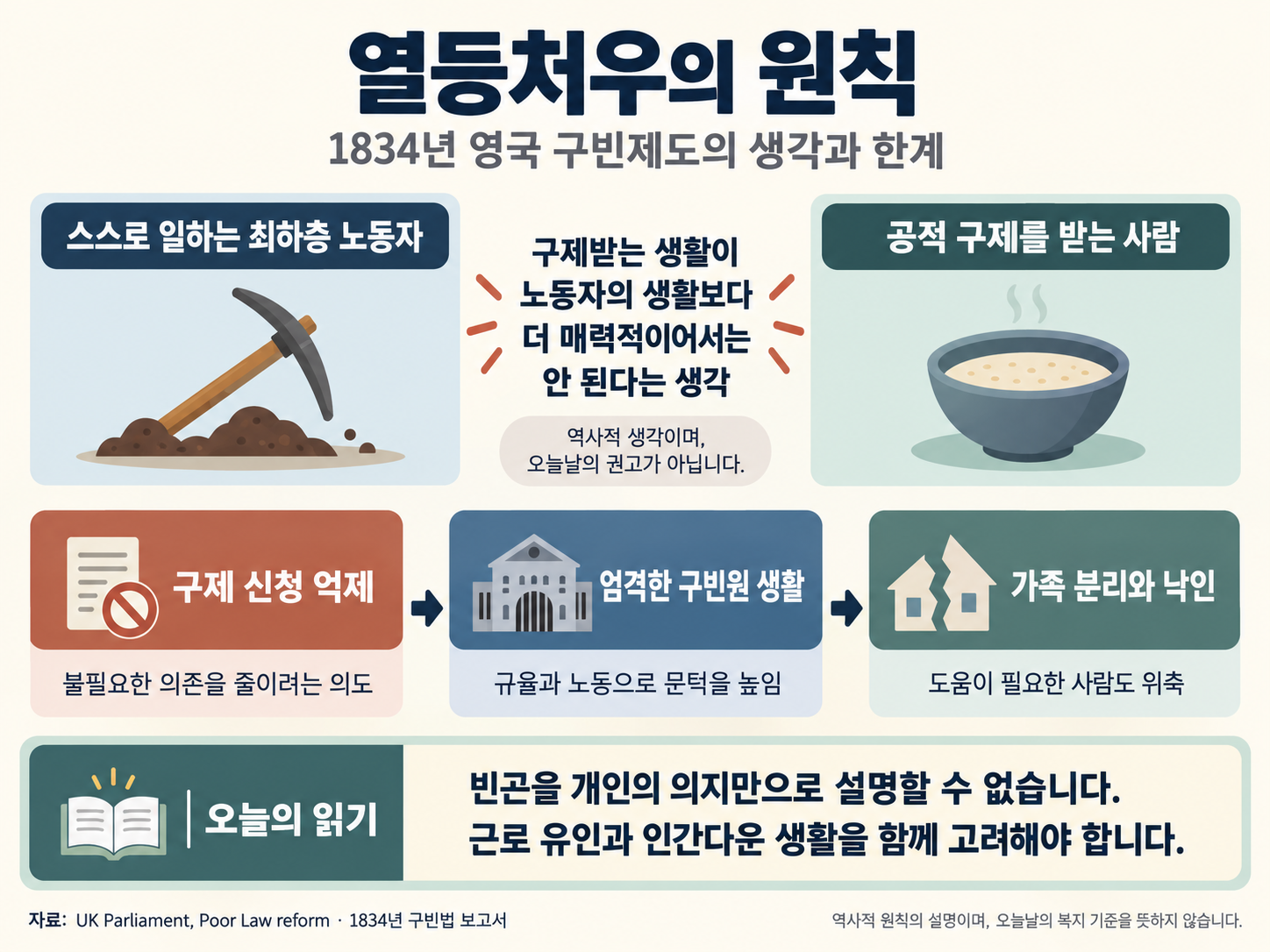
Put simply, the principle of less eligibility means ‘the standard of living of a person receiving public relief must be lower than that of the lowest-paid worker who earns a living on their own.’ This idea, which formed the backbone of Britain’s New Poor Law of 1834, began from the worry that welfare could encourage idleness, and under changing names and forms it still lingers in today’s welfare debates.
In this piece, we will look in turn at the background against which the principle of less eligibility emerged, its core ideas, the reality of the workhouses it created, and the traces and challenges it has left in modern welfare systems.
The Idea That Relief Can Never Be Better Than Work
Why Did the Principle of Less Eligibility Emerge?

In England, after the Elizabethan Poor Law of 1601, a system continued in which parishes helped their poor neighbors with the poor rates they collected. But in the late 18th century, population growth, war, and soaring grain prices came together, and the number of people in need of help rose sharply.
(1) The Speenhamland System That Topped Up Wages
In 1795, magistrates gathered at Speenhamland in Berkshire and drew up a scale for topping up insufficient wages from the poor rates according to the price of bread and the size of the family. This Speenhamland System spread through the rural south of England, but it was criticized for having the side effect that farmers, knowing the parish would make up the shortfall, paid even lower wages.
(2) The Diagnosis of the 1832 Royal Commission
As the cost of poor relief kept swelling, the British Parliament set up a Royal Commission in 1832 to investigate how the Poor Laws were being run. The commission, whose members included Edwin Chadwick and the economist Nassau William Senior, concluded that the old system was expensive and loosely run, and put forward the principle of less eligibility as the solution.
The Core of the Principle

The commission’s 1834 report firmly stated that the situation of a person receiving relief must not be made, either really or apparently, more desirable than that of the independent laborer of the lowest class. Here, ‘eligibility’ was used not in the sense of qualification but in its older sense of ‘being worth choosing.’ In other words, relief had to be less attractive than work.
- Abolition of Outdoor Relief: The practice of receiving money or goods while living at home was to be ended, and those able to work were to be helped only inside the workhouse.
- Workhouse Test: Being willing to enter the workhouse was itself taken as proof of genuine poverty. The assumption was that only those prepared to endure hard labor and strict discipline would ask for help.
- Central Control: Several parishes were grouped into poor law unions, and a central Poor Law Commission was to apply the same standards across the country.
These recommendations led that same year to the Poor Law Amendment Act, commonly known as the New Poor Law. Underlying it were Malthus’s theory of population, which held that population grows faster than the food supply, and Bentham’s utilitarianism, which held that people seek pleasure and avoid pain.
The Reality of the Workhouses and the Criticism They Drew

The workhouses built under the new system focused on confining many people at low cost and came to resemble prisons more and more, so that opponents called them ‘Poor Law Bastilles.’
(1) Families Torn Apart
Workhouses separated inmates by sex and age. Husbands, wives, and children had to live apart even while inside the same building, and this separation of families provoked especially fierce opposition.
(2) The Andover Workhouse Scandal
In 1845 it came to light that at the Andover workhouse in Hampshire, starving inmates had been gnawing the marrow and gristle off the bones they were crushing to make fertilizer. The scandal led to a parliamentary inquiry, and in 1847 the Poor Law Commission was replaced by the Poor Law Board, which included government ministers.
(3) Criticism From Literature and Reformers
In his novel ‘Oliver Twist,’ Charles Dickens satirized the system with a scene in which a great uproar breaks out after a workhouse boy asks for more gruel. In 1909, the Minority Report of a Royal Commission, led by Beatrice Webb, looked for the causes of poverty in the structure of society rather than in the individual and called for the Poor Law to be broken up, an idea that later carried through to the Beveridge Report. The Poor Law was finally abolished by the National Assistance Act of 1948.
Traces Left in Modern Welfare

The workhouses are gone, but the idea that welfare must not sap the will to work lives on in many systems and debates today.
(1) The Tug-of-War Between a Minimum Standard of Living and the Incentive to Work
The argument that public assistance benefits should be kept below the income earned at the minimum wage shares the same roots as the principle of less eligibility. On the other side stands the counterargument that if benefits are cut too low, it becomes hard to protect even a minimally decent human life. Korea’s National Basic Livelihood Security System, too, seeks a balance between these two values, for example by making participation in self-sufficiency programs a condition for recipients who are able to work.
(2) The Welfare Trap and Stigma
When earning a little more income from work causes benefits to be cut by the same amount, leaving a person worse off, this is called the welfare trap. Today, rather than lowering benefits, many efforts try to solve this problem with measures such as earned income tax credits, where support increases the more one works. In addition, the stigma that makes people who receive help feel ashamed is pointed to as a shadow left by the principle of less eligibility, because it makes even those who truly need help hesitate to apply.
The principle of less eligibility started from the simple idea that relief must not be better than work, but as a result, a system meant to help the poor sometimes turned into a system that punished them. The history of this principle shows how difficult it is, when designing welfare, to protect both the will to work and a decent human life. Even in the phrase we often hear today, ‘people who work should not lose out,’ the question of 190 years ago lives on unchanged.
Asking how high to set the threshold for help: that is the first step in social welfare studies toward thinking about fair welfare.